The golden jackal literally changes its coat with the seasons, trading a pale creamy-yellow summer coat for a darker tawny-beige winter pelt that helps it blend into the dry grasslands and scrubland it calls home.
This wolf-like canid, Canis aureus, belongs to the dog family Canidae within the order Carnivora, and is the northernmost and most widely distributed of all jackal species. It ranges from Southeast Europe across the Middle East into Central, South, and Southeast Asia, favoring dry open country, steppe, and grassland. The IUCN lists it as Least Concern, a status earned through its broad range and the high densities it reaches wherever food and shelter are plentiful.
Despite its resemblance to a small wolf, the golden jackal builds its life around a lifelong monogamous partnership, cooperative hunting, and a surprising tolerance for both scorching deserts and the outskirts of towns—traits that have let it expand into new territory even as larger predators vanish from parts of its range.
Identification and Appearance
The clearest way to separate a golden jackal from a similar-sized wolf is its build: a more elongated torso, a less prominent forehead, and a muzzle that is narrower and more pointed than even the smallest wolf subspecies, the Arabian wolf.
Males measure 71–85 cm in body length and weigh between 6 and 14 kg; females are slightly smaller at 69–73 cm and 7–11 kg. Both sexes stand about 45–50 cm at the shoulder, far less than the roughly 20 kg average weight of the Arabian wolf. The legs are long relative to the body and the feet are slender with small pads, while the skull is smaller and less massive than a wolf's, with weaker carnassial teeth suited to a varied diet of small vertebrates, insects, carrion, and fruit rather than large prey.
The coarse, relatively short fur is golden at its base but shifts seasonally from pale creamy yellow to dark tawny beige, with a mix of black, brown, and white hairs on the back that can create the impression of a dark saddle. The underparts run light pale ginger to cream, and each animal carries unique light markings on the throat and chest. Jackals from high elevations tend toward a buffier tone, while those in rocky mountain terrain often look grayer; the bushy tail ends in a tan-to-black tip.
Rare individuals show melanism, a dark coat likely caused by an independent mutation rather than interbreeding with domestic dogs, as seen historically in Bengal; a probable albino was photographed in southeastern Iran in 2012. Folklore in South Asia also describes a small horny "jackal's horn" on the skull, though no physical evidence for it has ever been found.
Distribution and Habitat
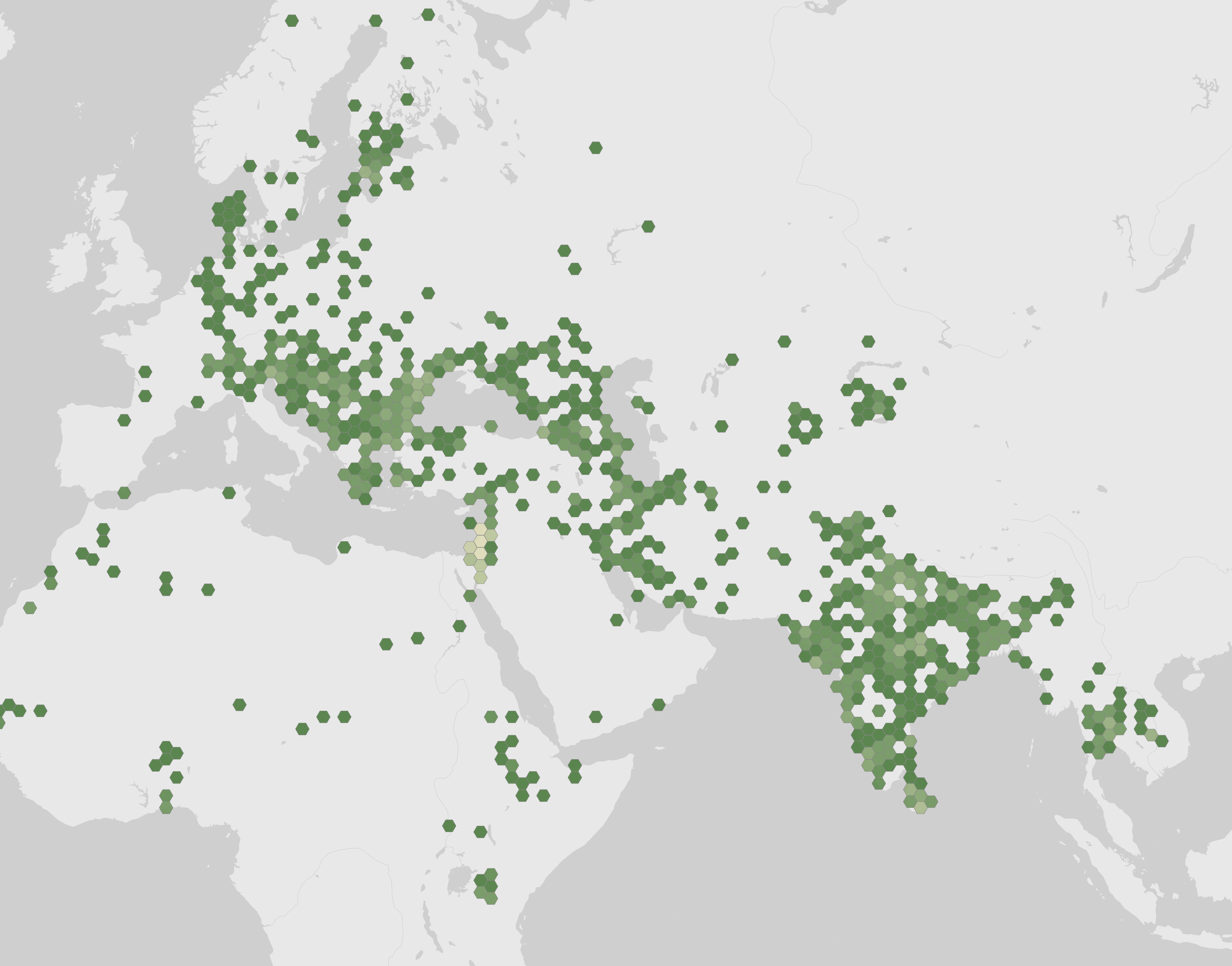
The golden jackal is the northernmost jackal species and also the most widely distributed, ranging across Southeast Europe, the Middle East, and Central, South, and Southeast Asia. Its only overlap with another jackal species occurs in East African savannas, where its range meets that of the black-backed jackal.
It favors dry open country: arid short grasslands, steppe, savanna, desert margins, and scrubland, along with the fringes of forest. This flexibility in habitat use lets it occupy landscapes as different as Himalayan foothills and Mediterranean coastal grassland.
GBIF occurrence records show observations year-round, with monthly counts ranging from about 4,163 to 8,185 sightings; the highest tallies fall in October and November. Because these figures are presence observations rather than abundance or population counts, they should be read only as a rough sign of when and where the species is most often recorded, not as a measure of how many jackals exist.
Behavior and Lifestyle
A mated pair forms the core of golden jackal society, foraging, resting, and hunting together in tightly synchronized fashion. Cooperative hunting pays off: pairs are three times more likely to succeed than lone jackals, and family members share large food items, even carrying meat in their stomachs to regurgitate later for pups or a nursing mother.
Hunting families hold year-round territories of 2–3 square kilometers, which the male or female marks with urine to deter intruders, though overall home ranges can stretch from 1 to 20 square kilometers depending on food availability. Many families include one or two non-breeding "helpers," subordinate to the parents, who guard the den, warn pups of danger with rumble growls and predator barks, bring food to a lactating mother, and improve pup survival by freeing the parents to hunt as a pair.
Jackals are strictly nocturnal near people but can be partly active by day where humans are scarce. They shelter in dug caverns, rock crevices, or burrows abandoned by other animals, and pairs are affectionate toward one another, grooming and scratching their partner, while encounters between strangers are marked by displays of subordination or aggression.
Golden jackals also scavenge boldly: they will howl in response to a lion's kill, a call that draws in other jackals, and rush a carcass the moment a sated lion moves off. If challenged by other scavengers, they bury spare pieces of meat by digging a trench with their forepaws and closing it with the ridge of the nose.
Communication
Golden jackals rely heavily on touch and scent to maintain their bonds and territories. Pairs groom and scratch each other extensively, reinforcing the closeness of their lifelong partnership.
Chemical signals, delivered through urine and feces, mark territory boundaries and den sites and help space out neighboring families without direct confrontation.
Hunting and Diet
As opportunistic foragers, golden jackals hunt alone or, more successfully, in pairs—a partnership that triples their odds of a kill compared with hunting solo. Much of their prey is small and vulnerable: newborn gazelles taken during birthing seasons, rodents (especially through winter), hares, ground-nesting birds and their eggs, reptiles, frogs, fish, and insects.
Their diet skews roughly 54% animal matter and 46% plant matter, with fruit making up the bulk of the latter. They take carrion when they find it, and their varied, opportunistic approach lets them adjust readily to whatever food is locally abundant, from wetlands rich in frogs and fish to arid grasslands where rodents and insects dominate.
Reproduction and Raising Young
Golden jackals are strictly monogamous, pairing for life, and often breed cooperatively with the help of one or two non-breeding adult "helpers" that assist for a year after reaching sexual maturity. The mating period lasts 26–28 days, and females in their first estrus may be pursued and fought over by several males; copulation ends in a tie lasting several minutes, as in other canids.
Breeding season shifts by region—October to March in Israel, February to March in India, Turkmenistan, Bulgaria, and Transcaucasia—so that births coincide with local peaks in food availability. Gestation lasts about 63 days, after which pups are born in a den within the pair's territory: dug burrows 2–3 meters long and 0.5–1 meter deep with one to three openings, though jackals in Central Asia instead build lairs in dense tugai thickets, reed beds, or long grass.
Litter size varies geographically, from an overall range of 1 to 9 pups (average 4.5) down to regional norms such as 3–8 in Transcaucasia, 2–8 in Uzbekistan, and about 4 in India. Newborns weigh only 200–250 grams, open their eyes at 8–11 days, and begin taking solid meat at 15–20 days despite nursing for 8–10 weeks. Growth is rapid: a pup reaches roughly 0.56–0.73 kg by one month and 2.7–3.25 kg by four months.
Both parents feed and guard the young, regurgitating food and defending the den; play among littermates turns genuinely aggressive at 4–6 weeks before settling into a stable hierarchy by 10–12 weeks. Once lactation ends, the mother drives the pups off, and late-born litters typically stay with her until autumn before dispersing alone or in small groups. Females reach sexual maturity at 10–11 months, males later, at 21–22 months.
Population and Ecological Role
The golden jackal's omnivorous diet and tolerance for aridity let it occupy an unusually wide range of habitats, from river valleys, canals, lakeshores, and seashores where it is most abundant, to the edges of true deserts such as the Karakum and Kyzylkum, which it avoids outright but exploits at their fringes and oases. In India it goes further still, living within the Thar Desert itself, and it has been recorded climbing above 1,000 meters in the Himalayas and tolerating temperatures as low as −25°C, occasionally −35°C, even though it is poorly adapted to travel through snow.
Within this range it competes with red foxes, wolves, jungle cats, wildcats, and raccoon dogs. Wolves dominate jackals outright—their ranges are largely mutually exclusive in Europe, and jackals abandon territory when a wolf pack arrives—while jackals in turn dominate red foxes, which avoid close contact and decline in number wherever jackals are common. The species' recent spread through eastern and western Europe has been linked directly to the extermination of local wolf populations, which removed its main competitor and predator.
Ecologically, the golden jackal functions as both a small-prey hunter and an opportunistic scavenger, feeding on rodents, insects, and carrion, including the leftovers of larger predators' kills. Historically it also fed on and was hunted by tigers and leopards; today, with tigers extinct and leopards rare across most of its range, the Eurasian lynx remains one of its few natural predators.
Conservation and Threats
The golden jackal is classified as Least Concern by the IUCN, reflecting how common it is across its enormous range and the high densities it reaches wherever food and shelter are abundant. Population estimates put roughly 70,000 individuals in Europe and more than 80,000 across the Indian subcontinent, where the species occurs in nearly every protected area outside the higher Himalayas.
Legal protection is inconsistent. The species is fully protected in Albania, North Macedonia, Germany, Italy, Poland, and Switzerland, but unprotected in Belarus, Bosnia and Herzegovina, the Czech Republic, Estonia, and Greece, and actively hunted in countries including Bulgaria, Croatia, Hungary, Romania, Serbia, and Ukraine. It is listed under CITES Appendix III and, in India, under Schedule III of the Wildlife Protection Act, which gives it only the lowest tier of legal protection, mainly aimed at controlling trade in pelts and tails.
Some populations face specific pressures: the Syrian jackal was common in Israel and Lebanon through the 1930s and 1940s before an anti-rabies campaign sharply reduced its numbers, and its current status is further clouded by hybridization with pariah dogs and African golden wolves. Elsewhere, debate continues over whether the species counts as native wildlife in parts of Europe it has only recently colonized, which affects how governments choose to manage its expansion.
Conservation status
- LC
- NT
- VU
- EN
- CR
Least Concern
Cultural Significance
In South Asian storytelling the golden jackal is cast as a clever trickster, most famously in the Panchatantra fable in which a jackal cheats a wolf and a lion out of their shares of a camel, and in the Mahabharata's tale of a jackal who turns his friends against each other so he can eat a gazelle alone. Buddhist Jataka tales cast the jackal in a similarly cunning role, comparable to the fox of European fables, and a popular Indian saying calls it "the sharpest among beasts." Hearing a jackal howl before an early journey was traditionally taken as a sign of good fortune.
The animal also carries strong religious associations in Hinduism, appearing as the familiar of Chamunda and Kali, both goddesses linked to cremation grounds, and depicted as the head of the goddess Shivaduti; in Tibetan Buddhism and Hinduism alike, jackals serve as the vahana, or vehicle, of several protective deities. The character Tabaqui in Rudyard Kipling's The Jungle Book draws directly on the jackal's reputation as a scavenging, subservient schemer.
Around villages and farmland, golden jackals scavenge garbage and carrion, a habit that indirectly benefits agriculture by helping to limit rodent and lagomorph numbers, and they are sometimes hunted for their fur. Hand-raised jackals can become tame and housebroken, behaving much like a dog, though they typically remain wary of unfamiliar people.
Fun Facts
- Golden jackals typically live 8–9 years in the wild but can reach as long as 16 years in captivity.
- Some etymologists have suggested that the species' name, aureus ("golden"), echoes the Greek myth of King Midas, whose touch turned everything to gold.
- The golden jackal has left a deep mark on the folklore of the Middle East, where it appears in numerous traditional fables.
Ecology
Behavior
- Predator
- Territorial
- Social
- Scavenger
Habitat
- Shrubland
- Grassland
- Savanna
- Desert
Diet
- Omnivore
Photos
SourcesGBIFiNaturalistWikidataWikipediaAnimal Diversity WebAnAge