The maned wolf looks like a fox stretched onto stilts: its coat is fox-red, but it is neither a fox nor a true wolf, and it stands alone as the only living species in its genus, Chrysocyon.
It is a large South American canid found across Argentina, Brazil, Bolivia, Peru, and Paraguay, though it has been nearly wiped out from Uruguay since the 19th century. The IUCN lists it as Near Threatened.
What makes the maned wolf worth a closer look is its unusual mix of traits: a towering, long-legged build unlike any other wild canid, a black mane it can raise in display, and a habit of marking its territory with a scent so strong it has once triggered a police search for cannabis.
Identification and Appearance
The clearest field mark is the silhouette itself: tall, black stilt-like legs beneath a fox-colored body topped by an erectile black mane. An adult weighs around 21.5 kg and can stand up to 110 cm at the shoulder, making it the tallest of the wild canids. Head-to-body length reaches about 100 cm, with the tail adding roughly another 45 cm, and the large ears measure about 18 cm long.
The coat runs reddish-brown to golden-orange along the sides, set off by black legs and the namesake black mane, which the wolf raises to enlarge its profile when threatened or displaying aggression. A whitish tuft caps the tip of the tail, and a white "bib" marks the throat. All-black (melanistic) individuals exist but are rare; the first photograph of a black adult was taken by a camera trap in northern Minas Gerais, Brazil, in 2013.
The skull carries reduced carnassials, small upper incisors, long canine teeth, and a prominent sagittal crest, with a full set of 42 teeth typical of canids. The rhinarium (nose pad) extends onto the upper lip as in the bush dog, but the maned wolf's whiskers are notably longer.
Footprints offer another way to tell it apart from domestic dogs: the plantar pads are disproportionately small compared with the well-spread digit marks, and the third and fourth digits show a proximal union not seen in other South American canids. Pups are also easy to misidentify early on, since they are born with dark fur that only turns bronze as they mature.
Distribution and Habitat
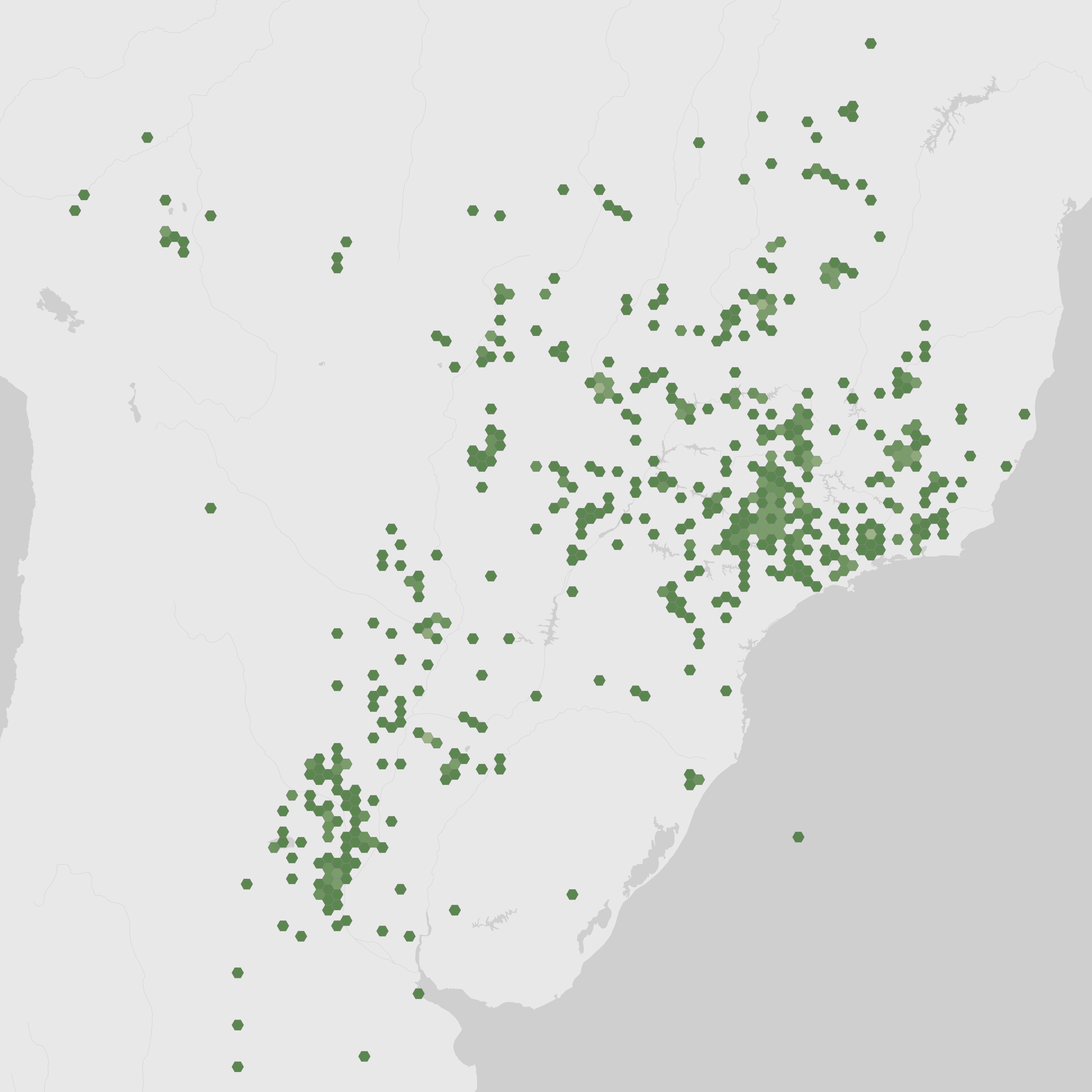
The maned wolf ranges across Argentina, Brazil, Bolivia, Peru, and Paraguay, with its former range once reaching Argentina south of the La Plata River. It has become almost locally extinct in Uruguay, where it disappeared during the 19th century.
Across this range it uses open grassland, savanna, dry shrub forest, swampy ground, forest-edge habitat, and river corridors, generally foraging in open fields at night and retreating to denser cover, such as riparian forest, to rest during the day.
Monthly presence-observation counts show a rise from around 140 records in January to a high of 261 in April, followed by another rise to 233 in September before easing toward year's end. These figures reflect where and when the species has been recorded, not its actual abundance, so the pattern should be read only as a cautious hint of seasonal detectability rather than a population estimate.
Behavior and Lifestyle
Activity is nocturnal with strong crepuscular peaks, concentrated between 8 and 10 a.m. and again between 8 and 10 p.m.; on cold or overcast days the wolf may stay active through the daylight hours instead. During the heat of the day it rests in thick brush cover, moving only short distances until conditions cool.
Unlike most large canids, the maned wolf does not live or hunt in packs. It hunts alone, typically between sundown and midnight, rotating its large ears to pick out prey moving through the grass, tapping the ground with a front foot to flush animals into the open before pouncing fox-style and killing with a bite to the neck or back.
The basic social unit is a monogamous male-female pair that shares a home range averaging around 27 to 30 square kilometers, yet the two animals travel, hunt, and rest mostly on their own, coming together mainly during the breeding season. Neighboring pairs respect strict territorial boundaries patrolled along regular paths, marked with urine and feces, and nomadic unpaired males wait at the edges to fill in when a resident male dies or is removed.
In captivity, paired wolves behave quite differently, grooming, resting, and feeding together far more than wild pairs do, and captive fathers take an active role in births and in provisioning and defending pups. Several wild adults may also gather where food is briefly plentiful, such as a freshly burned patch of grassland that leaves small vertebrates exposed.
Communication
Vocally, the maned wolf uses three distinct calls: a single deep-throated bark often heard after dusk, a high-pitched whine, and a growl produced during aggressive encounters.
Scent is just as important as sound. Both sexes mark hunting paths and buried food caches with urine that carries a strong odor often compared to hops or cannabis, likely from a pyrazine compound also found in those plants — a smell distinctive enough to have earned the species the nickname "skunk wolf" and to have once sent Rotterdam Zoo staff investigating a supposed cannabis smoker.
Touch also plays a role between bonded animals: paired wolves and family members groom one another, a tactile channel that reinforces the pair bond alongside the chemical signals left across the territory.
Hunting and Diet
The maned wolf hunts alone, usually between sundown and midnight, relying on its large, mobile ears to locate prey rustling through tall grass. It taps the ground with a front foot to flush hidden animals into the open, then pounces in a fox-like motion and kills by biting the neck or back, shaking the prey violently if it resists.
Animal prey taken this way is varied: armadillos, rabbits, rodents and other small mammals, birds and their eggs, reptiles, fish, insects, and gastropods and other terrestrial mollusks all feature in the diet.
Plant matter makes up a substantial part of the diet as well, especially in season. Fruit is a favorite, above all the tomato-like Solanum lycocarpum, along with bananas and guavas, while roots and bulbs are also eaten. Notably, Solanum lycocarpum may help the wolf fight off Dioctophyme renale, a parasitic worm that infects the kidneys.
Contact with people's livestock is occasional but real: newborn lambs or piglets are sometimes taken, and free-ranging chickens are frequent targets, a habit that puts the maned wolf at odds with poultry farmers.
Reproduction and Raising Young
Maned wolves are monogamous, though mated partners live largely independent lives outside the breeding season. Breeding is tied to photoperiod, with mating concentrated between August and October in South America and October to February among captive pairs in the Northern Hemisphere; females experience a single annual estrus lasting one to four days, and courtship follows the typical canid pattern of frequent approaches and anogenital investigation before copulation, which can last up to 15 minutes.
Gestation runs about 60 to 65 days, with wild births concentrated between June and September, though one birth was recorded as early as May in Brazil's Canastra Mountains. Litters usually hold one to five pups, with a record of seven, and each pup is born weighing only 340 to 430 grams in a natal nest hidden deep in vegetation — wild parents are rarely seen with their young.
Development is rapid: eyes and ears open around day nine, pups nurse for up to four months, and from about three weeks of age they also begin receiving regurgitated food from their parents, a practice that can continue for up to ten months. Their black birth coat turns reddish by about ten weeks, and by three months old pups start following their mother as she forages. Both parents help raise the litter, though females do most of the work; in captivity, fathers have been seen assisting during birth itself.
Pups reach adult body proportions and sexual maturity at about one year old, when they leave the natal territory. Breeding success in the wild is difficult, with high infant mortality, and females can go up to two years between litters. Captive maned wolves typically live 15 years, though one individual at the São Paulo Zoo reached 22.
Conservation and Threats
The maned wolf is classified as Near Threatened by the IUCN, an improvement in category status from Vulnerable, which it held until 1996; it is also listed under CITES Appendix II and as Endangered under the U.S. Endangered Species Act. Its broad range and tolerance of human-altered land keep it out of the more severe risk categories despite an ongoing decline.
The leading threats are habitat loss from deforestation and the annual burning of native grasslands, followed by rising roadkill as highway traffic expands through its range, persecution by poultry farmers reacting to chicken losses, and hunting for sport or live capture. As habitat shrinks, wolves increasingly move into urban areas in search of food, which raises their contact with domestic animals and, with it, the risk of infectious and parasitic disease.
Legal protection varies by country and, within Brazil, by state. Hunting the species is banned in Brazil, Argentina, and Uruguay. Brazilian state assessments rank it as vulnerable in São Paulo and Minas Gerais, endangered in Paraná and Santa Catarina, and critically endangered in Rio Grande do Sul, while its status in Bolivia and Paraguay remains uncertain. Uruguay treats it as a conservation priority even though it survives there in only the smallest numbers.
Conservation status
- LC
- NT
- VU
- EN
- CR
Near Threatened
Cultural Significance
People's relationship with the maned wolf is practical as much as symbolic: by preying on rabbits and small rodents, it helps control animals that damage crops, even as its occasional taste for free-ranging chickens puts it in conflict with poultry farmers.
Beyond this, some popular writing has drawn connections between the maned wolf and Babylonian mythology and symbolism, though such associations sit uneasily with a species native only to South America, and the specific mythological content behind the claim is not well documented.
Fun Facts
- The maned wolf is the only living species in its genus, Chrysocyon, first described in 1815.
- Fossils of the genus have turned up only near Lagoa Santa, Minas Gerais, Brazil, hinting the species may have originated there.
- Its cannabis-like scent marking has earned it the nickname "skunk wolf."
- Rare all-black (melanistic) individuals exist; the first one photographed was caught by a camera trap in Minas Gerais in 2013.
- Its footprints have unusually small plantar pads compared with the wide digit spread, distinguishing them from domestic dog tracks.
- Pups are born with black fur that only turns reddish-bronze at about ten weeks of age.
- While most captive maned wolves live around 15 years, one individual at the São Paulo Zoo reached 22.
Ecology
Habitat
- Wetland
- Shrubland
- Grassland
- Savanna
Behavior
- Nocturnal
- Predator
- Solitary
- Territorial
Diet
- Omnivore
Photos
SourcesGBIFiNaturalistWikidataWikipediaAnimal Diversity WebAnAge