The gray wolf is the largest wild member of the dog family, Canidae — yet it remains close enough kin to the coyote and golden jackal to produce fertile hybrids with either species.
Canis lupus Linnaeus, 1758 ranges across Eurasia and North America, occupying habitats from Arctic tundra to temperate forest and arid steppe. More than thirty subspecies have been described, including the domestic dog and dingo, though the name "gray wolf" is usually reserved for the wild, naturally occurring populations. The IUCN lists the species as Least Concern, reflecting the size and resilience of its overall range even where regional populations have been wiped out.
Its coat, mottled white, brown, gray and black, and nearly pure white in some Arctic subspecies, hints at the adaptability that has let the wolf outlast centuries of persecution. Few animals carry as much cultural weight, feared and revered in equal measure, and it remains one of the most studied social carnivores on Earth.
Identification and Appearance
The most reliable field mark separating a gray wolf from a coyote or jackal is its build: a broader snout, shorter, more triangular ears, a shorter torso and a notably longer, bushier tail. Adults measure 105–160 cm (41–63 in) in body length and stand 80–85 cm (31–33 in) at the shoulder, with a tail adding another 29–50 cm (11–20 in).
Body mass follows Bergmann's rule, increasing with latitude: the average wolf weighs around 40 kg (88 lb), but individuals range from as little as 12 kg (26 lb) up to 79.4 kg (175 lb), with the heaviest wolves recorded in Alaska, Canada and central Russia, where some males reach 69–79 kg (152–174 lb). European wolves average 38.5 kg (85 lb), North American wolves 36 kg (79 lb), and Indian and Arabian wolves just 25 kg (55 lb). The skull measures 230–280 mm (9.1–11.0 in) long, with heavy jaws and large teeth adapted for crushing bone, more so than in other canids though less specialized than a hyena's.
Females are subtly built: narrower muzzles and foreheads, thinner necks, slightly shorter legs and less massive shoulders than males, who typically outweigh them by 2.3–4.5 kg (5–10 lb). The winter coat is dense and fluffy, with a soft undercoat beneath long, coarse guard hairs that lengthen into a mane-like crest on the shoulders and neck; much of it sheds each spring. This fur insulates so well that wolves can rest comfortably at −40 °C (−40 °F) by curling their tails over their muzzles, and it resists icing where a dog's coat would not.
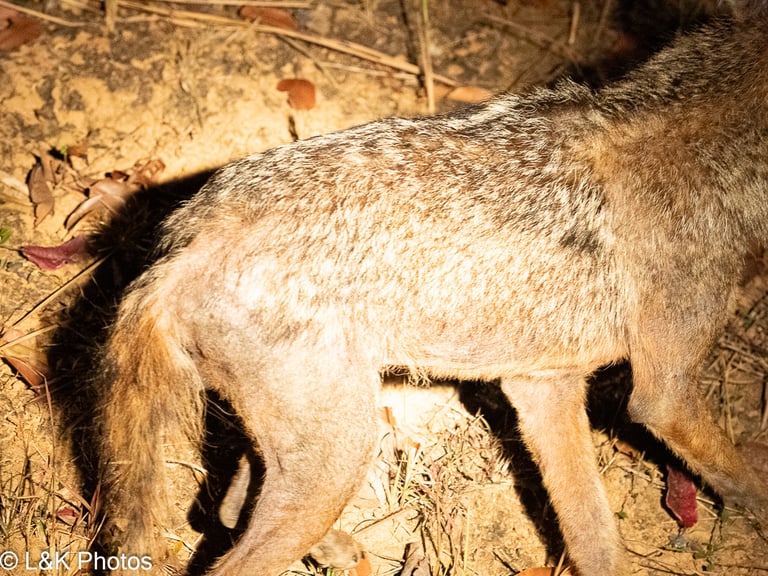
Coat color, set by the guard hairs, ranges from mottled white, brown, gray and black to almost pure white in some Arctic populations. Older wolves accumulate white hairs on the tail tip, muzzle and forehead, while lactating females keep their winter coat longest, aside from some hair loss around the teats.
Distribution and Habitat
Gray wolves range across Eurasia and North America, occupying more habitat types than almost any other land mammal, from Arctic tundra and taiga to temperate forest, prairie, chaparral, and arid steppe, at elevations from sea level up to 3,000 m (9,800 ft).
Deliberate persecution over livestock predation and fear of attacks has cut the wolf's range to roughly one-third of its historic extent. The species has been extirpated from much of Western Europe, the contiguous United States and Mexico, and entirely from the British Isles and Japan. Today it survives mostly in wilderness and remote regions, though populations persist in isolated pockets such as Poland, Scandinavia, Portugal, Spain and Italy.
Within this range, habitat use is shaped less by vegetation type than by the abundance of prey, snow depth, road and human density, and the presence of livestock. Wolves occupy forests, wetlands, shrublands, grasslands, pastures, deserts and rocky mountain terrain wherever these factors allow, which explains their presence in landscapes as different as tundra and desert.
Global occurrence records show observations rising through spring and peaking around June, before declining toward a low in November and December. Because these figures reflect where wolves have been reported rather than true abundance or a complete range map, the pattern most likely tracks seasonal visibility and observer activity rather than a real surge in numbers.

Behavior and Lifestyle
Gray wolves live in tightly structured packs of two to thirty-six animals, though most number five to nine. A pack usually centers on a monogamous alpha pair and their offspring from several years, sometimes joined by unrelated immigrants. A strict dominance hierarchy governs feeding and mating order, communicated through postures such as crouching, chin-touching and rolling onto the back to expose the stomach; if the alpha male loses his position, the beta male typically takes over.
Offspring remain in the natal pack for 10 to 54 months before dispersing, driven by sexual maturity or competition for food. Dispersing wolves can travel enormous distances, documented cases include journeys of 206 km (128 mi), 390 km (240 mi) and 670 km (420 mi), and typically pair with an unrelated disperser of the opposite sex to found a new pack in unclaimed territory. Packs rarely accept outsiders, and when they do, it is almost always an immature wolf unlikely to challenge the breeding pair.
Packs defend territories ranging from 130 to 13,000 km2, sized to the availability of prey and the number of six-month-old pups needing adult-level food. They travel roughly 25 km (16 mi) a day, covering about 9% of their territory, and concentrate roughly half their time within a core area averaging 35 km2 (14 sq mi). Movement is seasonal: packs stay relatively settled in spring and summer while rearing pups, then become nomadic through fall and winter, traveling up to 200 km in a day at a typical pace of 8 km/h and running at bursts of 55–70 km/h. Territorial disputes with neighboring packs are a leading cause of death, responsible for an estimated 14–65% of wolf mortality in Minnesota and Denali National Park.
A 2025 field report described a wolf pulling a crab trap's buoy and line to drag the submerged trap ashore and reach its bait cup, behavior the authors suggested might qualify as tool use, showing what they called a grasp of the multi-step link between a floating buoy and out-of-sight bait. They cautioned that whether this counts as true tool use depends on definition, and that the behavior's origin and how widespread it is remain unknown.
Communication
Howling is the wolf's long-range communication tool, audible over areas up to 130 km2 (50 sq mi) under the right conditions. Packs howl to assemble members before and after hunts, to raise an alarm near a den, to relocate each other during storms or while crossing unfamiliar ground, and to declare territorial boundaries to neighboring packs. Contrary to popular belief, the phases of the moon have no effect on howling, and wolves do not howl at the moon. Growls, barks and whines round out the vocal repertoire; wolves bark only a few times before retreating from a threat, unlike the sustained barking of dogs.
Body language conveys rank and mood: an assertive wolf moves slowly and deliberately, holds its body high, and raises its hackles, while a submissive one lowers its body, flattens its fur, and drops its ears and tail. Scent marking, usually performed only by the alpha male, is even more effective than howling at advertising territory. Marks of urine, feces and gland secretions are left roughly every 240 m (790 ft) along regular travel routes and can last two to three weeks; raised-leg urination alone accounts for 60–80% of all scent marks.
Hunting and Diet
Gray wolves hunt mainly in packs, using coordinated pursuit to bring down prey far larger than themselves, moose, elk, bison, muskoxen and reindeer, by locating animals through chance encounter or scent and then attacking the rump, flank and shoulders once prey is run down. Pack hunting lets wolves exploit ungulates that a lone wolf could not safely tackle, and by selectively taking the weak, old and immature, wolves help regulate prey populations.
Lone wolves, by contrast, target smaller game such as beavers and rabbits, which make up a substantial share of the diet in some regions. Wolves also steal kills from other predators and scavenge carrion when it is available, and a single wolf can eat up to 9 kg (20 lb) of meat in one meal, consuming nearly the entire carcass including hair and bone.
What a wolf eats varies by geography and prey availability rather than by fixed preference; where wild ungulates are scarce, wolves may turn to livestock or garbage, a habit that drives much of the conflict with humans.
Reproduction and Raising Young
Breeding is restricted to the pack's dominant pair, who are monogamous and often bonded for life; if one partner dies, a new alpha quickly takes its place. Females choose their mates and come into estrus once a year for five to fourteen days, with mating taking place between January and April, later in northern populations than in southern ones.
After mating, the pregnant female digs or adopts a den, a burrowed slope, a rock fissure, a hollow beneath a fallen tree, or even an appropriated fox or marmot burrow, usually within 500 m (1,600 ft) of water and facing south to warm quickly in the sun. Gestation lasts 60 to 75 days, and litters range from one to fourteen pups, averaging six or seven; young females typically bear four to five pups, while older, more experienced females can produce six to eight or more. Pup mortality is steep, at 60–80%.
Newborns weigh 300–500 g (11–18 oz), are blind, deaf and covered in soft gray-brown fur; their eyes open at nine to fifteen days, and they begin walking and vocalizing about a week later. Mothers stay in the den almost constantly for the first three weeks, relying on the father and other pack members to bring food. Pups take solid food at three to four weeks and grow nearly thirtyfold in weight over their first four months. All pack members share pup-rearing duties, regurgitating food for pups until 45 days old and then bringing them meat directly.
Pups leave the den for good around 8 to 10 weeks, begin hunting alongside the pack at about ten months, and reach sexual maturity at two years in females and three in males; most disperse from the natal pack between one and three years of age.
Population and Ecological Role
As apex predators, gray wolves regulate the populations of the large ungulates they hunt, culling weak, old and immature animals and shaping the behavior and distribution of prey species across entire landscapes.
Wolves typically dominate other canids sharing their range, killing coyotes and raiding coyote den sites, and killing red, Arctic and corsac foxes in disputes over carcasses. Brown bears usually win contests over carcasses, but wolf packs often prevail in defending den sites, and each species kills the other's young. Wolves also dominate wolverines and black bears, sometimes seeking out and killing black bears in their dens without eating them, while interactions with cougars vary from wolves stealing kills to cats killing lone wolves; in the Russian Far East, Siberian tigers can depress wolf numbers to local extinction.
Wolves carry and can spread viral diseases including rabies, canine distemper, parvovirus and infectious canine hepatitis, along with bacterial diseases such as brucellosis, Lyme disease and bovine tuberculosis; rabid wolves may travel up to 80 km (50 mi) a day, spreading infection as they roam.
Domestication and Human History
The domestic dog and the dingo are both classified as subspecies of Canis lupus, making the wolf the wild ancestor from which one of humanity's oldest domesticated animals descends, though no specific date or place of that domestication is given here.
Historically, people trapped and killed wolves for their thick, insulating fur, valued for its resistance to cold. Beyond hunting, wolves remain economically significant today for reasons unrelated to fur: as one of the most charismatic wild carnivores, they draw wolf-watching visitors to parks and reserves, and wolf ecotourism is now a major source of revenue for those protected areas.
The wolf's image also sells widely in its own right, appearing on posters, books, apparel and other merchandise that trade on its symbolic association with wilderness and freedom.
Conservation and Threats
The IUCN lists the gray wolf as Least Concern, a status earned by its still-wide global range and, in most regions, a stable or recovering population, even though the species has vanished entirely from large parts of its former range.
The greatest threats remain human-driven: competition with people over livestock and game, fear of attacks, and habitat fragmentation from settlement and agriculture. In the contiguous United States, agricultural expansion and the near-elimination of bison, the wolf's main prey, drove extermination campaigns that reduced the species to a few hundred animals in places like Minnesota by the mid-20th century. Wolves were exterminated from Great Britain by 1684, Ireland by 1770, Central Europe by 1899, France by the 1930s and much of Scandinavia by the early 1970s.
Legal protection has reversed many of these declines since the 1970s. The global wild population was estimated at 300,000 in 2003. The contiguous U.S. now holds about 2,600 wolves, with nearly 2,000 in Minnesota alone, while Alaska manages 6,000–8,000 and Canada around 50,000–60,000 across 80% of its historical range. Reintroductions into Yellowstone and Idaho helped rebuild populations in the northern Rocky Mountains, and a captive-breeding program launched jointly by the United States and Mexico in 1977–1980 has grown the reintroduced Mexican wolf population past 300 individuals. In the European Union, roughly 20,300 wolves live in breeding packs across 23 countries, protected under the 1979 Berne Convention and the 1992 Habitats Directive.
Most U.S. populations have since been delisted from the Endangered Species Act, except experimental Mexican wolf populations in the Southwest, and the species sits in CITES Appendix II worldwide except in Bhutan, India, Nepal and Pakistan, where it is Appendix I.
Conservation status
- LC
- NT
- VU
- EN
- CR
Least Concern
Cultural Significance
The wolf appears across the mythologies of nearly every culture within its range. The Ancient Greeks linked it to Apollo, god of light and order, while the Romans connected it to Mars and credited a she-wolf with suckling Romulus and Remus, the legendary founders of Rome. Norse mythology cast the wolf as menace and companion alike, with the monstrous Fenrir set against Odin's loyal wolves Geri and Freki.
In Chinese astronomy the wolf represents Sirius, guardian of the heavenly gate, though Chinese tradition also used wolf imagery to describe greed, cruelty and mistrust. Hindu and Buddhist traditions cast the wolf as a mount of protective gods, while for the Pawnee it was the first animal brought to Earth, and Sirius itself became known as the "wolf star." The wolf also serves as a crest symbol for Pacific Northwest clans such as the Kwakwaka'wakw, and the Dena'ina traditionally viewed wolves as brothers to humankind.
European folklore shaped a darker image: Aesop's fables, including "The Boy Who Cried Wolf," painted the wolf as deceitful, while the werewolf legend and villains such as the Big Bad Wolf of "Little Red Riding Hood" and "The Three Little Pigs" cemented its reputation as a predator to be feared. That reputation persists alongside modern uses of the wolf as a commercial symbol of wilderness, sold through posters, books and apparel, and as the draw behind wolf ecotourism in parks and reserves.
Fun Facts
- Cortisol levels in wolves spike sharply when a pack member dies, hinting at genuine grief-like stress responses to loss.
- Newborn pups closely resemble German Shepherd puppies, born blind and deaf and weighing only 300–500 g (11–18 oz).
- The infamous "Custer Wolf," documented in early 20th-century reports, reportedly traveled with coyotes that warned him of danger, though he never allowed them to approach his kills.
- The largest wolves on record come from Alaska, Canada and central Russia, where some males weigh up to 79.4 kg (175 lb), nearly double the species average.
- Wolf fur is such an effective insulator that it does not ice over even when warm breath condenses against it, unlike dog fur.
- Numerous local and ancient names exist for Canis lupus across its historic range, reflecting its long relationship with people in different regions.
Ecology
Diet
- Carnivore
Behavior
- Nocturnal
- Predator
- Territorial
- Social
Habitat
- Forest
- Mountain
- Grassland
- Tundra
Photos
SourcesGBIFiNaturalistWikidataWikipediaAnimal Diversity WebAnAge