Goldfish released into the wild have become an invasive pest in parts of North America and Australia, even though the same fish is one of the most popular pets kept in aquariums around the world.
The goldfish, Carassius auratus, is a freshwater fish in the carp family Cyprinidae, within the order Cypriniformes. It lives in still or slow-moving fresh water and, on the IUCN Red List, is assessed as Least Concern.
Few fish live such a double life: a docile bowl companion in one setting and a self-sustaining wild colonizer in another. That contrast, between domestic icon and ecological disruptor, makes the goldfish worth a closer look.
Identification and Appearance
The goldfish is a freshwater fish in the family Cyprinidae, within the order Cypriniformes. It is one of the most widely kept aquarium species and instantly familiar to most people, though the available record for this entry does not detail specific measurements such as body length, weight, or a defined color-pattern range.
Its taxonomic placement links it closely to other carp species native to Eurasian freshwater systems, a relationship that explains many of its physiological traits described elsewhere in this profile.
Distribution and Habitat
Goldfish occupy fresh inland waters and wetlands across temperate regions, favoring bodies of water with slow or no current. This includes rivers, lakes, ponds, streams, marshes, bogs, and swamps. A description from East Asian waters characterizes the species as highly adaptable, thriving in almost any water body but most common in shallow, muddy habitats thick with aquatic vegetation, where it behaves as an alert, easily startled fish.
Goldfish typically live at depths between 1 and 20 meters, averaging around 10 meters. They tolerate water temperatures from 0°C to 10°C for extended periods and can survive spikes as high as 30–40°C. They are more common in water with a pH between 5.5 and 7.0 but can tolerate conditions as alkaline as pH 10.5, and they manage salinities up to 17 parts per trillion, though they do not thrive above 15 ppt.
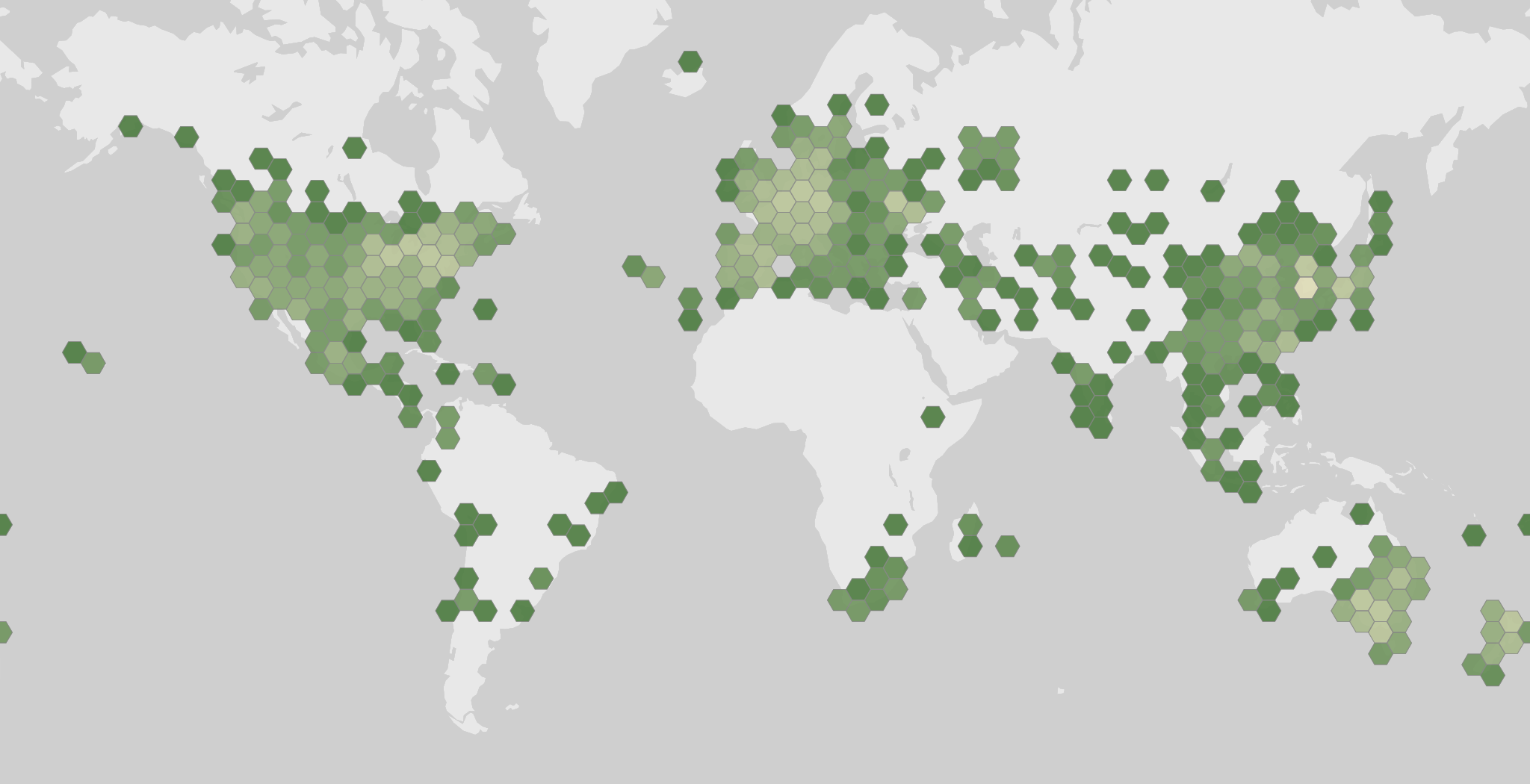
Monthly observation data show a clear seasonal pattern, with counts climbing from roughly 2,600–4,800 in January through March to a peak near 26,600 in June, before tapering off through the second half of the year. Since these are presence records rather than abundance or population figures, the June peak most likely reflects when goldfish are most visible or actively observed, coinciding with their spring–summer activity, rather than a true measure of how many fish are present.
Behavior and Lifestyle
Goldfish are highly social, forming schools that both structure their daily life and provide protection: grouping together helps individuals watch for and evade predators. Within these schools there is no aggression and no dominance hierarchy, an unusual trait among gregarious fish. Activity peaks at dawn and dusk, when the species is most mobile in the water column.
Goldfish tolerate conditions that would kill many other fish. They withstand ammonia concentrations as high as 4,132 micromoles, a level toxic to most species, and can survive heavy turbidity and pollution. When water temperatures fall below 10°C and oxygen is sufficient, they enter a winter hibernation; they can also endure several months at just 2°C on lower oxygen levels.
Movement studies illustrate how mobile the species can be outside the aquarium. In Australia's Murray River, tagged goldfish moved an average of 0.30 km per day, while fish in South Korea's Jangheung Dam averaged 1.4 km per day. During the breeding season, river-dwelling goldfish migrate out of flowing channels into still, off-channel waters to spawn. They do not defend territories at any point in this cycle.
Goldfish also show notable cognitive ability. They form strong associative memories, learn from watching other goldfish feed, and can visually distinguish between individual humans, often reacting differently to a familiar keeper than to a stranger. Their memory span extends to at least three months, and they can be trained to respond to colored light signals or anticipate feeding times.
Communication
A lateral line running along each side of the body lets goldfish sense ripples, currents, and vibrations produced by other fish nearby, functioning as a form of touch-at-a-distance communication within the school. Their hearing reaches frequencies of 2 to 3 kHz, detected through an inner ear coupled to the gas bladder.
Vision plays an equally large communicative role. Goldfish are tetrachromats, perceiving red, green, blue, and ultraviolet wavelengths. Because UV light penetrates water more effectively than visible light, this extra sensitivity helps them detect predators and prey through subtle reflections, and it supports their ability to memorize visual landmarks for orientation.
Chemical signals round out the repertoire. A goldfish with damaged skin releases a substance that alerts the rest of its school to potential danger, while females ready to spawn release pheromones that stimulate nearby males to produce more milt. Goldfish also learn feeding behavior socially, joining in when they observe a schoolmate consuming an unfamiliar food item.
Diet and Nutrition
Goldfish are opportunistic, generalist omnivores that search widely through aquatic vegetation and sandy substrates for anything edible, rather than pursuing a narrow or fixed set of prey.
A gut-content study of goldfish from Stoneycroft Pond in Quebec found that vegetation, especially pondweeds of the genus Potamogeton, made up about 45% of their diet. Insects such as non-biting midges and mosquito larvae contributed 21%, while small crustaceans including brine shrimp, Daphnia magna, and other zooplankton made up roughly 4%. The rest of their intake includes terrestrial earthworms, detritus scavenged from the water, and occasionally the carrion of insects and crustaceans; controlled pond experiments also showed caged goldfish will consume amphibian eggs when available.
In captivity, this broad natural diet narrows to commercial fish flakes supplemented with small vegetables like peas. Newly hatched fry eat the same range of foods as adults, simply in smaller portions, and no dietary differences have been recorded between males and females.
Reproduction and Life Cycle
Goldfish are polygynandrous, with both males and females mating with multiple partners in a single season. Courtship begins when a female carrying eggs releases a pheromone into the water; this triggers nearby males to produce milt, and both sexes then chase and bump one another before spawning.
Breeding runs seasonally from February to June, driven primarily by water temperature, with 10°C acting as the threshold that starts the cycle. Within that window, goldfish spawn about once a month. Both sexes reach sexual maturity between 3 and 4 years of age.
Females release eggs into the water, where they are fertilized externally by milt from one or more males. A typical spawning event produces 2,000 to 4,000 eggs, though the largest recorded clutch reached 380,000. The adhesive eggs attach to submerged plants such as Cabomba or Elodea, and hatch within 2 to 9 days.
Parental investment stops at fertilization. Neither parent guards the eggs or the resulting larvae, which are independent the moment they hatch. Adult goldfish will readily eat eggs or fry they encounter, making their own offspring one of the biggest early threats to survival.
Population and Ecological Role
No specific population estimate or trend figure is recorded for the species, but its ecological role is well documented: goldfish act as agents of sediment bioturbation, stirring bottom sediments through foraging, spawning, and predator-avoidance movements. This activity spreads nutrients through the water column and can increase food availability for other aquatic organisms sharing the same habitat.
Goldfish sit within a wider food web as prey for various mammals and as hosts to a long list of parasites. Documented endoparasites include trematodes of the genus Metagonimus, nematodes (Contracaecum), the apicomplexan Plasmodium, monogenean flatworms, and the myxosporean parasites Sphaerospora and Mitraspora. External parasites include fish lice (Argulus foliaceus), anchor worms (Lernaea cyprinacea), and leeches (Trachellobdella torquata), underlining how deeply goldfish are woven into the parasite communities of the waters they occupy.
Domestication and Human History
Goldfish sustain a global pet-trade economy, sold both as ornamental pets and as bait for larger predatory fish. Prices span an enormous range, from about 15 cents for basic feeder goldfish to over $120 for rarer ornamental stock. Beyond the pet trade, goldfish are also used in scientific research, including toxicity testing such as studies on ammonia tolerance.
As a coldwater species, goldfish can live in unheated indoor aquaria at temperatures comfortable for humans, with an optimum range of 20–22°C. Sudden temperature swings are dangerous, and fancy varieties in particular struggle below about 10°C or above 30°C, though common and comet varieties tolerate a wider range. Their coloration is not fixed for life: pigment-producing cells called chromatophores respond to light exposure, so a goldfish kept in darkness will gradually fade toward gray, much as human skin responds to sun exposure.
Outdoors, hardier forms such as common, comet, London and Bristol shubunkin, jikin, and wakin goldfish can live in ponds year-round in temperate and subtropical climates, sometimes surviving briefly under surface ice if the pond does not freeze solid and oxygen remains sufficient. More delicate ornamental forms, including moor, veiltail, oranda, and lionhead varieties, need warmer, more tropical conditions to overwinter safely outdoors. Compatible pond species include rudd, tench, orfe, and koi, though koi require specialized care and orfe will eat goldfish eggs, which helps limit overpopulation in mixed ponds.
Because goldfish eat live plants, most aquarium and pond vegetation must be chosen carefully; only a few plants, such as Cryptocoryne and Anubias, tend to survive alongside them without constant uprooting.
Conservation and Threats
Goldfish are listed as Least Concern on the IUCN Red List and carry no special status under the US Federal List, CITES, or the State of Michigan List. This reflects a species that is, if anything, too resilient rather than at risk: its tolerance for polluted, oxygen-poor, and temperature-variable water means it is not known to be harmed by climate change or moderate pollution.
The main documented threat to goldfish themselves is hybridization with other carp. There are no active conservation programs aimed at protecting the species, since none are needed; instead, the concern runs in the opposite direction, with possible efforts underway to remove goldfish from waters outside their native range, where their hardiness lets them establish and persist as an invasive species.
Conservation status
- LC
- NT
- VU
- EN
- CR
Least Concern
Cultural Significance
A Chinese legend called the Dragon Gate tells of a carp that spent a hundred years struggling to leap to the top of a waterfall; upon finally succeeding, the gods transformed it into a golden dragon. The story is often cited to explain why carp and their descendants, including the goldfish, are held in cultural regard across East Asia.
In both Chinese art and Japanese tradition, the goldfish carries symbolic weight as a sign of luck, wealth, and abundance. Its golden color and its lineage tracing back to revered carp give it a place in decorative and symbolic contexts well beyond the aquarium.
Historically, goldfish were among the very first fish bred purely for ornamental purposes, developed in China before spreading to Japan and later to Europe. That early role as a decorative species set the pattern for the modern pet trade, in which goldfish remain a mainstay of household aquariums and garden ponds worldwide.
Fun Facts
- Newly hatched goldfish larvae weigh only about 0.15 to 0.17 grams, a tiny fraction of an adult's mass.
- Researchers examined the evolutionary origin of the goldfish genome in a 2020 study published in the Proceedings of the National Academy of Sciences.
- One tagged goldfish tracked in Australia's Murray River covered 231.3 km over the course of a single year, while another moved 5.4 km in just one day.
- Goldfish are tetrachromats, able to see ultraviolet light in addition to red, green, and blue, a sensory range humans cannot perceive.
Ecology
Habitat
- Wetland
- Freshwater
Behavior
- Hibernating
- Aquatic
- Social
- Crepuscular
Diet
- Omnivore
Photos
SourcesGBIFiNaturalistWikidataWikipediaEncyclopedia of LifeAnimal Diversity WebAnAge