Males of Goliathus goliatus can reach a body length of 110 millimeters, making this beetle one of the largest insects on Earth.
It belongs to the scarab beetle family, Scarabaeidae, within the order Coleoptera, and is native to the tropical forests and savannas of equatorial Africa.
Its combination of sheer bulk, bold coloring, and a horned head used in combat between males has made it a favorite subject for collectors and a striking example of just how large an insect can grow.
Identification and Appearance
The most reliable field mark on a male is the black, Y-shaped horn on the head, used as a lever in fights with rival males over feeding sites or mates; females lack this horn entirely.
Size alone sets this species apart from most other insects. Males measure 50 to 110 millimeters in body length, while females are somewhat smaller and more uniform in size, ranging from 54 to 80 millimeters.
The pronotum is mainly black with whitish longitudinal stripes, and the head is pale. In the typical form, the elytra are mostly dark brown, but coloration varies considerably across named forms: the "quadrimaculatus" form has largely white elytra, and intermediate forms known as "albatus," "apicalis," "conspersus," "hieroglyphicus," and "undulatus" show varying patterns of brown, white, and black. These forms occur alongside the typical brown form in Benin, eastern Nigeria, and western Cameroon. Beneath the hardened elytra, the beetle carries a large membranous flight wing, folded away when not in use.
As one of the largest species in the genus Goliathus, this beetle stands out even among its close relatives for its size and the male's prominent cephalic horn, which is the clearest way to distinguish males from females and from smaller-horned relatives.
Distribution and Habitat
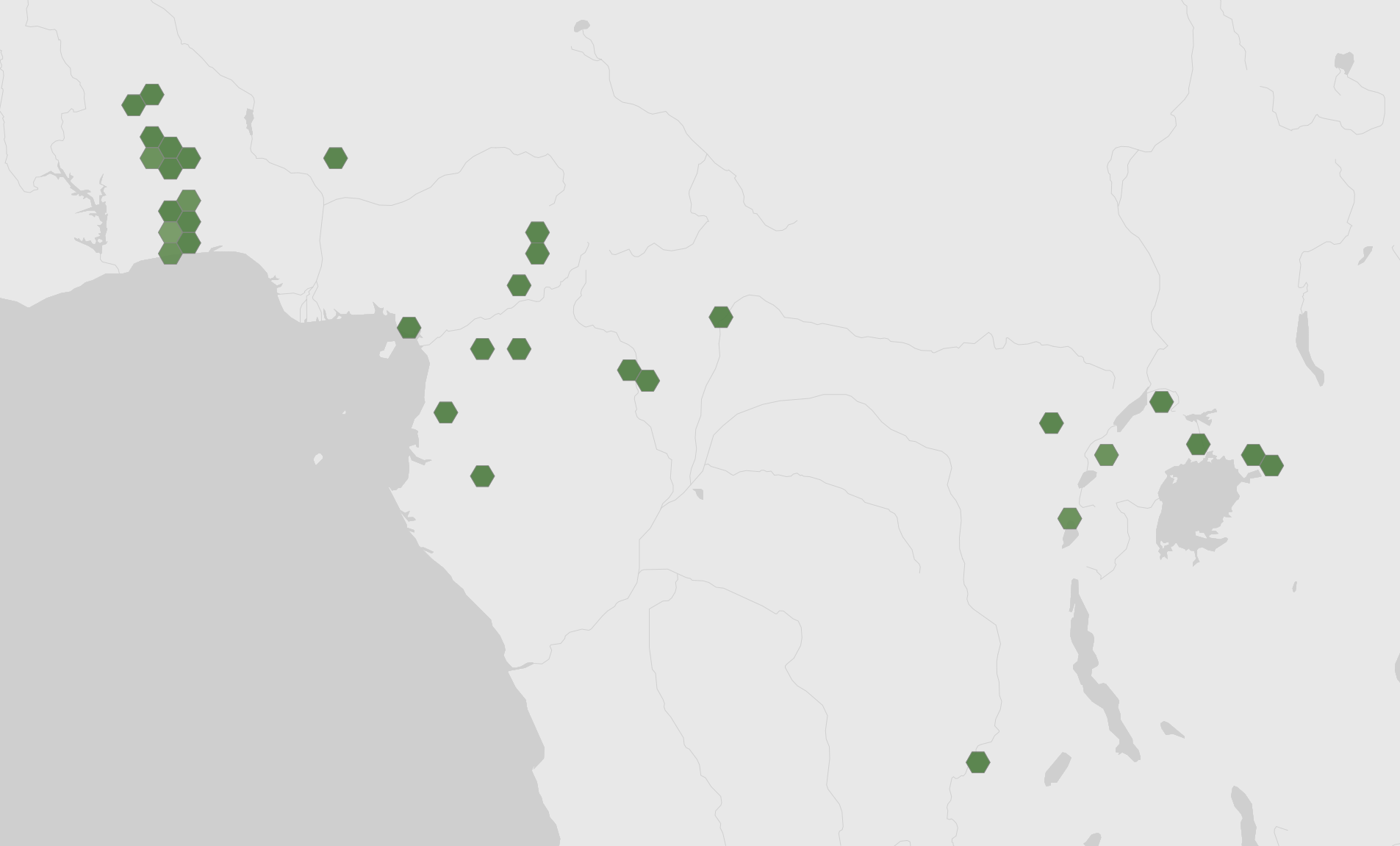
Goliathus goliatus ranges widely across equatorial Africa, with populations recorded in Nigeria, Cameroon, the Central African Republic, Gabon, the Republic of the Congo, the Democratic Republic of the Congo, Uganda, western Kenya, and northwestern Tanzania.
The species occupies two main habitat types: equatorial forest, where it is most closely associated, and sub-equatorial savanna at the edges of its range.
Monthly observation records show counts fluctuating from a low of 6 to 7 sightings in September and October up to peaks of 22 in April and 28 in December, with another rise to 19 to 20 in November and January. This pattern suggests the beetle may be more frequently encountered in the later months of the year and into early spring, though these figures reflect presence observations rather than actual abundance or population size, and they do not describe a complete picture of its range.
Cultural Significance
The genus name Goliathus draws directly on the biblical giant Goliath, a namesake that frames this beetle, quite literally, as an insect of giant proportions.
A notable specimen has been exhibited to showcase tropical biodiversity and the appeal of exceptionally large insects, though the beetle itself carries little of the symbolic weight given to other beetle species in mythology and folklore.
The legend behind its namesake endures independently in human culture as a story of great size confronted by courage and resilience, an association that lends the beetle's name a resonance beyond its biology.
Fun Facts
- The genus name Goliathus references the biblical giant Goliath, tying the beetle's identity to a legendary figure of great size.
- Despite its imposing name, Goliathus goliatus holds little of the symbolic or mythological weight often given to other large beetle species.
- A notable specimen of this species has been put on public display specifically to highlight tropical biodiversity and the fascination people have with oversized insects.
- The name "Goliath" itself is thought by some researchers to have Semitic origins, fitting within the cultural context of the Iron Age Southern Levant.
Ecology
Habitat
- Forest
- Savanna
Behavior
- Territorial
Diet
- Frugivore