Known by a long list of nicknames—Maybug, Maybeetle, doodlebug—the common cockchafer announces itself every spring with a loud, buzzing flight around trees and streetlights at dusk. Few people realize that this familiar beetle is almost impossible to tell apart from its close cousin, Melolontha hippocastani, the forest cockchafer, even though genetic studies show the two are more distantly related than their nearly identical looks suggest.
Melolontha melolontha is a scarab beetle in the order Coleoptera and family Scarabaeidae, native across Europe and holding no special conservation status. What makes it worth a closer look is not rarity but detail: subtle differences in antenna shape between males and females, a multi-year underground larval life, and a set of mating behaviors unusual enough to have drawn dedicated scientific study.
Identification and Appearance
The clearest way to separate Melolontha melolontha from its lookalike M. hippocastani is pronotum color: melolontha has a black, hair-covered pronotum, while hippocastani's is brown. Adults measure 25 to 30 millimeters long, with a dark head bearing two segmented antennae, reddish-brown elytra covering the back, and a black abdomen marked with white triangular patches along the sides.
Sex is easy to read from the antennae alone. Males carry seven flattened, leaf-like extensions called lamellae, while females have only six—a difference tied directly to their different roles in mate-finding.
The larvae look nothing like the adults. Newly hatched grubs (the L1 stage) measure just 10 to 20 millimeters, growing to 30–35 millimeters in their second year (L2) and 40–46 millimeters by their final year (L3); in parts of Eastern Europe a fourth year (L4) occurs before pupation. The grub has a creamy white, C-shaped body with a dark abdominal tip, a large brown head armed with strong mandibles, and long, hairy legs adapted for burrowing.
Larval antennae are large and fan-shaped, with the male's noticeably larger than the female's even at this immature stage, foreshadowing the adult dimorphism. Larvae rely on smell and touch rather than sight, using chemosensory organs to forage for roots underground.
Distribution and Habitat
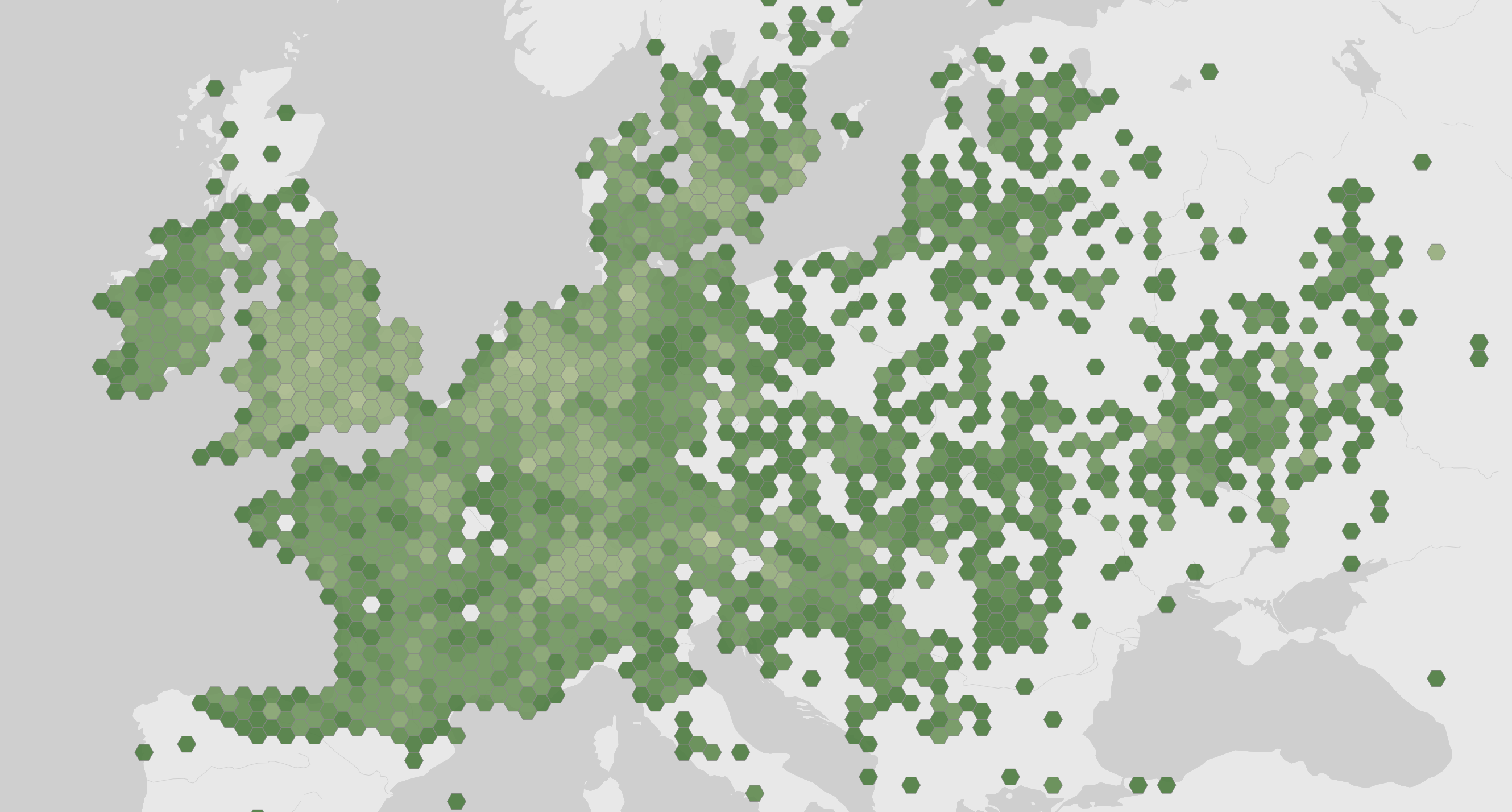
The common cockchafer occurs widely across Europe, favoring temperate regions with soft, shaded soil suitable for larval development, and it has also been recorded in parts of Asia, including Turkey and the Caucasus. It shows a strong association with agricultural land, deciduous forest, grassland, and suburban areas with accessible soil.
Its range has real limits: the species does not occur in the high-altitude, cold regions of Tyrol in the Alps, and individual beetles rarely disperse more than 2 to 3 kilometers from the site where they emerged, keeping populations tied closely to specific fields and woodlands.
Monthly observation records show an unmistakable seasonal pattern, with counts climbing sharply from a few dozen in winter months to a peak of over 29,000 in what appears to be May, alongside elevated counts in April and June. These figures reflect presence, not abundance, but they line up with the known spring emergence and swarming period of the adults.
Behavior and Lifestyle
Cockchafers are nocturnal and crepuscular, most active at dusk when they take to the air with an audible buzz around trees and, frequently, house lights. Some individuals concentrate on a single tree while others range across an entire forest searching for food, and the species survives the colder months by hibernating underground.
Mate-finding depends on an unusual two-signal system. Females release toluquinone, a sex pheromone, while feeding on foliage; at the same time, the leaves they damage emit green leaf volatiles (GLVs) such as (Z)-3-hexen-1-ol. Only males respond strongly to these plant volatiles, using them to pinpoint which branches hold receptive females—making M. melolontha the first insect reported to require both a sex pheromone and plant-derived cues for successful mating.
This chemical division of labor produces a distinct swarming pattern: males hover and patrol foliage at forest edges around dusk, while females stay put on twigs and branches to feed and signal. Male sensitivity to GLVs is sharper than that of females, a difference linked to differences in antennal anatomy between the sexes.
Underground, the larvae show their own specialized behavior, gnawing on roots and pausing only to burrow deeper for winter hibernation. Their gut contains enzymes capable of neutralizing plant and bacterial toxins, including compounds from dandelion roots and a Bacillus thuringiensis toxin, allowing the grubs to exploit a wide range of soil-based food sources.
Diet and Nutrition
As herbivores, adult cockchafers feed on the leaves of deciduous and fruit trees, particularly oak, maple, sweet chestnut, beech, plum, and walnut, flying out singly in search of food through April and May. Large adult populations can strip enough foliage to become a nuisance, but the damage they cause is minor compared to that of their larvae.
Larvae are indiscriminate root feeders, gnawing on grain, grass, tree, and beet roots as they move through the soil, and they can travel as much as 30 centimeters a day while feeding. Unlike many soil-dwelling grubs, they target fresh, living roots rather than decaying organic matter, which is precisely what makes them destructive to crops and turf.
The scale of the damage depends on density: once populations exceed roughly 1,000 larvae per square meter, root injury to soil and crops becomes clearly visible. Damage also shifts across the larval stages, peaking during the second year of development when crops such as strawberries suffer the most, before easing somewhat—though remaining severe—in the third year.
Reproduction and Life Cycle
Breeding is tightly seasonal, triggered by day length and temperature acting on hormonal cycles in females. Males emerge from the soil in April or May and begin swarming at dusk around trees at forest edges, searching for mates for roughly 10 to 20 days, while females remain on branches feeding until they reach sexual maturity, typically around three years of age.
Mating itself lasts several hours and occurs mainly in late May and early June. Afterward, each female returns to open fields and digs 15 to 25 centimeters into the soil to lay a batch of 10 to 38 eggs, then stays on the surface for two to four days guarding the site.
The trip back to the fields is risky: only about a third of females survive it, but the ones that do may make a second, or even third, swarming and egg-laying trip. Incubation time depends heavily on temperature, ranging from just 5 to 8 days at 27°C to as long as 23 to 32 days at 32°C.
Once hatched, larvae begin gnawing on small roots within 4 to 6 weeks and then spend the next three to four years developing underground through several larval stages before finally emerging as adults.
Population and Ecological Role
Cockchafer numbers rise and fall with soil temperature, humidity, and vegetation type, with warm, humid conditions favoring adult activity even as those same conditions can desiccate and kill larvae. Deciduous trees and shrubs provide the habitat structure the species depends on for both feeding and reproduction.
The beetle sits at the center of a distinct predator network. European moles hunt larvae underground using scent and digging skill, while ground beetles and ants take adults, and click beetles prey on larvae below ground. Starlings, crows, and gulls often follow the plow to pick off exposed larvae in freshly turned fields.
A specialized parasite, the fly Dexia rustica, lays eggs that hatch underground and seek out hibernating cockchafer larvae; at depths of 30 to 35 centimeters, more than 10 percent of grubs can be parasitized by one to six fly larvae, which ultimately kill their host. Through this web of predators and parasites, the cockchafer functions as both a consumer of plant roots and a food source that supports several other species.
Conservation and Threats
The common cockchafer carries no special conservation status: it is not listed on the IUCN Red List, has no US federal listing, and is not covered by CITES. In practical terms, this reflects a species that remains widespread and abundant across its European range rather than one facing identified population decline.
No specific threats to the species itself are documented; if anything, cockchafers are more often discussed as an agricultural concern for the damage their larvae cause to crop roots than as a species needing protection.
Cultural Significance
The cockchafer has a long history as a plaything and a subject in literature rather than as a species of practical human benefit—no positive human use has been attributed to it. Since antiquity, children have caught the beetles and tied threads to their legs to watch them fly in spirals, a game played in ancient Greece and again by Victorian English boys, who sometimes used a pin through the wing instead; Nikola Tesla recalled building one of his first "inventions," a beetle-powered engine, this way as a child.
The insect appears in literature and folk culture across Europe, including Hans Christian Andersen's "Thumbelina," Madame d'Aulnoy's "Princess Rosette," and the German children's song Maikäfer flieg!, whose lyrics trace back to the devastation of Pomerania during the Thirty Years' War and which resurfaced in popular memory during the early years of World War II. Four Royal Navy ships have also carried the name HMS Cockchafer.
Fashion and food both left traces of the beetle's presence: 1750s–1780s dress trims known as sourcils de hanneton, or "cockchafer eyebrows," mimicked its fan-shaped antennae in knotted silk floss, and cockchafer soup remains documented as a traditional European dish made from the beetle itself.
Fun Facts
- The genus name Melolontha was first used by Étienne Louis Geoffroy in 1762, but because his publication was later suppressed by the International Commission of Zoological Nomenclature, naming authority officially belongs to Johan Christian Fabricius's 1775 work instead.
- Historical naturalists took note of the species long before modern entomology: Aldrovande's 1644 De Animalibus Insectis Libri Septem and Erasmus Darwin's 1800 Phytologie both discuss Melolontha larvae, showing centuries of human curiosity about the insect.
Photos
Photographs from via iNaturalist, licensed under CC0 1.0., by Maciej Boenisch via iNaturalist, licensed under CC BY 4.0., by Tilgate Zoo via iNaturalist, licensed under CC BY 4.0., by Barry Stewart via iNaturalist, licensed under CC BY 4.0., by Natasha March via iNaturalist, licensed under CC BY 4.0., by Frank Ashwood via iNaturalist, licensed under CC BY 4.0., by Will Taylor via iNaturalist, licensed under CC BY 4.0., and by agreiner99 via iNaturalist, licensed under CC BY 4.0., credited on each photo.
Ecology and classification
Classification
- Phylum
- Arthropoda
- Class
- Insecta
- Order
- Coleoptera
- Family
- Scarabaeidae
- Genus
- Melolontha
- Species
- Melolontha melolontha
Sources
- GBIF Species names and classification
- iNaturalist Photos
- Wikidata Common names and conservation status
- Wikipedia Summary extract
- Animal Diversity Web Animal habitat, behavior and diet