A great white shark's liver can account for more than a quarter of its total body weight, acting as a built-in flotation device that keeps this massive predator from sinking as it cruises the open ocean.
Carcharodon carcharias belongs to the family Lamnidae, alongside the mako sharks, porbeagle, and salmon shark. It patrols temperate and tropical coastlines and open ocean from South Africa to California, Australia to the Mediterranean, and is currently listed as Vulnerable by the IUCN.
What sets the species apart is its unusual biology: it is partially warm-blooded, letting it hunt effectively in cold water, and it carries roughly 300 serrated teeth arranged in conveyor-belt rows, constantly replacing any that break or wear down.
Identification and Appearance
The clearest field mark is size paired with a stark two-tone coloration: a dark blue-gray to gray-brown back giving way sharply to a white belly, with black tips visible on the underside of the pectoral fins. Females mature at 4.6–4.9 m (15–16 ft) and can weigh 1,000–1,900 kg, while males mature smaller, at 3.4–4.0 m (11–13 ft) and 680–1,000 kg. Reliably measured record specimens include a 6.02 m individual from the northwest Pacific and a 5.94 m shark from Ledge Point, Western Australia, though older claims of sharks over 11 m are discredited.
The body is stocky and torpedo-shaped with a short, cone-like snout, a large triangular first dorsal fin, a tiny second dorsal fin, and a tail with two nearly equal lobes and a single caudal keel. Skin is covered in small, ridged dermal denticles, and some individuals are known to darken white blotches with added melanin over months, altering their pattern slightly with age.
The roughly 300 teeth change shape through life: juveniles have narrow, pointed teeth suited to catching fish, while adult teeth broaden and gain coarser serrations as the diet shifts toward marine mammals. Front teeth puncture prey while backward-curved rear teeth tear flesh; a 2008 study estimated a 6.4 m adult could generate a bite force up to roughly 18,216 newtons at the back of the jaw.
The eyes are solid-looking black with blue irises and a mostly horizontal pupil, and lack a protective nictitating membrane; instead the eye itself can roll to track prey or avoid injury during an attack. Cone-dominant vision suggests strong daytime eyesight, complemented by acute smell, electroreception through the Ampullae of Lorenzini, and lateral-line water-flow sensing.
Distribution and Habitat
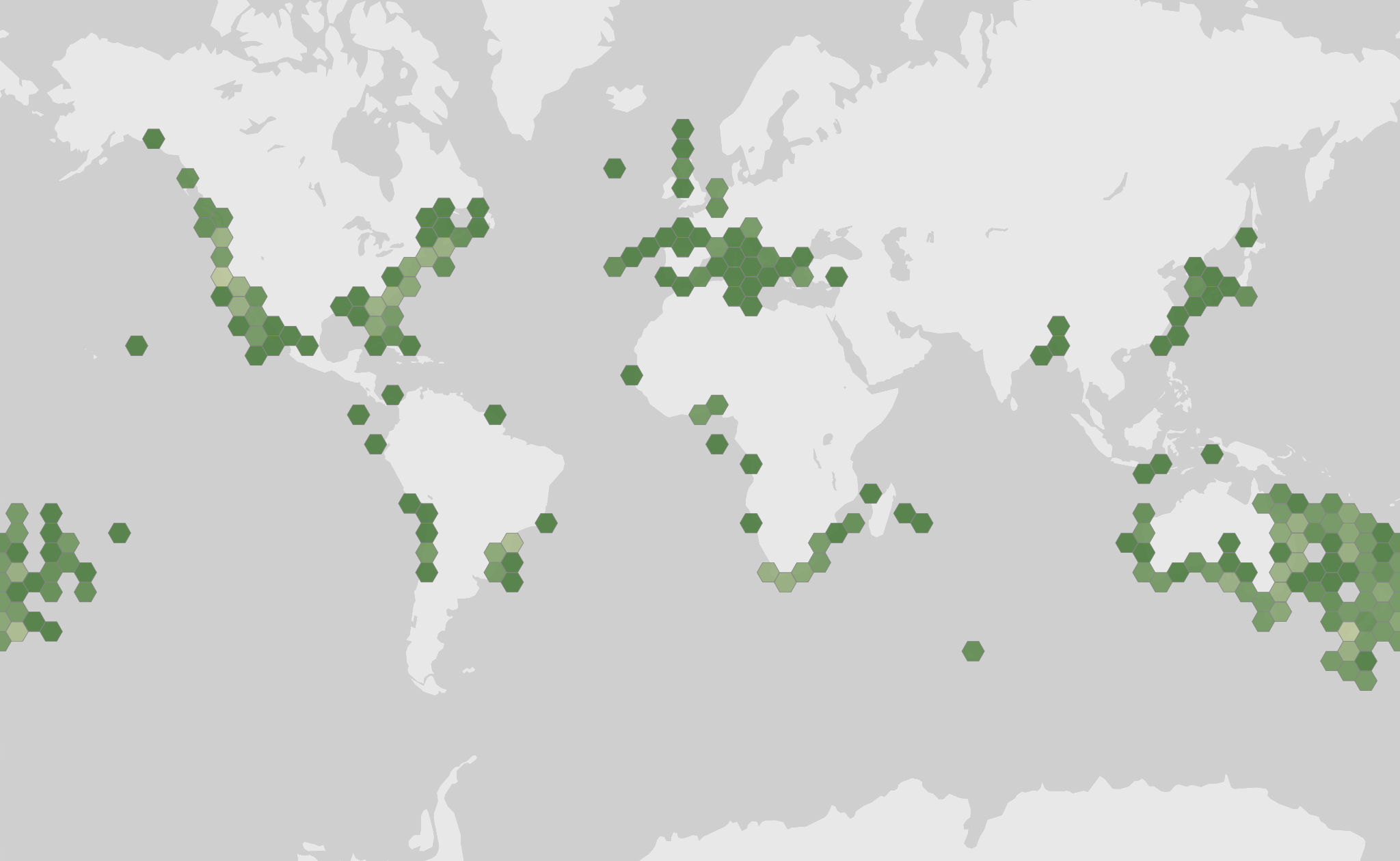
Great white sharks range from tropical to cold-temperate seas across the globe, with major populations in the northwestern and northeastern Pacific, the western North Atlantic, the Mediterranean, southern Africa, and Oceania; they are present but apparently uncommon along South America. Known coastlines include California to Alaska, the eastern United States, the Gulf of Mexico, Hawaii, South Africa, Australia (excluding the north coast), New Zealand, West Africa to Scandinavia, Japan, and eastern China to Russia.
The species uses both coastal and open-ocean habitats, typically staying near the surface but capable of diving to depths of 1,300–1,875 m, with the deepest dives more common far offshore. Coastal habitat includes nearshore archipelagos, offshore reefs, banks, shoals, and headlands, while a documented offshore feeding ground between western North America and Hawaii is known as the White Shark Café. Major coastal aggregation sites include the Farallon Islands and Monterey Bay in California, Guadalupe Island in Mexico, Cape Cod, South Africa's Western Cape, the Neptune Islands in Australia, and New Zealand's Stewart and Chatham Islands.
Migration is extensive and tied to food and temperature: one shark tagged off South Africa swam to Australia and back within a year, and another completed a 20,000 km round trip to northwestern Australia in under nine months. In the northeastern Pacific, sharks feed along the coast in fall and winter and move farther offshore in spring and summer; in the western Atlantic, sharks gather from the Gulf of Maine to Cape Hatteras in spring and summer before shifting toward Florida and the Gulf of Mexico in fall and winter.
Monthly observation counts show a rise from roughly 1,100 sightings in January to a peak above 2,100 in October, suggesting greater seasonal presence in late summer and fall in the regions most represented in the data. These figures reflect presence records only, not true abundance or a complete picture of the species' range.
Behavior and Lifestyle
Great white sharks are largely solitary, though they gather at feeding sites such as seal rookeries and whale carcasses, where individuals establish temporary dominance hierarchies based mainly on body size. Typical cruising speed is a modest 2.88–4.86 km/h, but sharks can sprint up to 24.12 km/h when attacking, and one migrating individual sustained 4.7 km/h for extended periods, a pace closer to that of fast-swimming tuna than most sharks.
At the surface, sharks display spyhopping, lifting the head out of the water to inspect objects above, and a related "repetitive aerial gaping" behavior, possibly a sign of frustration after a missed strike. Aggregation patterns vary by site: a 2016 study near Mossel Bay, South Africa found largely random associations, while studies at the Neptune Islands and Guadalupe Island found structured groupings, the latter possibly reflecting social learning about where to find prey or carcasses.
White sharks can live past 70 years, with juveniles showing an annual survival rate above 70 percent and adults above 90 percent in a 2018 study of Australian and New Zealand populations. Orcas are known predators and competitors: groups of two to six orcas off South Africa flip sharks belly-up to induce tonic immobility, then target the liver, and sharks often abandon an area, at least temporarily, when orcas arrive.
As many as 116 parasite species infest white sharks, including copepods that attach to skin and gills and two tapeworm species in the genus Clistobothrium, one of which has been recovered in numbers exceeding 2,500 from a single shark's spiral valve.
Communication
Smell and electroreception dominate a great white's perception of its surroundings: it can detect a single drop of blood diluted in 100 liters of water and sense electrical fields as weak as 0.005 microvolts, useful for locating hidden or hiding prey. Social communication, by contrast, relies heavily on visual body language, with at least 20 documented forms observed mostly around seal rookeries after peak hunting periods, when sharks swim past, parallel to, or in circles around one another to size each other up.
One shark will sometimes perform a lateral display, showing off its full body to a rival, apparently to establish rank by size and avoid direct conflict; this signaling is more frequent between similarly sized sharks, where the outcome of a confrontation is less obvious. When disputes over food arise, sharks often resolve them through splash fights, slapping the tail on the surface to throw water at a competitor, who either withdraws or answers with a splash of its own; the shark producing the most persistent, forceful splashing typically wins the standoff, and body size does not always decide the contest. Similar tail-splashing has been directed at competing tiger sharks and even at boats and shark cages perceived as rivals.
Hunting and Diet
A great white shark typically hunts by approaching from directly below its prey, then driving upward in a fast, near-vertical strike that ends in a collision followed by a bite; prey commonly die from blood loss, decapitation, or the loss of vital fins rather than immediate consumption. This ambush strategy suits the shark's build for short, explosive bursts of speed rather than sustained pursuit.
Diet shifts sharply with age. Juveniles feed on smaller, easier prey such as squid, stingrays, and other small sharks, while adults turn to seals, sea lions, dolphins, and whale carcasses; elephant seals are among the most frequent prey of mature sharks. This shift tracks changes in tooth shape, from narrow and pointed in young sharks to broad and coarsely serrated in adults, better suited to tackling large, blubber-rich mammals.
Sea turtles and various seabirds are taken occasionally, rounding out a diet that spans fish, mammals, reptiles, and mollusks. Despite the species' reputation, humans are not a preferred prey item, and documented fatal attacks remain a small fraction of recorded encounters, consistent with the shark's tendency to target blubber-heavy marine mammals rather than people.
Reproduction and Life Cycle
Mating in the great white shark remains poorly documented, with only two anecdotal accounts—both off New Zealand, in 1991 and 1997—describing belly-to-belly rolling during copulation. Researchers assume, as in other sharks, that the male bites the female's head, flank, or fin to hold position while inserting a clasper; scarring on mature females at sites such as Guadalupe Island and Cape Cod may be evidence of this behavior, and the mating system is considered polygynandrous. Some researchers propose that males gather offshore in a lek-like system that females visit to choose partners, while a 2013 study suggested whale carcasses may serve as meeting points for mating due to the excitement they generate.
Reproduction is ovoviviparous: fertilized eggs hatch inside the female, and embryos develop in the uterus, first living on yolk, then a nutrient-rich uterine secretion, and finally on unfertilized eggs. After a gestation of roughly 12 to 14 months, females give birth to live litters of 2 to 10 pups (occasionally up to 14), typically in shallow water around islands with temperatures of 15.7–23.1 °C, though specific nursery grounds remain largely unidentified.
Newborns measure about 1–1.6 m and receive no care from the mother; they swim away immediately and are capable predators from birth. Growth then continues at roughly 25 cm per year. Estimates of the age at maturity differ sharply between studies: a 1985 analysis put maturity at 9–10 years, while a more recent 2015 study using vertebral growth bands concluded that males mature around 26 years old and females around 33, with growth slowing markedly after age 40. Females are believed to breed at intervals of two years or more, mating again shortly after giving birth.
Population and Ecological Role
As apex predators, great white sharks exert strong top-down pressure on populations of elephant seals, sea lions, and other marine mammals, shaping prey behavior and distribution well beyond their own numbers. Genetic studies show the global population is not a single interbreeding group but is split into three major lineages—North Atlantic, Indo-Pacific, and North Pacific—that diverged around 7,000 years ago following a long-term decline that began roughly 800,000 years ago, with movement between ocean basins still limited by cold and warm-water barriers.
Regional population estimates vary widely: South Africa's population was estimated at around 1,279 individuals in the early 1990s and roughly 1,953 after 1991 legal protections took effect, while eastern Australia and New Zealand together are estimated to hold 2,500–6,750 sharks. A 2025 global study put the minimum population at about 5,800 individuals, though one of its authors suggested the true figure could be closer to 20,000.
The species also hosts a range of commensal and parasitic organisms, including the copepods Pandarus sinuatus and Pandarus smithii, underscoring its role as both predator and habitat for smaller marine life.
Conservation and Threats
The IUCN lists the great white shark as Vulnerable, citing an estimated population decline of 30–49 percent since around 1859, with the species further described as "moderately depleted" in a 2021 assessment. The greatest threats are accidental capture in commercial fishing gear and shark-control measures such as protective nets and traps used near beaches in Australia and South Africa, though sharks released from such gear tend to survive at high rates.
International trade is regulated under CITES Appendix II, requiring permits for any exchange of shark parts, a response to sustained demand for fins, jaws, teeth, meat, cartilage, and liver oil. South Africa has banned deliberate killing and sale of the species since 1991, and its population there appears to have remained roughly stable since that protection began, though sightings have dropped in the Western Cape—a shift some researchers attribute to eastward movement, possibly linked to orca predation, though this explanation is disputed by more recent catch data.
Conservation status
- LC
- NT
- VU
- EN
- CR
Vulnerable
Cultural Significance
The species carries a long history of mythologizing its teeth and reputation. Carl Linnaeus originally classified it in 1758 as Canis carcharias, struck by the ragged shape of its teeth and a perceived resemblance to dogs, while French naturalist Guillaume Rondelet named it "Lamia" in 1554 after a child-eating monster of Greek mythology and linked it to the fish that swallowed the prophet Jonah in biblical tradition.
Modern popular culture recast the species as a fearsome man-eater, an image cemented by Peter Benchley's 1974 novel Jaws and Steven Spielberg's 1975 film adaptation, following the shark's earlier introduction to the public through the 1971 documentary Blue Water, White Death—a characterization Benchley himself later regretted.
Economically, the species has shifted from a minor sport-fishing target, difficult to catch commercially due to its size and power, toward a valuable trade commodity: fins, jaws, teeth, meat, cartilage, skin, and liver oil are all traded, with jaws and teeth commanding the highest prices. Shark tourism, including cage diving to view sharks up close, has also become an income source in areas where the species is reliably found.
Fun Facts
- Carl Linnaeus originally classified the species as Canis carcharias in 1758, based on the ragged shape of its teeth and its perceived similarity to dogs.
- French naturalist Guillaume Rondelet named it "Lamia" in 1554, after a child-eating monster from Greek mythology, and identified it as the fish that swallowed the prophet Jonah in biblical texts.
- The great white shark is the sole living species in its genus, Carcharodon; a fossil relative named Carcharodon caifassii in 1876 is now considered a probable synonym of the modern species.
- In 1959, angler Alf Dean landed a 1,208 kg (2,663 lb) great white off Streaky Bay, South Australia, setting a rod-and-reel record for the largest fish ever caught.
- Keeping great whites in aquariums has proven extremely difficult; the most successful attempt was at California's Monterey Bay Aquarium, which housed six sharks between 2004 and 2011 using a 4-million-US-gallon net pen to help them recover from capture before display.
Ecology
Habitat
- Marine
- Coastal
Diet
- Carnivore
Behavior
- Predator
- Solitary
- Migratory
Photos
SourcesGBIFiNaturalistWikidataWikipediaAnimal Diversity WebAnAge