A greater flamingo raised in captivity can live nearly 59 years, placing it among the longest-lived of all birds.
The greater flamingo (Phoenicopterus roseus) is the largest and most widespread species in the flamingo family, ranging across coastal Northern Africa, Sub-Saharan Africa, the Indian subcontinent, Central Asia, the Middle East, and the Mediterranean shores of southern Europe. The IUCN lists it as Least Concern, a status that reflects its wide range and large numbers rather than an absence of pressures on its wetland habitats.
Beyond its size, the species is known for its flamboyant courtship dances, its ability to filter food from mud with a uniquely engineered bill, and a long-standing place in mythology as a possible inspiration for the phoenix. Those threads run through everything that makes this bird recognizable, from its coloring to its social life.
Identification and Appearance
The clearest field mark is the combination of pink-white plumage with crimson-red wing coverts and jet-black flight feathers, visible whenever the bird spreads or folds its wings. Adults stand 110 to 150 centimeters tall and weigh around 2 to 4 kilograms, making them the tallest and heaviest species in the flamingo family.
The bill's shape, a shallow downward keel, sets it apart even before its color is visible, and the pink base fades to black only at the very tip. Legs are pink from the joint down to the webbed feet, without the dark patches seen in some relatives.
Chicks hatch covered in grey down and lack any pink coloring. Subadults are noticeably paler than breeding adults and have dark legs rather than pink. Adults actively feeding chicks also fade in body color but keep their bright pink legs, since the carotenoid pigments that create the rosy hue come from the algae and invertebrates in their feeding grounds and from secretions of the uropygial gland.
During the breeding season, birds spread these gland secretions over their feathers more frequently, deepening their color in what has been described as an application of makeup.
Distribution and Habitat
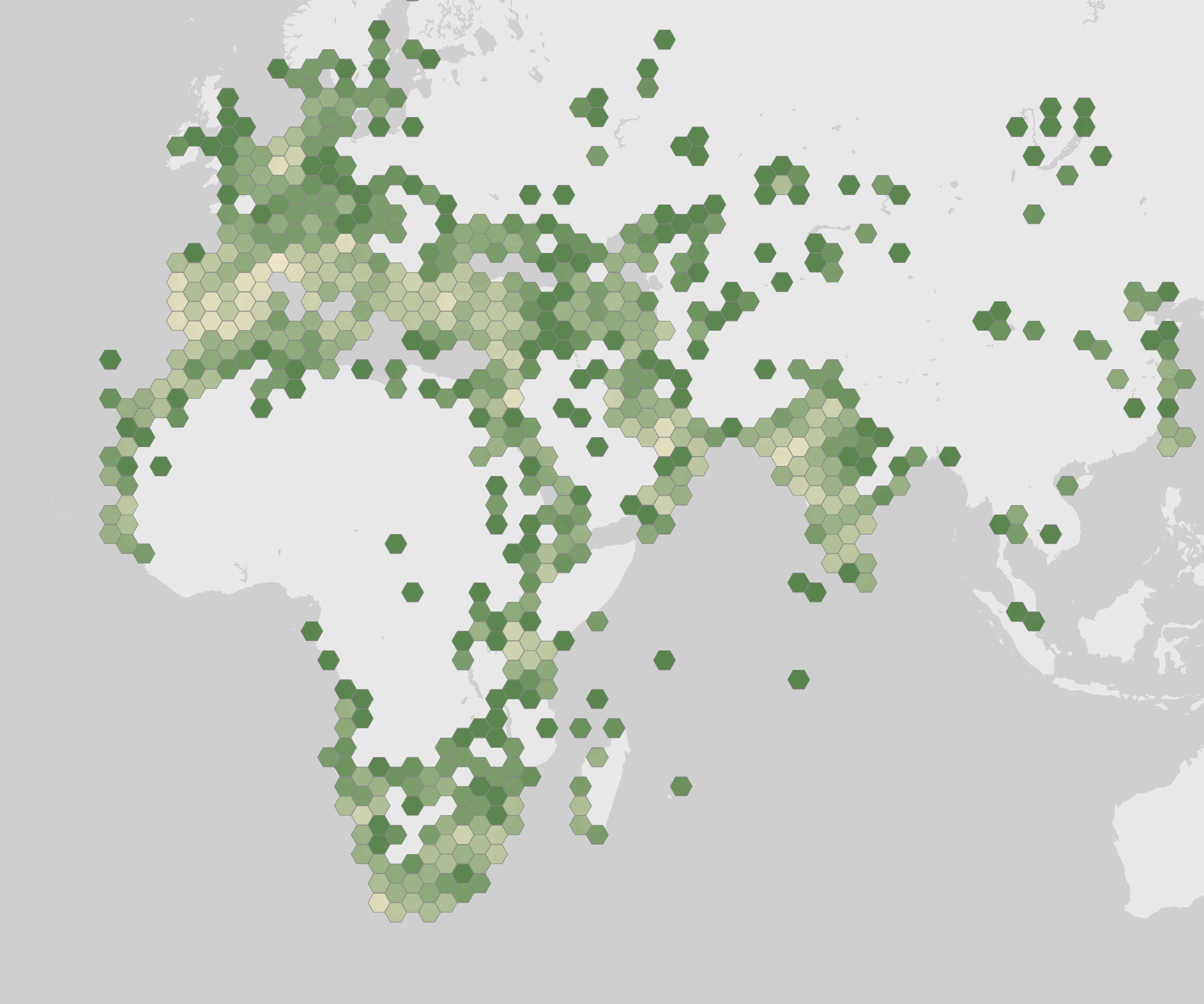
Greater flamingos occupy a broad arc of the Old World, from coastal Morocco, Algeria, Tunisia, Libya and Egypt (including inland along the Nile) through Sub-Saharan strongholds in Kenya, Tanzania, Uganda, Rwanda and Madagascar, across Western Asia (Bahrain, Iraq, Iran, Oman, Israel, Kuwait, Qatar, the UAE), the Indian subcontinent (coastal India, Pakistan, Bangladesh, Sri Lanka), and southern Europe from Portugal and Spain to Turkey, including France's Camargue, Corsica, Italy, Greece and the Balkans.
It favors shallow, highly saline or alkaline waters, with a pH up to 11, in lagoons, lakes, estuaries and muddy beaches, and it also turns up around sewage treatment plants, dams, rice fields, low islands, sea bays, salt marshes and, in Africa, hot springs. Its elevational range is unusually wide for a wading bird, from sea level to 4,500 meters.
The northernmost breeding colonies sit near 50°N at Lake Tengiz in Kazakhstan's Korgalzhyn Nature Reserve, where several thousand pairs nest each year. Farther south, birds breed at three sites in Abu Dhabi Emirate, and large numbers winter at Gujarat's Nal Sarovar, Khijadiya and Thol bird sanctuaries in India. A small feral population, descended from zoo escapees, breeds alongside escaped Chilean flamingos at Zwillbrocker Venn in western Germany.
Monthly observation counts peak near 59,000 in January and dip to about 25,000 in June, a pattern that hints at seasonal shifts in where birds are recorded rather than in overall numbers; these counts reflect where observers have logged sightings, not a census of the population.
Behavior and Lifestyle
Greater flamingos live in colonies that can number in the thousands, coordinating movement and feeding through constant contact with the flock. Because they feed on organisms in shallow-water mud, they depend on low water levels and shift location whenever conditions change, making the species nomadic across a wide range rather than tied to a fixed territory.
After the first few days of life, chicks are gathered into large crèches supervised by multiple non-breeding adults. Adults minding a crèche become hostile toward hatchlings that do not belong to their group, yet show no aggression toward chicks that do, a distinction that suggests some level of recognition within these communal nurseries.
Activity is diurnal, and greater flamingos occasionally mix with lesser flamingos (Phoeniconaias minor) in Sub-Saharan Africa, forming flocks with both species present. There is no evidence of a fixed dominance or pairing structure within a flock beyond the fact that its members tend to breed on the same schedule.
Communication
Flocks communicate constantly through a noisy cackle, and greater flamingos can tell individual calls apart by their timing and frequency patterns, letting a bird recognize specific companions in a crowd of thousands. A softer gabbling murmur accompanies group feeding.
As breeding approaches, the flock performs elaborate synchronized displays, including head flagging, wing saluting, twist preening and wing-leg stretching. These visual displays are thought to provide hormonal stimulation across the group, timing courtship so that most birds mate within the same narrow window.
Scent also plays a role: pheromones are listed among the species' communication channels alongside its visual and acoustic signals, though the specific messages they carry are less studied than the calls and dances.
Filter Feeding and Diet
Feeding begins with an upside-down posture: the greater flamingo bends its long neck so the head is submerged, using its shallow, keeled bill to dig into bottom mud. Inside that bill sits what is described as the most sophisticated filtering and pumping system of any bird, straining food particles from water and sediment as the bird sweeps its head side to side.
What passes through the filter depends on what lives in the mud: algae, diatoms, crustaceans, insect larvae and mollusks make up the bulk of the diet, supplemented locally by brine shrimp (Artemia salina), chironomid larvae known as lake flies, and even cultivated rice.
The algae consumed are directly responsible for maintaining the pink tones in the plumage, so any disruption to that food supply shows up in a bird's color. In captivity, diets lacking sufficient carotenoids leave flamingos duller than their wild counterparts and have been linked to foot lesions, while wild hatchlings that go without enough food can develop a dopamine-receptor polymorphism tied to poor early body condition.
Water pollution compounds the problem because contaminants settle into the same bottom sediments the birds filter for food, meaning polluted feeding grounds can degrade both nutrition and health at once.
Nesting and Breeding
Breeding starts with group courtship rather than pair-specific rituals: the whole flock performs exaggerated stretching, preening, marching and simultaneous turning, and the hormonal stimulation from this shared display pushes most birds to mate within the same narrow window, producing an irregular, flock-wide breeding season rather than a fixed calendar date. Greater flamingos are polygynandrous and rarely keep the same partner across seasons, tending to pair with mates of similar age and showing a preference for older, more experienced birds. The complexity of an individual's courtship display appears to track its age and condition, increasing until around 20 years old before declining.
Nesting pairs build a mound of mud and other material on an island or lakeshore, hardened by the sun with a concave top that cradles a single chalky-white egg; a lost egg can be replaced with another, but only one is raised at a time. If the surrounding resources prove inadequate, parents will abandon the site and re-nest elsewhere rather than persist. Incubation runs 26 to 32 days, with both parents alternating shifts so one can always forage.
Chicks hatch altricial and are fed crop milk by both parents before being moved into a crèche watched over by non-breeding adults. Fledging takes 65 to 90 days, after which the bill finishes curving into the adult's downward-keeled shape, allowing the young bird to filter-feed on its own instead of depending on its parents.
Full adult plumage rarely arrives before 4 years of age, though it can appear as early as 30 months. Sexual maturity technically begins around 3 years, but most females do not breed until 5 to 6 years old.
Population and Ecological Role
Greater flamingos face relatively few natural predators as adults, but eggs and chicks are vulnerable to raptors, crows, gulls and the marabou stork (Leptoptilos crumenifer); in the Mediterranean, the yellow-legged gull (Larus michahellis) alone accounts for an estimated half of all predation on flamingo eggs and chicks.
The species also hosts several species of chewing and feather lice, including Colpocephalum heterosoma, Triniton femoratum, Anaticola phoenicopteri and Anatoecus pygaaspis, along with additional feather lice recorded on the Eurasian subspecies. These parasite loads are a routine part of its role within wetland food webs, where its filter feeding also shapes local invertebrate and algal communities.
Conservation and Threats
The IUCN Red List classifies the greater flamingo as Least Concern, reflecting its wide range and large total numbers rather than freedom from threats. It carries no special protected status under the US Migratory Bird Act, the US Federal List, or CITES.
Pollution is the most pressing threat. Soda ash runoff from mining operations can build up around a flamingo's legs, immobilizing the bird until it starves or falls prey to predators. Lead poisoning from ingested bullet fragments, along with other heavy metals and pollutants, adds to the mortality toll, and general water pollution and habitat encroachment from human development compound the pressure on breeding and feeding sites.
Zoo-based breeding has helped document the species closely: the first recorded zoo hatch occurred in 1959 at Zoo Basel, which has since hatched over 400 chicks, adding 20 to 27 birds a year since 2000.
Cultural Significance
In ancient Egypt, flocks of greater flamingos gathering in fiery pink and red masses are thought to have shaped the legend of the Bennu bird, linked to solar worship at the Temple of Ra in Heliopolis, where hieroglyphic texts describe it rising from the sacred persea tree every 1,461 years. That image carried forward into the Mediterranean and Middle Eastern phoenix myth, with migrating flamingo formations spanning hundreds of miles and appearing as crimson clouds against desert landscapes.
Beyond myth, the species has a documented practical use: greater flamingos are hunted and sold in markets across the Middle East and northern Africa, and their eggs are collected and sold there as well.
Fun Facts
- A recorded lifespan of 58.8 years makes the greater flamingo one of the longest-lived birds ever documented.
- Ancient Egyptian hieroglyphs describe the mythical Bennu, likely inspired by flamingo flocks, rising from the sacred persea tree every 1,461 years.
- Breeding pairs almost never last more than one season; individuals tend to choose a new partner most years.
- The intricacy of a flamingo's courtship dance increases with age up to about 20 years old, then starts to fade.
- Birds smear secretions from their uropygial gland over their feathers during breeding season, a behavior likened to applying makeup to boost their pink color.
- The northernmost breeding colony sits near 50°N at Lake Tengiz in Kazakhstan, hosting several thousand breeding pairs.
- A feral colony breeds alongside escaped Chilean flamingos at Zwillbrocker Venn in western Germany, far outside the species' native range.
Photos
Photographs from via iNaturalist, licensed under CC0 1.0., by Vsevolod Rudyi via iNaturalist, licensed under CC BY 4.0., by jk6000 via iNaturalist, licensed under CC BY 4.0., by Emily Nyenyedzi Davies via iNaturalist, licensed under CC BY 4.0., by Léo Souillard via iNaturalist, licensed under CC BY 4.0., by Fabian Schwarz via iNaturalist, licensed under CC BY 4.0., by Cricket Raspet via iNaturalist, licensed under CC BY 4.0., by Alexander Bach via iNaturalist, licensed under CC BY 4.0., by S. Menéndez via iNaturalist, licensed under CC BY 4.0., and by Mourad Harzallah via iNaturalist, licensed under CC BY 4.0., credited on each photo.
Ecology and classification
Classification
- Phylum
- Chordata
- Class
- Aves
- Order
- Phoenicopteriformes
- Family
- Phoenicopteridae
- Genus
- Phoenicopterus
- Species
- Phoenicopterus roseus
Sources
- GBIF Species names and classification
- iNaturalist Photos
- Wikidata Common names and conservation status
- Wikipedia Summary extract
- Animal Diversity Web Animal habitat, behavior and diet
- AnAge Longevity