The greylag goose is the ancestor of most breeds of domestic goose, a link that stretches back to at least 1360 BCE. This large waterfowl belongs to the family Anatidae and is the type species of the genus Anser.
It is a big bird, measuring 74 to 91 centimetres long and weighing about on average. It has mottled grey and white plumage, an orange bill and pink legs. It can live up to , often in captivity.
The species ranges widely across Europe and Asia, covering about . Its conservation status is Least Concern, and its numbers have grown strongly in many areas.
Identification and Appearance
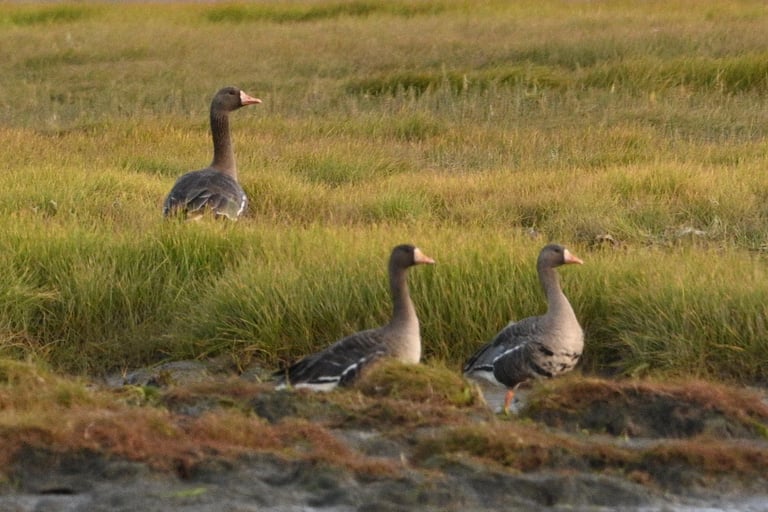
The greylag's most useful field marks are its orange or pink bill and pink legs and feet. Its greyish brown body has a darker head and paler breast and belly, often with black spotting.
The greylag is the largest and bulkiest of the grey geese in the genus Anser. It is 74 to 91 centimetres long, with a wingspan of 147 to 180 centimetres. Its wings are noticeable in flight: a pale grey forewing and rump contrast with darker flight feathers.
Males are generally larger than females, and the difference is more pronounced in the eastern subspecies A. a. rubirostris. Adults have a distinctive concertina pattern of folds in the feathers of the neck.
Juveniles lack the black speckling on the breast and belly, and their legs are greyish rather than pink. A white line along the upper flanks also helps separate the species from its domestic relatives, which are more heavily built.
Distribution and Habitat
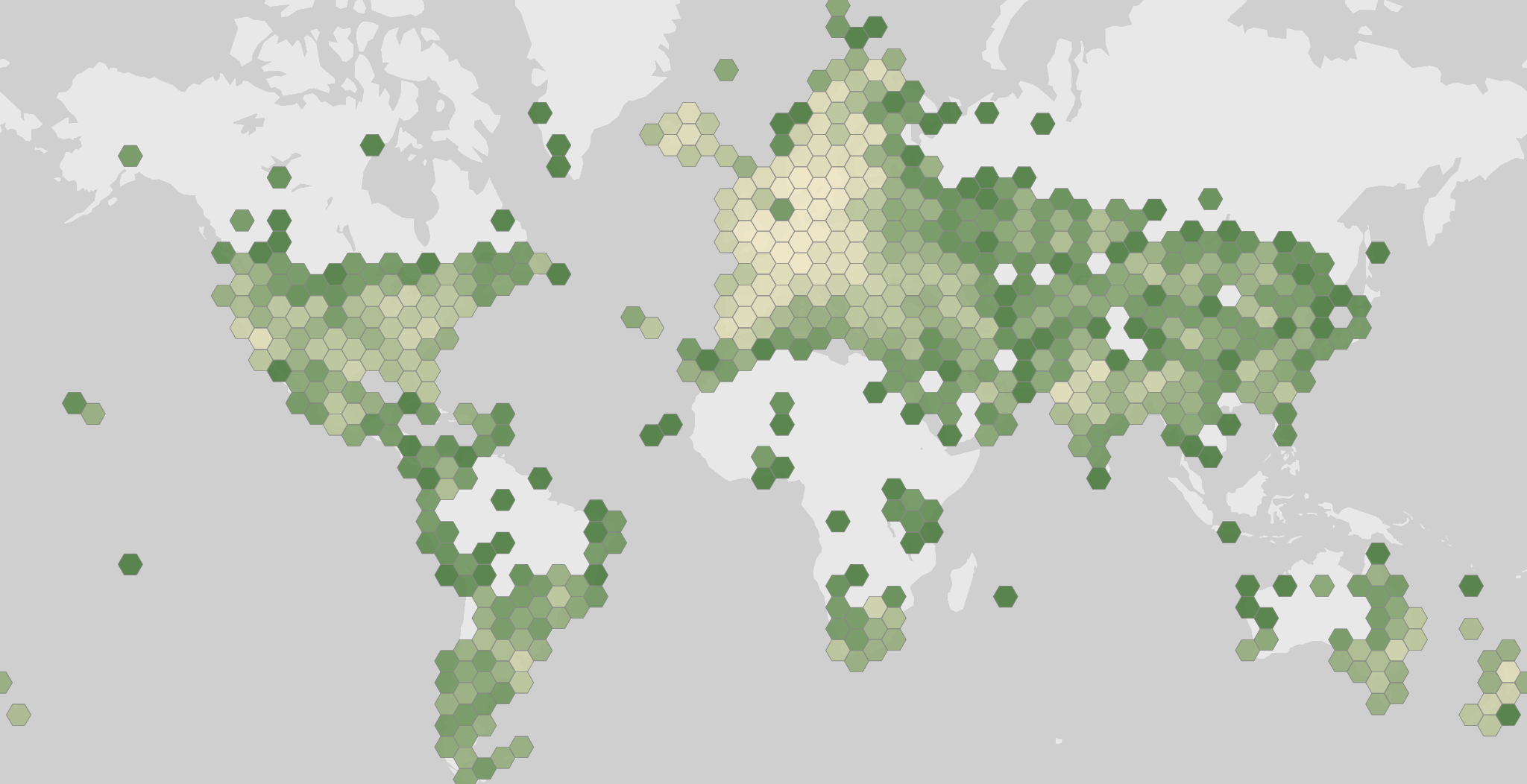
The greylag has a Palearctic distribution. The nominate subspecies breeds in Iceland, Norway, Sweden, Denmark, Finland, the Baltic States, northern Russia, Poland, Germany and the Netherlands, and it breeds locally in the United Kingdom and several other European countries. The eastern subspecies extends across much of Asia to China.
In breeding areas, greylags favour lowland marshes, fens and peat-bogs with dense ground cover of reeds, rushes, heather and willow thickets. They also use moors with scattered lochs, lakes and small islands some distance offshore.
In winter, they frequent salt marshes, estuaries, freshwater marshes, flooded fields and pastures near lakes and rivers. Many birds feed on winter cereals, rice and beans, moving at night to shoals, sandbanks and mudbanks on the coast.
Since the 1950s, warmer winters have allowed many birds in northern and central Europe to stop migrating or to travel shorter distances. Large numbers of immature birds gather each summer to moult on the Rone Islands near Gotland in the Baltic Sea.
Behavior and Lifestyle
Greylags are sociable birds. They occur in groups from small families to flocks of thousands, and they usually fly in V-shaped formations on long journeys. Their flocks rely on shared vigilance: some birds watch for danger while the rest feed.
Greylags spend much of the day feeding, because their low-nutrient diet passes quickly through the gut. They are fast runners on land and can move quickly to avoid predators.
Many greylags form long-term monogamous pairs. Most pairs stay together for life, although about 5 to 8% of pairs separate and re-mate. Same-sex pairs are also common, making up 14 to 20% of pairs depending on the flock. Same-sex pairs often hold high rank in the flock because of their strength and courage.
After the young hatch, families sometimes group together so adults can defend the goslings by mobbing or attacking predators.
Communication
Greylags have a loud, cackling call that sounds much like the domestic goose, a sequence rendered as "aahng-ung-ung". They use it on the ground and in flight, and it has several subtle variations used in different situations.
Individual geese appear to recognize other known geese by their voices. A flock's combined calls resemble the baying of hounds.
After driving off a predator, a gander returns to its mate and gives a triumph call: a resonant honk followed by a low cackle, given with the neck stretched forward. The mate and even unfledged young answer it. Goslings chirp or whistle softly, and adults hiss when threatened or angered.
Recordings
alarm call · Czech Republic · Petr Holecek · Public domain
· Sweden · Grégoire Chauvot · Public domain
Diet and Nutrition
Greylags are largely herbivores, and they feed chiefly on grasses. They favour short, actively growing grass, which is more nutritious, and they are often found grazing in pastures alongside sheep or cattle.
Beyond grasses, they eat the tubers of sea clubrush, rhizomes of marsh plants, roots, fruits and water plants such as duckweed. In winter they also eat leaves, glean spilled grain from cereal stubbles and feed on growing crops, especially at night. Acorns are sometimes eaten, and on the coast they may take seagrass.
Some greylags also eat small aquatic animals, including fish, amphibians, crustaceans, molluscs and insects.
Potatoes became an important food in the twentieth century. Pink-footed geese began feeding on waste potatoes in Britain in the 1920s, and greylags followed in the 1940s, now regularly searching ploughed fields for tubers.
Nesting and Breeding
Greylags form monogamous pairs, and the breeding season begins in early May in Iceland and in late April in Scotland. It starts a little earlier in central Europe.
The nest is built on the ground among heather, rushes, dwarf shrubs or reeds, or on a raft of floating vegetation. It is made from reed pieces, heather sprigs, grasses and moss, lined with small feathers and down. Nests are also placed in high, elevated spots, marshy ground and small islands, where eggs and goslings are safer from predators.
A typical clutch is four to six creamy-white eggs, which become stained as incubation goes on. Eggs range from three to twelve, and they measure about 85 by 58 millimetres. Eggs are laid on successive days, and incubation starts after the last one is laid.
Only the female incubates, for 27 to 28 days, while the male stays nearby to guard the nest. The chicks are precocial and leave the nest soon after hatching, once they have dried out. Both parents care for them, and the young soon learn to peck at food.
Goslings become fully fledged at eight or nine weeks, about the time their parents regain flight after moulting their main wing and tail feathers. Greylags reach sexual maturity at two to three years, and most breed first at three.
Population and Ecological Role
Greylag numbers have risen strongly in many areas. In Norway, the population is estimated to have grown three to five times between 1995 and 2015, and conflicts with farmers over grazing on farmland have grown with it.
In the Orkney Islands, the breeding population rose from 300 pairs to 10,000 in 2009 and 64,000 in 2019. Because of crop damage there, the hunting season now runs for most of the year.
Greylags are an important food source for predators. Red foxes, wolves, ravens, white-tailed eagles, golden eagles, white and black storks, crows and gulls all take them, and the greylag's grazing shapes wetland and farmland vegetation.
Domestication and Human History
Greylags were domesticated thousands of years ago, and they are the ancestor of most breeds of domestic goose. Domestication dates back at least to 1360 BCE.
People kept geese for several purposes. Their meat is very rich in flavour, and raising geese for food remains a major reason for keeping them today.
Goose down, the soft feathers of the birds, has long been valued as a material for pillow stuffing, lightweight mattresses, outdoor clothing, sleeping bags and insulation.
Conservation and Threats
The greylag is listed as Least Concern on the IUCN Red List, which means it is widespread and not currently at risk of global extinction.
Greylags were once very common in Western Europe, but drainage of marshes caused a severe drop in their numbers. The population has since recovered, and flocks now reach tens of thousands of birds.
The main pressure today is conflict with farmers. In some areas, grazing damage to crops has led to extended hunting seasons, as in the Orkney Islands.
Photos
Photographs from via iNaturalist, licensed under CC0 1.0., by s_schizik via iNaturalist, licensed under CC BY 4.0., by Bernd De Bosscher via iNaturalist, licensed under CC BY 4.0., and by Coralie via iNaturalist, licensed under CC BY 4.0., credited on each photo.
Ecology and classification
Classification
- Phylum
- Chordata
- Class
- Aves
- Order
- Anseriformes
- Family
- Anatidae
- Genus
- Anser
- Species
- Anser anser
Sources
- GBIF Species names and classification
- iNaturalist Photos
- Wikidata Common names and conservation status
- Wikipedia Summary extract
- Xeno-canto Audio recordings
- Animal Diversity Web Animal habitat, behavior and diet
- AnAge Longevity
- AVONET Bird mass, habitat, migration, diet and range size
- GloBI What it eats, what eats it, parasites and pollinators
- trophiCH
- Wardeh et al. 2015 (EID2)
- HWML Parasite Collection
- TETRA-EU