In Japan it is called maitake, the "dancing mushroom," because folklore holds that anyone lucky enough to find one danced with joy at its rarity and value, both for flavor and for its reputed healing powers.
Grifola frondosa is a polypore fungus that grows in dense, overlapping clusters at the base of trees, especially old-growth oaks and maples. It occurs natively across China, Europe, and eastern North America, where it is also known as hen-of-the-woods, sheep's head, or ram's head.
Few mushrooms combine culinary appeal with such a long history of medicinal folklore, and its habit of returning to the same tree base year after year makes it a favorite target for foragers who know where to look.
Fruiting Body and Identification
The most reliable way to recognize Grifola frondosa is by its growth form: a rosette-like cluster of overlapping, spoon- or fan-shaped caps arising from a single branching stalk, itself rooted in an underground, potato-sized sclerotium. Individual clusters typically reach up to 50 cm (20 in) across, though specimens as large as 150 cm (60 in) have been recorded, and mushrooms found in Japan have grown to more than 45 kilograms (100 pounds).
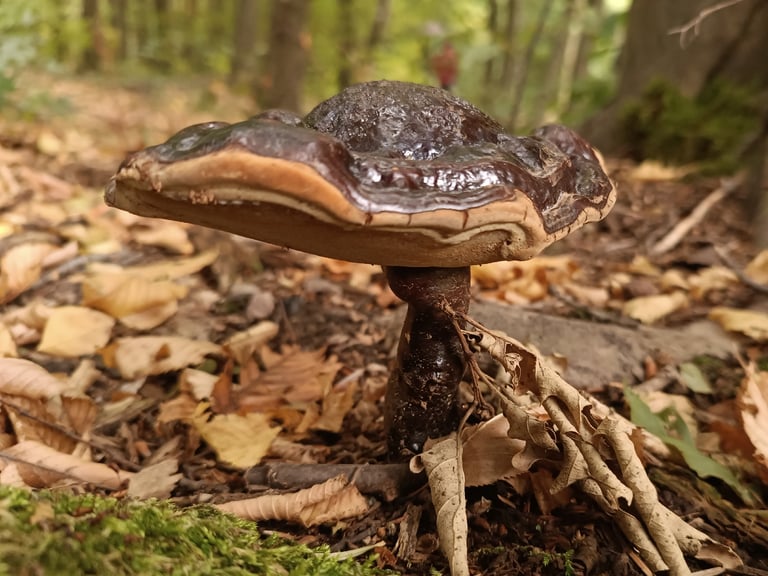
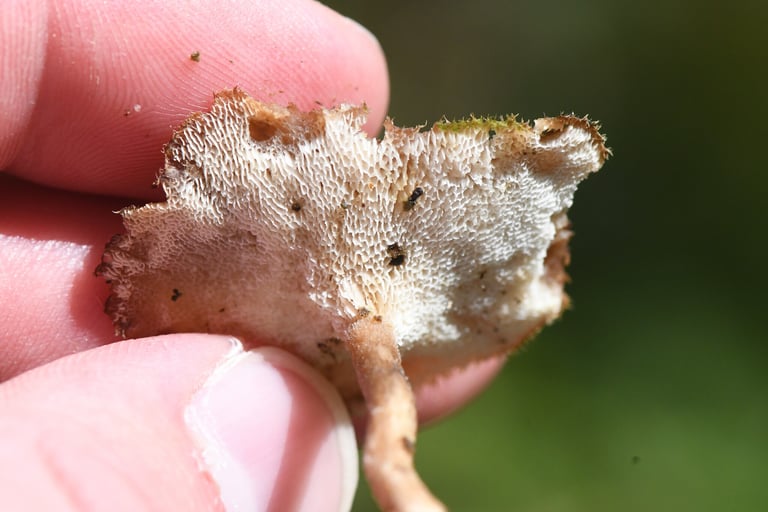
Each cap is grayish-brown, wavy-margined, and 2–10 cm (1–4 in) broad, often curled or spoon-shaped. The undersurface bears fine pores, about one to three per millimeter, with tubes rarely deeper than 3 mm (1/8 in). The stipe is cream-colored and branches repeatedly to support the many caps, and the spore print is white. The mushrooms toughen noticeably as they mature, which is why cooks favor young caps.
Grifola frondosa is distinctive enough that confusion is uncommon, but a few edible look-alikes exist. Meripilus sumstinei, the black-staining polypore, tastes similar but has a rubbery texture and stains black when bruised. Sparassis spathulata and Laetiporus sulphureus (chicken of the woods) are other clustering bracket fungi sometimes mistaken for it, while Polyporus umbellatus can be told apart by its distinct, rounded individual caps.
Distribution and Habitat
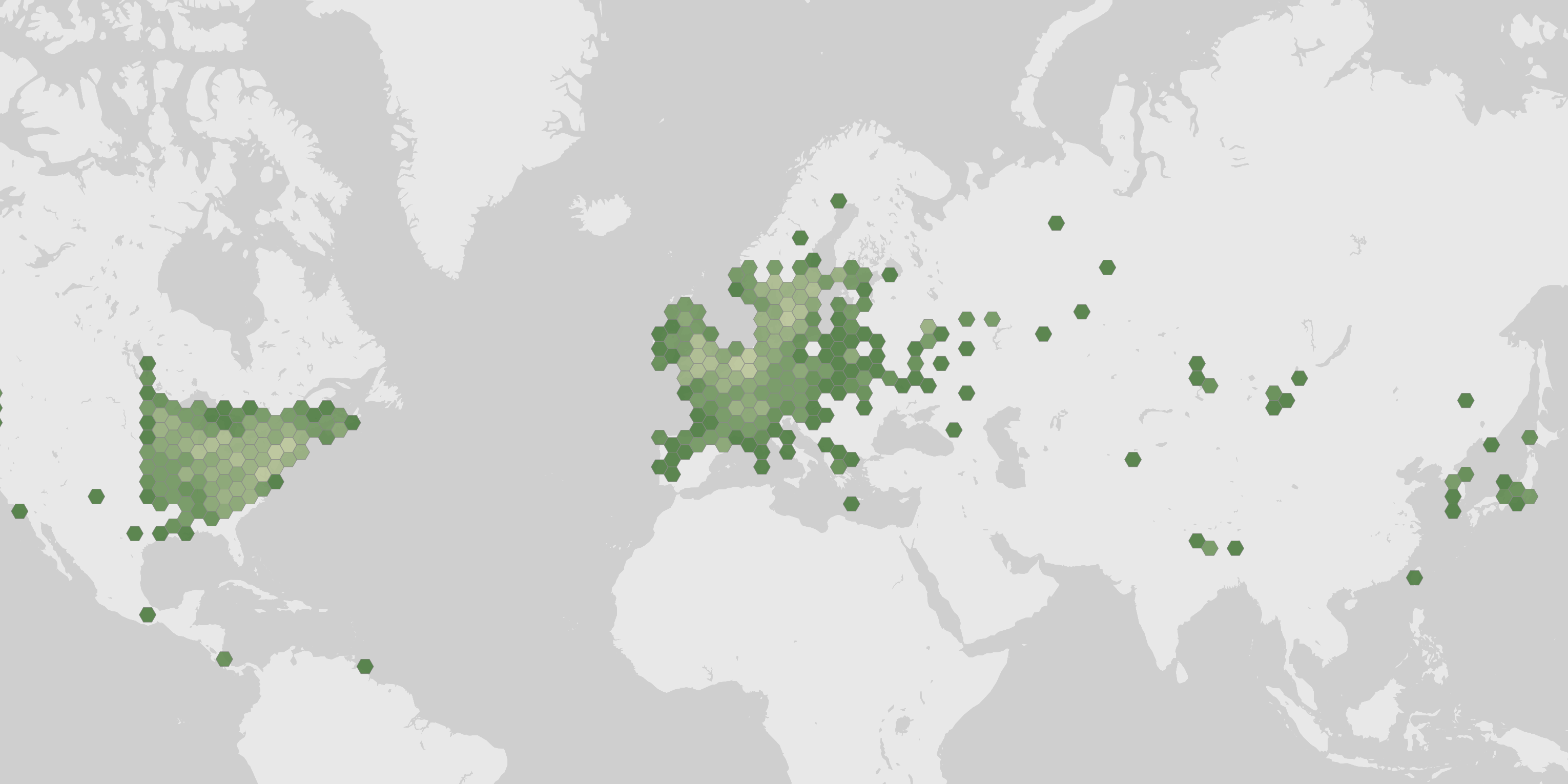
Grifola frondosa is native to China, Europe, and eastern North America, where it fruits most prolifically; it has also been recorded as far west as Idaho. It grows at the base of living trees, particularly old-growth oaks and maples, and behaves as a perennial fungus, often reappearing at the same spot for several years in a row.
Fruiting is seasonal: in Europe it appears from August to October, and in eastern North America from September to October. Observation records show a sharp rise in sightings from August through November, peaking in September, which lines up with its known autumn fruiting season, though these presence records only show where the fungus has been observed, not how abundant it is or its complete native range.
Uses and Cultural History
Grifola frondosa is regarded as a choice edible, particularly the young, softer caps, which are typically slow cooked and must be thoroughly cooked before eating; it can also be pickled. Some people may be allergic to it. It has been consumed for centuries in China and Japan, where it ranks among the major culinary mushrooms and appears in dishes such as nabemono. North American foragers call it hen-of-the-woods or sheep's head, while Italian Americans know it as signorina.
Beyond the kitchen, maitake carries a long cultural reputation for healing properties, and legend describes finders dancing with joy upon discovering it, a story reflected in its Japanese name. In traditional Chinese medicine it is valued highly, with polysaccharides identified as its main active compounds.
This medicinal reputation has drawn sustained scientific interest: a 2009 study found that a sulfated polysaccharide extracted from the species could act as an immunomodulator in breast cancer survivors with no apparent maximum dose, though the researchers noted the botanical source itself may not produce optimal clinical effects. As of 2019, no completed, high-quality Phase III clinical trials on the species existed despite years of laboratory and preliminary clinical research.
Fun Facts
- Its Japanese name, maitake, means "dancing mushroom," from a legend that finders danced with joy at discovering something so rare and prized.
- It grows from an underground sclerotium about the size of a potato, from which its branching clusters of caps emerge.
- While typical clusters reach up to 50 cm (20 in) across, some have grown to 150 cm (60 in), and specimens in Japan have weighed over 45 kilograms (100 pounds).
- It goes by many regional names: hen-of-the-woods, sheep's head, and ram's head in North America, and signorina among Italian Americans.
- As a perennial fungus, it often fruits from the exact same spot at a tree's base for several years running.
Ecology
Habitat
- Forest
- Woodland