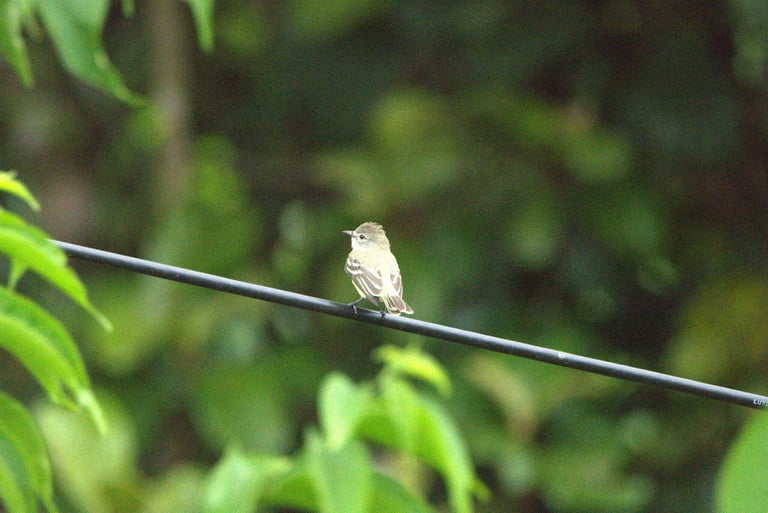
Hammond's Flycatcher is more often heard than seen, spending much of its time high in the canopy of coniferous forests where its distinctive three-part song gives away its presence long before it comes into view.
This small insectivorous bird, a member of the tyrant flycatcher family Tyrannidae, breeds in the coniferous and mixed forests of western North America and carries an IUCN status of Least Concern. Its subtle plumage and near-identical relatives make it one of the trickier Empidonax flycatchers to pin down by sight alone, which is exactly what makes learning its voice so rewarding.
Identification and Appearance
The single most reliable way to identify Hammond's Flycatcher is by its call, since its plumage overlaps heavily with several close relatives. Adults measure 12 to 14 centimeters long, span about 22 centimeters across the wings, and weigh only 8 to 12 grams.
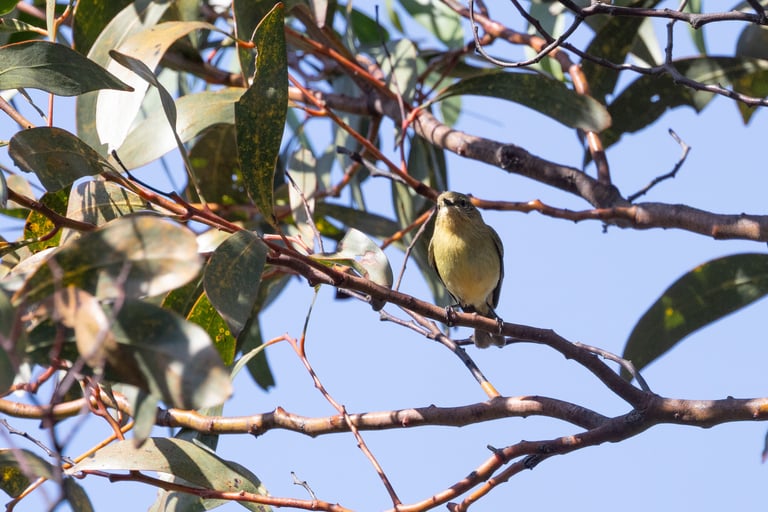
The upperparts are grayish-olive, darker on the wings and tail, contrasting with whitish underparts. A conspicuous white eye ring, white wing bars, a small bill and a short tail round out the field marks. The breast carries a gray wash while the sides of the belly show a yellow tint.
Females typically have a shorter, wider bill than males. Immature birds resemble adults but show broader, buffier wing bars.
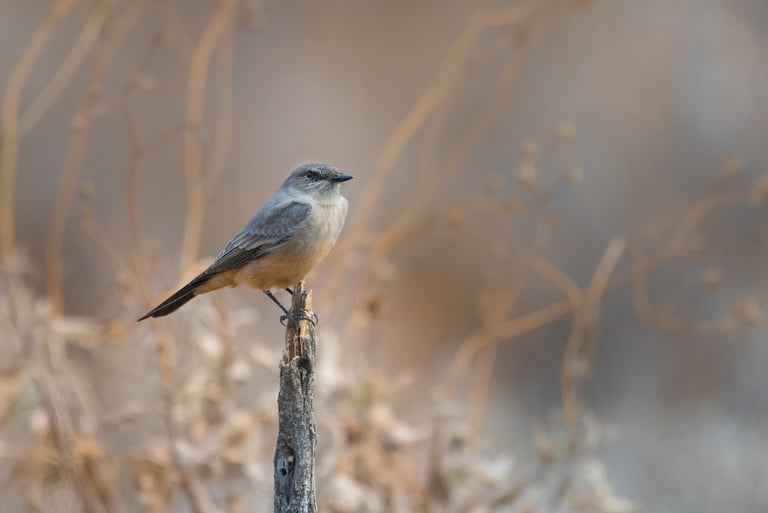
Hammond's Flycatcher is most easily confused with the Dusky Flycatcher and the Gray Flycatcher, both similar in size and color with overlapping ranges. Call, breeding habitat, and range remain the surest ways to separate the three.
Distribution and Habitat
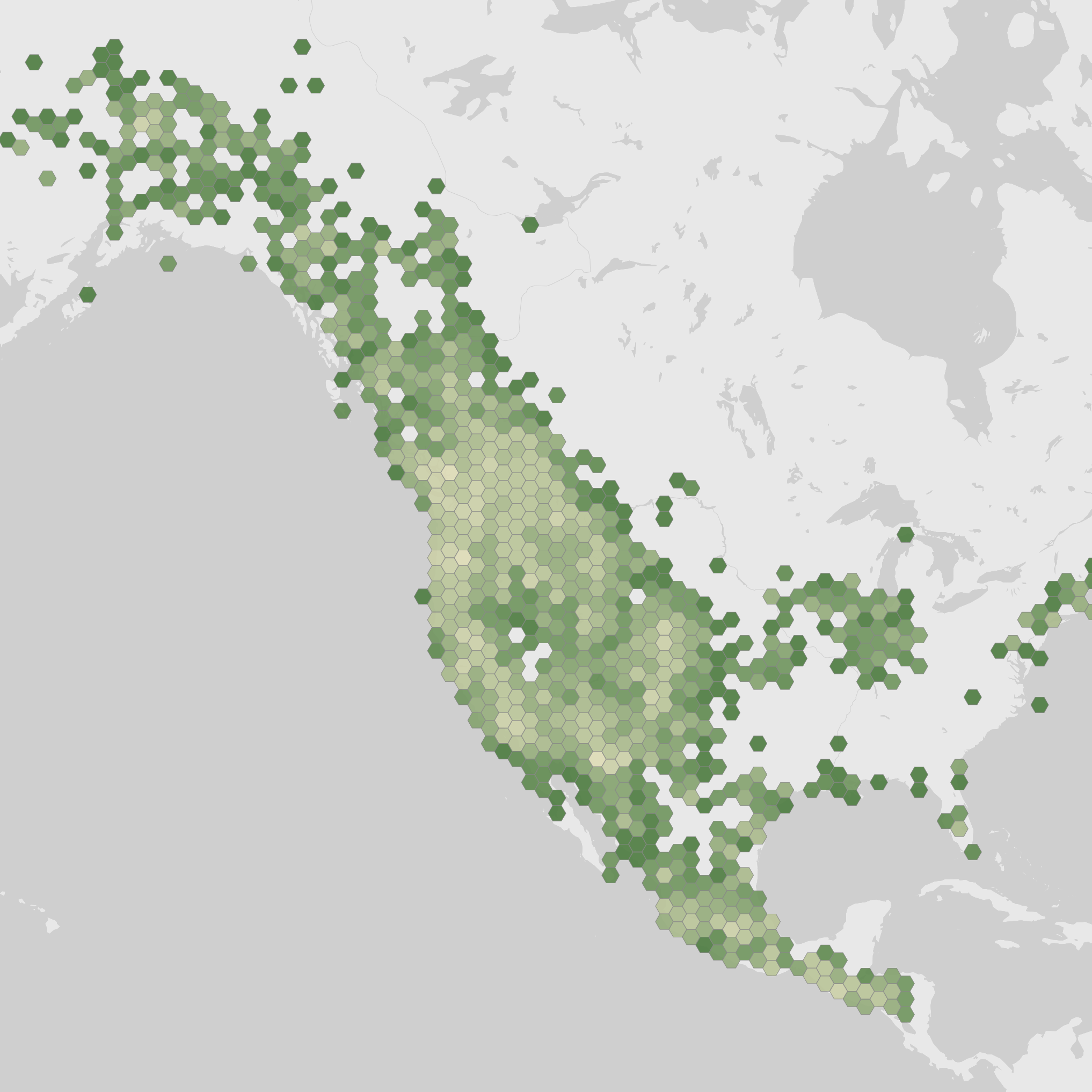
Hammond's Flycatcher breeds across a broad swath of western North America, with a breeding range covering about 2,760,000 square kilometers. It nests in states including Montana, Wyoming, California, Oregon, Nevada, Utah, Arizona, New Mexico and Colorado, and in Canada across British Columbia, Yukon and Alberta, with some birds reaching as far north as Alaska. Much of this breeding range lies in regions shaped by past glaciation.
The species favors mature coniferous and mixed forests, especially dense fir stands, conifer-aspen mixes and dogwood understory. Large stands with a dense canopy paired with an open understory appear vital to the species, giving it room to maneuver while foraging beneath the cover of tall trees.
Hammond's Flycatcher is fully migratory, wintering in Mexico and Central America in habitat similar to its breeding grounds. Observation patterns through the year show a pronounced rise in spring and early summer, consistent with birds arriving on and occupying their breeding grounds, before numbers fall off again heading into fall and winter.
Behavior and Lifestyle
Hammond's Flycatcher is an active, tree-dwelling forager that tends to stay high in the canopy, a habit that sets it apart from lower-foraging relatives like the Dusky Flycatcher. Because of this preference for elevated perches, the species is detected far more often by ear than by eye.
It is a migratory bird, moving between its western North American breeding grounds and wintering areas in Mexico and Central America each year.
Males compete aggressively at the start of the breeding season, sometimes locking together in midair and fluttering to the ground while fighting for territory or mates. This physical combat highlights how seriously males defend breeding space once they arrive back on territory.
The bird perceives its surroundings through visual, tactile, acoustic and chemical channels, but its acoustic behavior is what defines it most clearly in the field.
Communication
Male and female Hammond's Flycatchers use different call notes, with males giving a sharp "pip" and females a "peek." The song itself is a hoarse, multi-versed sequence often rendered as "see-wit...bzurrp...bzeep" or "ssilit, greeep, silit, pweet," built from three rough phrases sharing a similar pattern and vowel sounds.
Singing begins in early May shortly after arrival on breeding grounds and stops during fall migration and on the wintering grounds. Song frequency tends to run higher early in the mating season and drops as summer progresses; unpaired males sing more often and at a higher pitch than males that have already found a mate.
Bill-snapping and mandible-clicking serve as threat displays, a behavior shared with other Empidonax flycatchers.
Hunting and Diet
Hammond's Flycatcher hunts by sitting and waiting on a perch, then darting out to snatch a flying insect before returning to the same spot to wait for the next one. It favors the center portions of tall conifers and aspens for this sit-and-wait style of hunting.
Its diet consists mainly of insects, including ants and a range of flying insects such as beetles, moths and flies. The bird's beak opens and snaps shut quickly during the capture, a rapid strike suited to catching prey on the wing.
This foraging strategy keeps the bird tied closely to tall, dense-canopied forest, since it depends on elevated perches with good sightlines to spot passing insects.
Nesting and Breeding
Courtship and territory establishment begin with intense competition among males, who physically fight at the start of the breeding season, locking together in midair and tumbling to the ground. The birds are believed to be monogamous, with no evidence of extra-pair mating.
Nesting occurs from early June through late July, with females building a cup-shaped nest of bark, plant fibers, pine needles and twigs on a fork in a tree, typically 6 to 60 feet above the ground. Preferred nest trees include Douglas fir, ponderosa pine, western larch, tanoak, white fir, grand fir, aspen, birch and maple, often in old-growth stands at least 80 to 90 years old, with the nest positioned on the northeast or southwest side of the tree for cover.
Females lay three or four whitish or creamy eggs, sometimes marked with small reddish-brown dots, and incubate them alone for about 12 to 15 days. Once hatched, the altricial young are fed by both parents and leave the nest 17 to 18 days after hatching.
Conservation and Threats
Hammond's Flycatcher is listed as Least Concern by the IUCN and remains commonly found across the Pacific Northwest. Its persistence depends on cool, shady forests for nesting, roosting and foraging, making forest condition the central factor in its long-term outlook.
Interestingly, timber harvest and fire can sometimes benefit the species when they open up the forest understory while leaving the canopy intact, since the resulting open flight space aids its foraging style. This nuance means forest disturbance is not automatically a threat and may, in some circumstances, improve habitat quality.
Cultural Significance
Hammond's Flycatcher carries ecological rather than folkloric significance to people, valued chiefly for its role as a forest insectivore that may help control populations of forest insects. This practical, ecosystem-service role stands in for any documented mythology or artistic symbolism attached to the species.
Fun Facts
- The bird's name honors William Alexander Hammond, surgeon general of the US Army, reflecting a 19th-century tradition of naming species after patrons and collectors rather than folk tales.
- It was first described scientifically in 1858 by Xántus de Vesey.
- The species tends to perch higher in trees than other Empidonax flycatchers, such as the Dusky Flycatcher, which contributes to how rarely it is spotted despite being fairly common.
Photos
Photographs from via iNaturalist, licensed under CC0 1.0., by Daniel S. Katz via iNaturalist, licensed under CC BY 4.0., by Rosario Douglas via iNaturalist, licensed under CC BY 4.0., by Kevin Krebs via iNaturalist, licensed under CC BY 4.0., by Tristan Jobin via iNaturalist, licensed under CC BY 4.0., by Zack Abbey via iNaturalist, licensed under CC BY 4.0., by Simone Littledale via iNaturalist, licensed under CC BY 4.0., by Liam Steele via iNaturalist, licensed under CC BY 4.0., by Alfonso Xavier Rolon Perez via iNaturalist, licensed under CC BY 4.0., and by William Harmon via iNaturalist, licensed under CC BY 4.0., credited on each photo.
Ecology and classification
Classification
- Phylum
- Chordata
- Class
- Aves
- Order
- Passeriformes
- Family
- Tyrannidae
- Genus
- Empidonax
- Species
- Empidonax hammondii
Sources
- GBIF Species names and classification
- iNaturalist Photos
- Wikidata Common names and conservation status
- Wikipedia Summary extract
- Encyclopedia of Life Habitat, diet and behavior traits
- Animal Diversity Web Animal habitat, behavior and diet
- AnAge Longevity
- AVONET Bird mass, habitat, migration, diet and range size