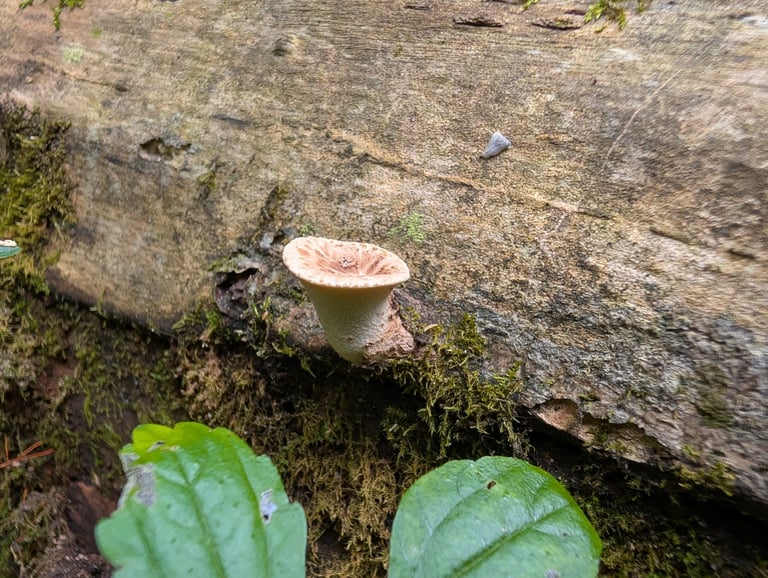
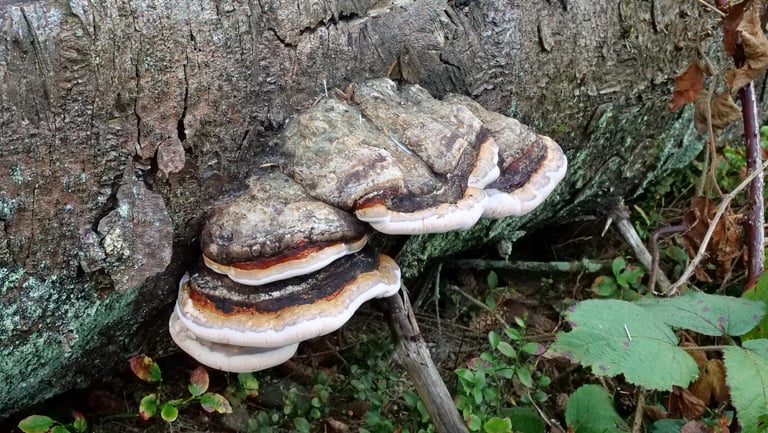
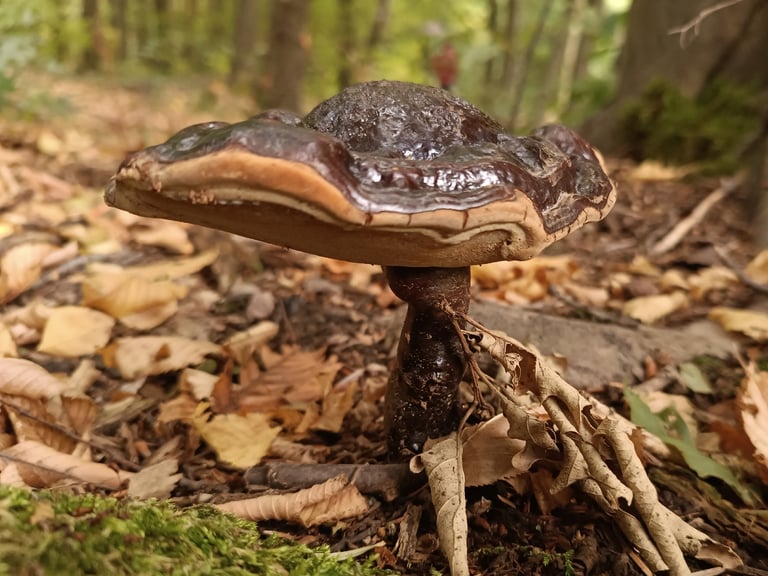
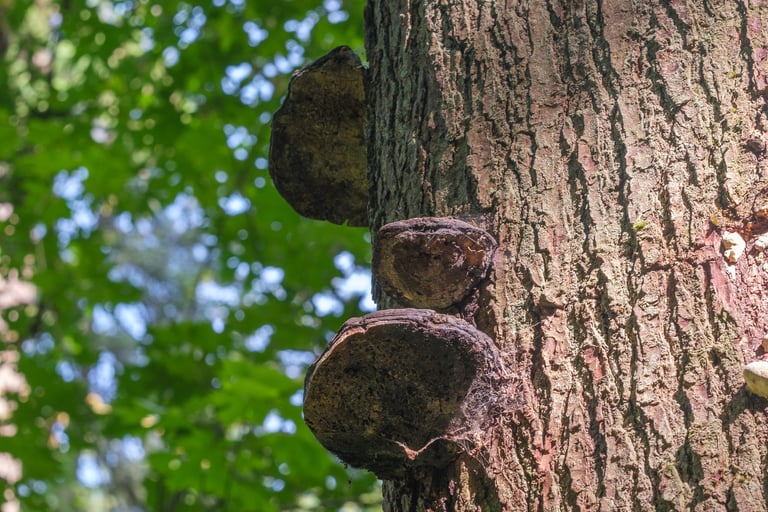
The fruit bodies of Hapalopilus rutilans start out soft and spongy, then turn hard and brittle once they lose their moisture. This polypore is a saprobe in the family Phanerochaetaceae, and it grows as a bracket on dead wood rather than on living trees.
The species was formally described in 1821 and moved into its current genus Hapalopilus six decades later. It goes by several common names, including tender nesting polypore, purple dye polypore, and cinnamon bracket.
The fungus is worth knowing for two reasons. Its fruit bodies are toxic, and it is prized by people who make mushroom dyes.
Fruiting Body and Identification
The cap is fan-shaped to semicircular and convex, reaching 2.5–12 cm (1.0–4.7 in) across. It has no stalk and attaches broadly to the wood. The cap surface is covered with matted hairs, marked by shallow concentric furrows, and dull brownish-orange in color.
The flesh is pale cinnamon and up to 3 cm (1.2 in) thick at its thickest point. The pore surface is yellowish to brownish, with angular pores numbering about 2–4 per millimeter. In young fruit bodies, the pore surface bruises reddish brown. The odor and taste range from sweetish to indistinct.
The spore print is white. The spores are elliptical to cylindrical, smooth, and translucent, measuring 3.5–5 by 2–3 μm. A dilute potassium hydroxide solution turns every part of the fruit body bright violet almost instantly, which is a useful check for identification.
Distribution and Habitat
Hapalopilus rutilans grows on the wood of dead and decaying deciduous trees. Its fruit bodies appear singly, in groups, or in fused, overlapping clusters. Oak, beech, and birch are its preferred hosts, although it occasionally grows on conifer wood. In central Europe oak is its usual host, while in northern Europe it is found most often on hazel and rowan.
Fruiting usually runs from early summer to autumn. The tough fruit bodies persist on the wood, so they can be found outside the normal growing season as well.
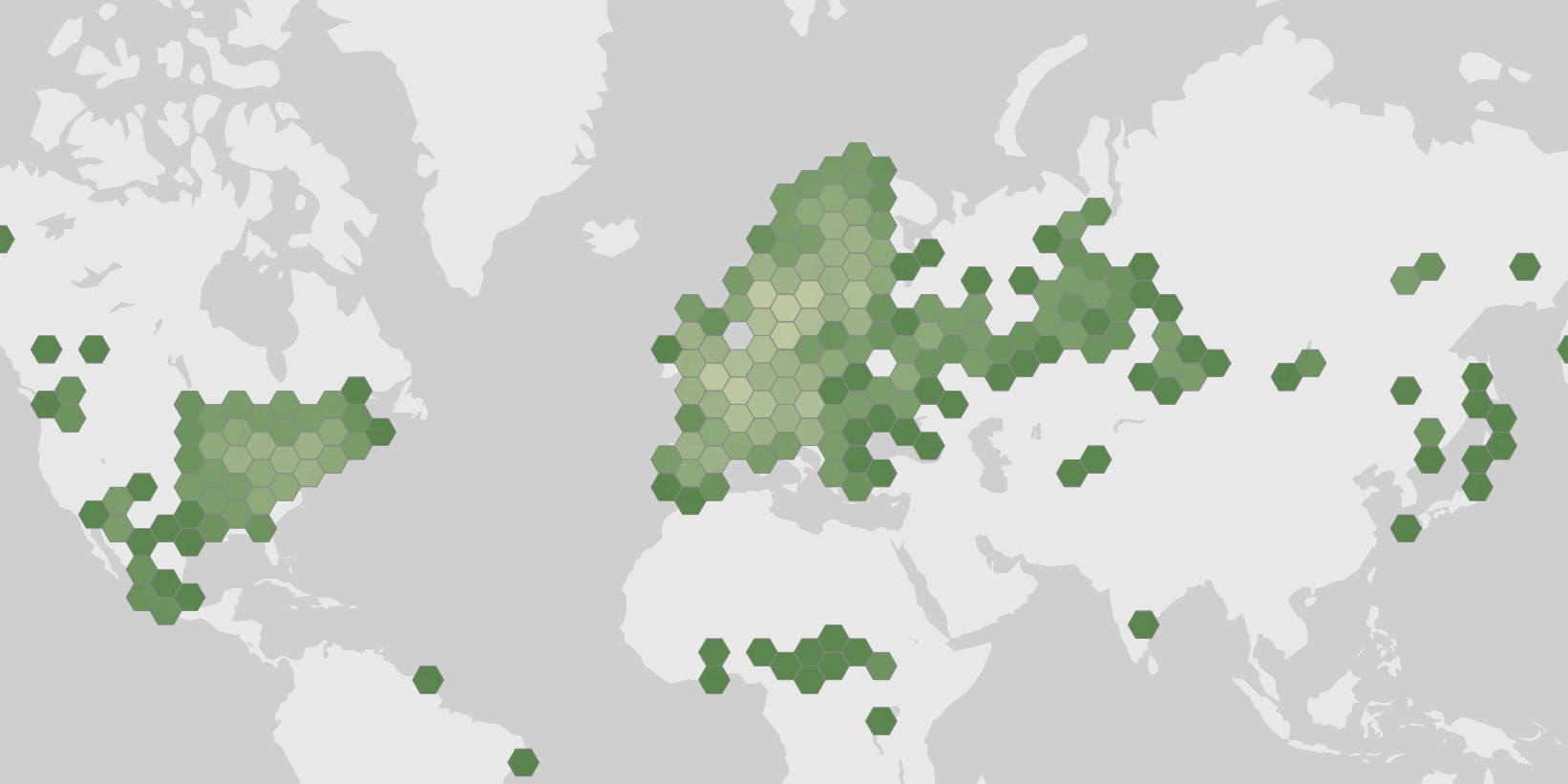
The species has a mostly circumboreal distribution across the north temperate zone. It occurs in North Africa, Asia, Europe, and North America, and it is also found in Australia and Oceania. In North America it reaches the Northwest Territories in Canada, and it is more common in the eastern and southwestern parts of the continent. In Europe its northern limit is Porsanger in Norway.
In 2011 it was first found in India, in forest depots in Chhattisgarh. There it grew on stored logs of several native trees, including Anogeissus latifolia, Chloroxylon swietenia, Desmodium oojeinense, Shorea robusta, and Terminalia elliptica. Several fungus beetles, including Sulcacis affinis, Hallomenus axillaris, H. binotatus, and Orchesia fasciata, live in its fruit bodies and rear their young there.
Uses and Cultural History
The fungus has a place in mushroom dyeing. Dyers value it because, combined with alkaline fixatives, its fruit bodies produce striking violet colors.
Despite its appeal to dyers, the fungus is not safe to eat. Its fruit bodies are neurotoxic, and the toxin is polyporic acid, a terphenyl compound first identified from a mycelial culture of the fungus in 1877. The compound makes up 20–40% of the dry weight of the fruit bodies and inhibits the enzyme dihydroorotate dehydrogenase. Other mushrooms contain it too, but in much smaller amounts.
In a 1992 poisoning in Germany, a family of three ate the fungus. Symptoms began about 12 hours later and included nausea, impaired movement, visual impairment, and liver and kidney failure. All three victims' urine turned violet for a time, and they recovered fully a week later. A 2013 case with similar symptoms and recovery involved a mushroom mistaken for the edible Fistulina hepatica. Doctors call the set of symptoms the neurotoxic delayed syndrome.
Photos
Photographs from via iNaturalist, licensed under CC0 1.0., by Paolo Zucca via iNaturalist, licensed under CC BY 4.0., by Dmitry Ivanov via iNaturalist, licensed under CC BY 4.0., by Arthur BADEL via iNaturalist, licensed under CC BY 4.0., by Sami Törnblom via iNaturalist, licensed under CC BY 4.0., by Manuela Fiorini via iNaturalist, licensed under CC BY 4.0., by rajesh rocky via iNaturalist, licensed under CC BY 4.0., by Andreas Schneider via iNaturalist, licensed under CC BY 4.0., by Petr Harant via iNaturalist, licensed under CC BY 4.0., by Matthew Sawyer via iNaturalist, licensed under CC BY 4.0., by Heather Alice-Grace Orchard via iNaturalist, licensed under CC BY 4.0., by Mike Dechter via iNaturalist, licensed under CC BY 4.0., by Luca Gagliano via iNaturalist, licensed under CC BY 4.0., and by Atsushi Nakajima via iNaturalist, licensed under CC BY 4.0., credited on each photo.
Ecology and classification
Habitat
Classification
- Phylum
- Basidiomycota
- Class
- Agaricomycetes
- Order
- Polyporales
- Family
- Phanerochaetaceae
- Genus
- Hapalopilus
- Species
- Hapalopilus rutilans
Sources
- GBIF Species names and classification
- iNaturalist Photos
- Wikidata Common names and conservation status
- Wikipedia Summary extract