The harlequin ladybird is one of the most variable lady beetles in the world, with an exceptionally wide range of colour forms. It is native to eastern Asia, but people introduced it to North America and Europe to control aphids and scale insects.
It goes by several names, including the harlequin, Asian and multicoloured Asian lady beetle. The species is now common and well known in those regions, and it has also established in Africa and widely across South America.
Its spread makes it one of the most closely watched insects in invasion biology. Its effects on native ladybirds are the main reason it is studied.
Identification and Appearance
The large size of this beetle is usually the first clue to its identity. Adults measure 5.5 to 8.5 mm (0.22 to 0.33 in) long, which makes them much bigger than most lookalikes.
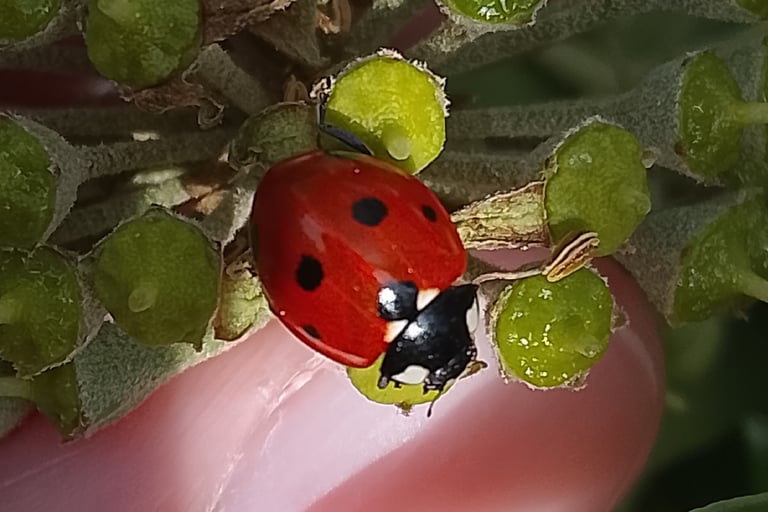
The common colour form is orange or red with 0 to 22 black spots of variable size. Other usual forms are uniformly black, with either two red markings or four red markings. The white pronotum, the shield behind the head, carries black patterning that ranges from a few spots in an M-shaped pattern to almost entirely black.
The underside is dark with a broad reddish-brown border. Legs are always reddish-brown, and the underside of the abdomen is obviously brown, even in the darkest forms. Extreme forms can be entirely black or show complex patterns of black, orange and red.
In Europe it looks similar to the much smaller Adalia decempunctata. In America it can be confused with the smaller Mulsantina picta and spotless forms of Adalia bipunctata. When identification is hard, the underside pattern usually settles the question.
Eggs are yellow when young and turn black about a day before they hatch. Each egg is about 1.2 mm (1/20 in) long.
Distribution and Habitat
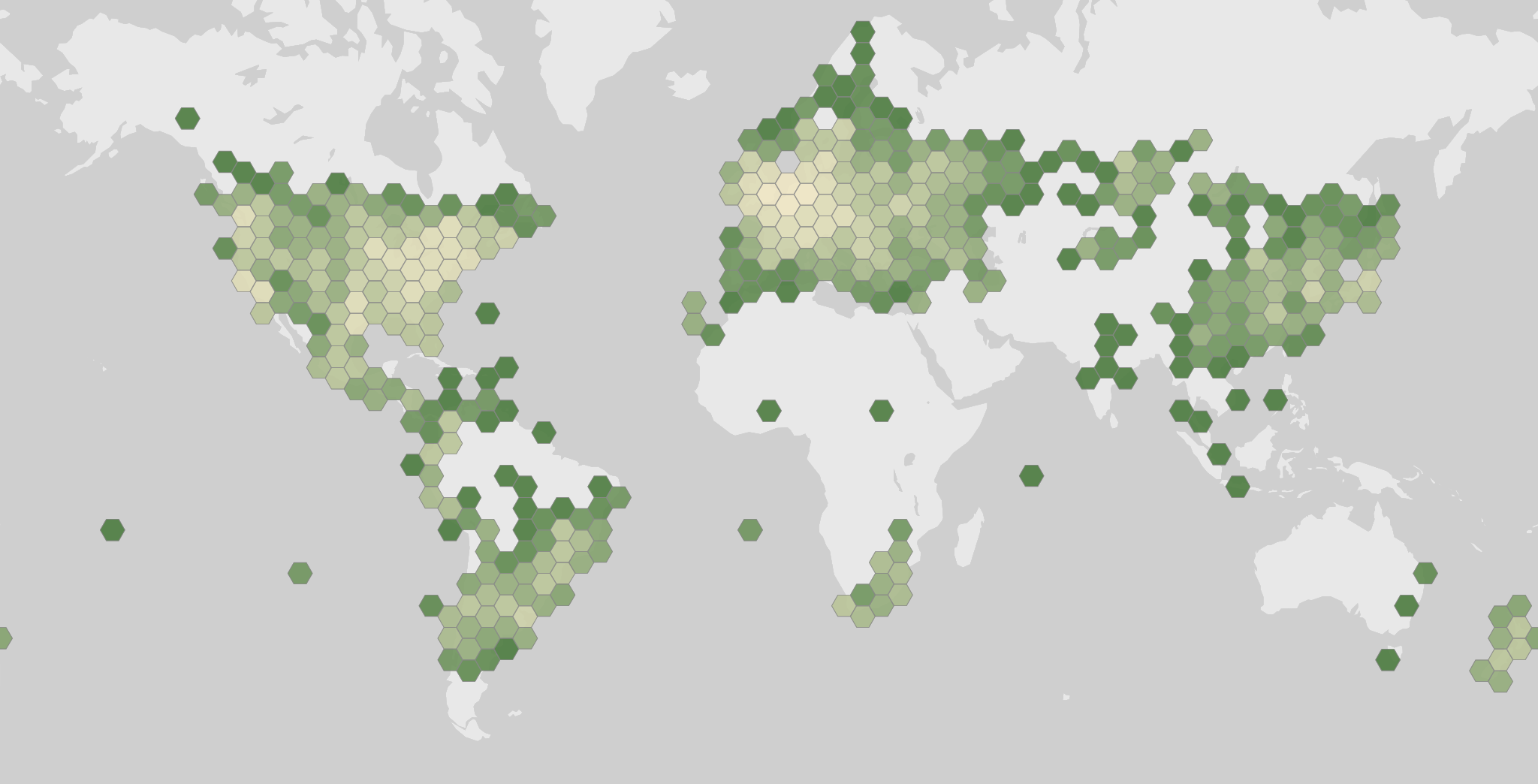
Harmonia axyridis is native to eastern Asia, from central Siberia, Kazakhstan and Uzbekistan in the west to the Pacific coast in the east. Its native range includes Japan, Korea, Mongolia, China and Taiwan, and extends south to the Himalayas.
People spread it across continents. Introductions into greenhouses, crop fields and gardens followed its identification as a biocontrol agent for aphids and scale insects. It is now established in North America, Central America, South America, Europe, Israel, New Zealand and South Africa.
The first introductions into the United States took place as early as 1916. A wild population was observed near New Orleans, Louisiana, around 1988. Within the following years it spread through the southern and midwestern states, becoming common in the Midwest by about 2000. It reached the Northwest by 1991 and the Northeast by 1994, aided by further introductions from its native range.
It lives on many crops in agricultural areas, on deciduous trees, on flowering plants and in open fields, meadows and suburban areas. It uses savanna, grassland, forest and scrub forest habitats in temperate regions.
Behavior and Lifestyle
Harmonia axyridis is mainly active during the day. It flies from plant to plant as it searches for the aphids and other prey that live on plants. It is a solitary species, although it gathers in large numbers to overwinter.
It does not defend a territory and moves freely through its habitat. It has good eyesight and will return to a site from which it has been removed.
In autumn, it gathers in large aggregations. These gatherings use pheromones, but visual cues are more important. Beetles pick out light-coloured structures that stand out from their surroundings, and they join earlier aggregations. Hydrocarbons left by previous aggregations also guide site selection.
The beetles become dormant in cooler months but move whenever the temperature reaches about 10 °C (50 °F). They overwinter in crevices and other cool, dry, enclosed spaces. If there is a large enough opening, significant numbers can gather inside walls, and some wake in sunlit spots on cold winter days because of solar heating. Large numbers can swarm and linger for a long time.
Communication
Harmonia axyridis relies on vision and chemical signals. Its pheromones are used for mating and for finding other individuals to gather with for winter hibernation.
The beetle's defensive compound, harmonine, is one identified signal. It is produced when the beetle is attacked and released by reflex bleeding from the tarsal joints of its legs.
Prey are usually found by sight or by smell, and the beetles also use visual cues when choosing aggregation sites.
Hunting and Diet
Harmonia axyridis is a mobile predator. It moves across plants searching for prey, and it finds aphids and scale insects by sight or smell. Its chewing mandibles let it feed on these hemipteran insects, which are its main food.
Its prey also includes Thysanura species, mites, and the eggs of butterflies and moths. When other food is scarce, it eats other lady beetles, including its own species. Adults and larvae both eat the eggs and smaller larvae of their own kind.
It will also eat grapes and similar fruits, along with pollen. Fruit feeding is unusual for lady beetles and may help the beetles gain resources before overwintering. Its wide diet has helped it succeed as an invasive species and as a pest of crops.
Reproduction and Life Cycle
Mating is sexual, and fertilization is internal. Females produce pheromones to attract males, and at close range they may use sight. Many females prefer males with particular elytra colours, and certain colour forms are better at evading predators. Each female mates with many males over her life, and males do not show any clear mechanism to protect their paternity.
Breeding starts when temperatures rise above about 12 °C (50 °F). Lower temperatures lengthen the time before mating and before egg laying. Adults breed continuously throughout their adult life.
Females lay eggs in clusters of 20 to 30 and average about 25 eggs per day. A female may produce between 1,642 and 3,819 eggs in a season. Some eggs are unfertilized, and larvae use these as food when aphids and scale insects are scarce.
Parental investment is minimal. Females provision their eggs with nutrients, and the young are independent after hatching.
Population and Ecological Role
Harmonia axyridis is a predator of aphids, scale insects and other pests, which helps limit crop damage in the regions where it was introduced. It also competes with native ladybirds, reducing their numbers in many invaded areas.
The species is a host for several parasites and parasitoids, including the fly Strongygaster triangulifer and the wasp Dinocampus coccinellae. Mites of the genus Coccipolipus, Microsporidia, nematodes and fungi such as Beauveria bassiana also use it as a host.
Spiders, true bugs, birds and other lady beetles prey on the species. Birds that eat it include passerines and gamebirds.
Conservation and Threats
The IUCN Red List has not evaluated Harmonia axyridis, and it has no special status under the US federal list, CITES or the State of Michigan list.
Its main threat is not to its own survival but to native ladybirds. The species outcompetes them, eats their eggs and poisons them with its chemical harmonine. Native ladybird species have experienced often dramatic declines in areas invaded by the harlequin. In Europe it is still increasing at the expense of native species, partly because of its large range and longer breeding period.
Cultural Significance
Harmonia axyridis is used as a biological control agent for many agricultural crops, because its main prey are major agricultural pests. People introduced it worldwide for this reason, based on its strong predatory nature. Its positive impact is that it controls pest populations.
Photos
Photographs from via iNaturalist, licensed under CC0 1.0., by Liem Malarney via iNaturalist, licensed under CC BY 4.0., by Ross McCallum via iNaturalist, licensed under CC BY 4.0., by Joe crutwell via iNaturalist, licensed under CC BY 4.0., by Caleb Catto via iNaturalist, licensed under CC BY 4.0., by Natasha Haggard via iNaturalist, licensed under CC BY 4.0., and by gpete via iNaturalist, licensed under CC BY 4.0., credited on each photo.
Ecology and classification
Classification
- Phylum
- Arthropoda
- Class
- Insecta
- Order
- Coleoptera
- Family
- Coccinellidae
- Genus
- Harmonia
- Species
- Harmonia axyridis
Sources
- GBIF Species names and classification
- iNaturalist Photos
- Wikidata Common names and conservation status
- Wikipedia Summary extract
- Encyclopedia of Life Habitat, diet and behavior traits
- Animal Diversity Web Animal habitat, behavior and diet
- GloBI What it eats, what eats it, parasites and pollinators
- trophiCH
- Wardeh et al. 2015 (EID2)
- DoPI