Its many names tell a story: called the Roman snail, the Burgundy snail, or simply escargot, Helix pomatia has been linked to human tables since antiquity. Formally described by Linnaeus in 1758, it is a large, air-breathing land snail in the family Helicidae, native to Europe and instantly recognizable by its globular, brown-banded shell.
Classified within the class Gastropoda and order Stylommatophora, the species carries an IUCN status of Least Concern, meaning it faces no immediate risk of extinction despite the pressures of harvesting and habitat loss across parts of its range.
Beyond its culinary fame, the Roman snail shows how a slow-moving, humble mollusc can become both an ecological presence in European woodlands and a closely regulated resource under multiple national laws.
Identification and Appearance
The most reliable field mark is the shell itself: a globular, five- to six-whorled structure ranging from creamy white to light brown, often carrying indistinct darker bands that can be faint or strikingly conspicuous depending on the individual.
Adult shells measure 30 to 50 millimeters in width and 30 to 45 millimeters in height, making Helix pomatia one of the larger land snails found in Europe. The aperture is large, and in mature individuals the apertural margin is slightly reflected outward. A narrow umbilicus sits at the shell's base, partly concealed by the reflected columellar margin.
Because Helix pomatia is a simultaneous hermaphrodite, there is no external difference between the sexes—every mature individual carries both male and female reproductive organs, so shell size and color vary with age and population rather than with sex.
Distribution and Habitat
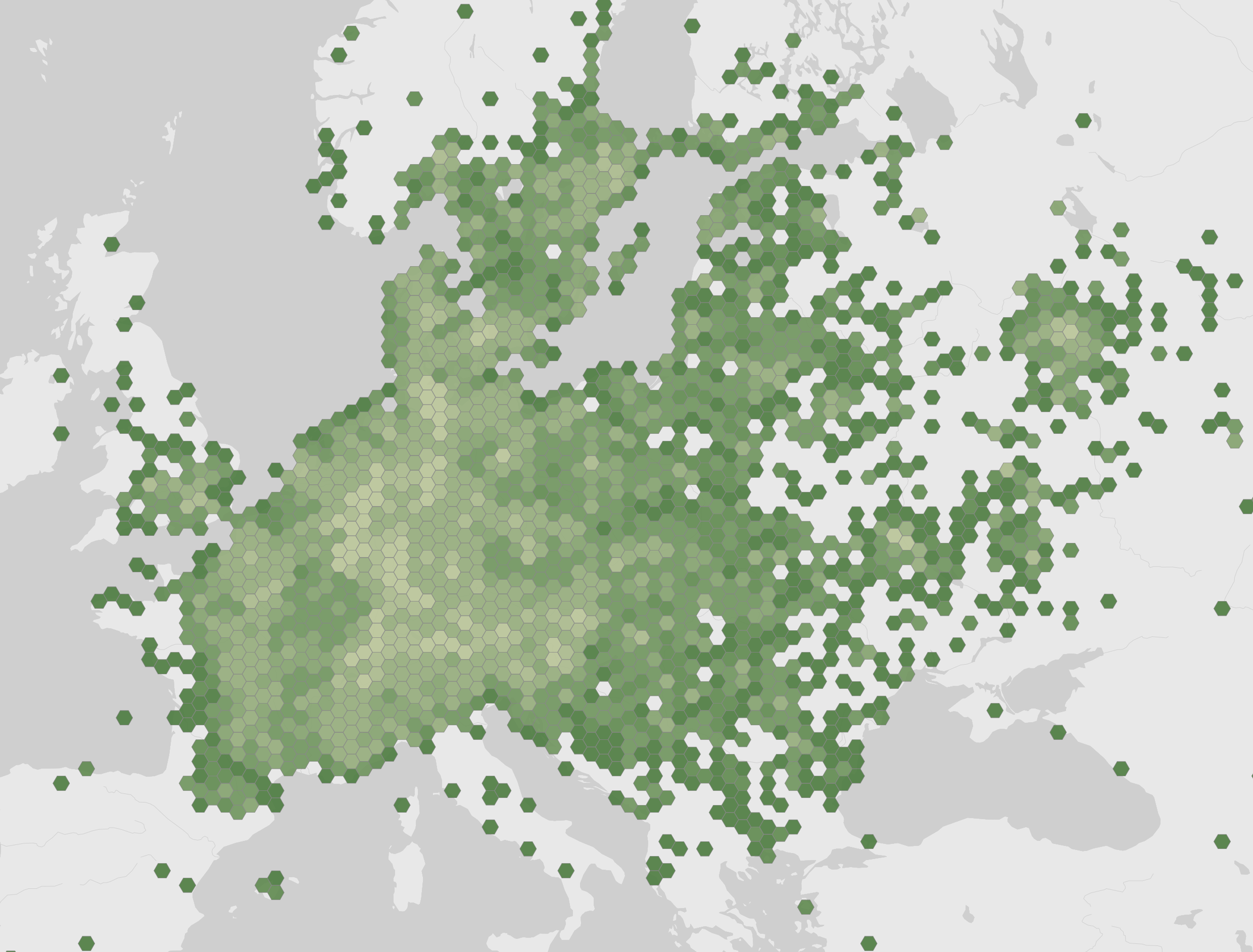
Helix pomatia is native to a broad swath of temperate Europe, with its natural range running from central Germany and southern Poland in the north, eastward through western Ukraine, Moldova, and Romania to Bulgaria, and south into northern Bulgaria, central Serbia, Bosnia and Herzegovina, Croatia, and northern Italy as far as the Po Valley and the Ligurian Apennines. To the west, the native range extends into eastern France.
Human activity has considerably expanded this footprint. Populations now persist as far east as western Russia, including a well-established presence around Moscow, and reach south of Finland, Sweden, and Norway, as well as Denmark and the Benelux countries. Introduced colonies exist in northern Spain, isolated pockets near Novosibirsk, and even in the eastern United States and Canada. In Great Britain, the species survives on chalk soils in southern and western England, restricted mainly to undisturbed grassy or bushy wasteland rather than gardens.
The snail favors low-lying chalk and limestone country but tolerates elevations up to 1,830 meters, and in the Alps it has been recorded as high as 2,100 meters, though it usually stays below 2,000 meters. Suitable habitat includes forests, shrubland, vineyards, gardens, thickets, and parks, provided conditions stay humid with fairly constant, mild temperatures; the species cannot tolerate heavy rain or direct sun exposure.
Monthly observation counts peak sharply in May, climbing from under 2,000 records in January to more than 54,000 in May before tapering through summer and dropping again by November. This pattern likely reflects seasonal surface activity rather than population size, since the snail stays underground during hibernation and is most detectable while foraging in spring and early summer.
Behavior and Lifestyle
Helix pomatia is primarily nocturnal, emerging to move and feed after sunset when cooler, moister air reduces the risk of drying out. As it travels, it lays down a slime trail that doubles as a navigational aid, letting the snail retrace its path home and return to the same food source the following night.
To limit water loss while crossing dry surfaces, the snail uses a technique sometimes called "jumping," in which only specific parts of the foot sole make contact with the ground rather than the whole surface. This selective locomotion helps conserve moisture during otherwise risky excursions.
Winter survival depends on hibernation. Before the cold sets in, the snail digs a hole, positions itself shell-mouth upward, and withdraws completely into its shell. It then seals the opening with a mucus secretion called the epiphragm, a hardened barrier that shields it from freezing temperatures until conditions improve.
The species is described as both nocturnal and crepuscular, active mainly in low light, and spends daylight hours motionless and hidden.
Communication
Specific documentation of communication in Helix pomatia is lacking. Like many land snails, it likely relies on chemical cues embedded in its mucus trails rather than sound or visual signaling, but no detailed study of dedicated signaling behavior has been reported for the species.
Diet and Nutrition
Helix pomatia feeds mainly between sunset and midnight, using its radula, a ribbon of tiny teeth, to brush and scrape food rather than bite it. This nocturnal feeding window matches its broader pattern of avoiding daytime heat and dryness.
The diet is herbivorous and varied, built around leaves, fruit, flowers, and plant sap. Because shell growth demands a steady calcium supply, the snail seeks out calcium-rich food sources alongside its regular plant fare, a need that becomes especially important during periods of active shell development.
As a folivore and frugivore, Helix pomatia grazes across a range of plant tissues rather than specializing on a single food type, which lets it exploit gardens, vineyards, and woodland vegetation alike.
Reproduction and Life Cycle
Courtship in Helix pomatia is a lengthy, ritualized process that can stretch over several hours, typically between snails from the same local population rather than distant ones. The pair begins by circling each other with heads raised, touching one another with their tentacles.
Once sufficiently stimulated, one snail fires a calcareous "love dart" into the other's foot; after resting, the second snail returns the gesture. The pair then aligns so their genital openings overlap, a step that intensifies stimulation, before twisting their bodies together to connect penis and vagina. One snail transfers a spermatophore during a four-to-seven-minute exchange, after which the penis withdraws, though the pair may remain joined at the foot for hours afterward.
As a simultaneous hermaphrodite, every mature Helix pomatia can both give and receive sperm, and mating can occur up to twice in a season, though dense populations tend to mate less, since heavier slime secretion in crowded conditions suppresses reproduction. Breeding runs from late spring into early fall, occasionally as late as October, with two to six breeding events possible per year.
After fertilization, the snail selects light, moist, deep soil and digs a hole to lay 8 to 30 eggs, spending 15 to 20 minutes per egg before covering the clutch with a mix of mucus and soil. No further parental care follows, and sexual maturity is reached only after two to four years.
Population and Ecological Role
Concrete population figures for Helix pomatia are not well documented, but its grazing habits give it a measurable role in shaping the plant communities it inhabits. By feeding on leaves, flowers, and fruit across gardens, vineyards, and woodland understories, the species can influence which plants thrive in the areas it occupies.
Beyond this grazing pressure, no specific data on overall population size or trend is available for the species.
Conservation and Threats
The IUCN Red List classifies Helix pomatia as Least Concern, and within its native range it remains a mostly common species. That status, however, does not mean it is free of pressure: continuous habitat destruction and land drainage are the primary threats, while commercial collection for the food trade plays a smaller but still notable role.
In Great Britain, repeated attempts to establish the species across Scotland and Ireland have failed, and it now survives only in natural habitats in southern England, where intensive farming and habitat destruction continue to squeeze its range. Populations in Switzerland and Austria face lower concern overall, though several regions still restrict commercial collecting.
Legal protection varies by country. The species is listed in Annex V of the European Union's Habitats Directive, and Germany specially protects it under the Bundesartenschutzverordnung. Austria's protection depends on individual Bundesländer, such as Burgenland. In England, the Wildlife and Countryside Act 1981 makes it illegal to kill, injure, collect, or sell the species. France permits collection only of individuals with a shell diameter over 3 centimeters and bans harvesting between April 1 and June 30, while Denmark prohibits commercial collecting outright.
Conservation status
- LC
- NT
- VU
- EN
- CR
Least Concern
Cultural Significance
Helix pomatia has fed people since antiquity: Ancient Romans ate the snail long before it became a fixture of French cuisine, where it is now known simply by its French name, escargot. Despite its reputation as the most prized species among edible land snails, it remains difficult to cultivate and is rarely farmed commercially, so much of what reaches the table still comes from wild-collected animals.
The species also has a quieter place in laboratory science: its intestinal juice contains high levels of aryl, steroid, and glucosinolate sulfatase enzymes with broad specificity, making it a useful hydrolyzing agent in analytical techniques such as chromatography.
Fun Facts
- Its common name "escargot" is simply the French word for snail, and Helix pomatia is considered the most prized species among edible land snails.
- Ancient Romans were eating this species long before it became a staple of French cuisine.
- The snail's intestinal juice contains powerful sulfatase enzymes used by scientists as hydrolyzing agents in chromatography.
- Despite being highly sought after as food, it is notoriously difficult to farm commercially, so wild collection still supplies much of the trade.
- In France, only snails with a shell wider than 3 centimeters may be collected, and harvesting is banned each year between April 1 and June 30.
- Before winter, the snail seals itself inside its own shell with a hardened mucus plug called an epiphragm to survive the cold.
Ecology
Behavior
- Nocturnal
- Hibernating
- Crepuscular
- Arboreal
Habitat
- Forest
- Shrubland
- Mountain
- Urban
Diet
- Herbivore