The Spanish slug is defined less by how it looks than by how far it has traveled: a species whose true homeland is still uncertain has, within about seventy years, colonized nearly all of Western, Central, Southern, Northern and Eastern Europe, with outlying populations now established in Canada and Mexico. Despite this explosive spread, the IUCN assesses Arion vulgaris as Least Concern.
It belongs to the roundback slug family Arionidae, within the order Stylommatophora and phylum Mollusca — an air-breathing, shell-less land mollusk. It turns up in gardens, farmland, forest edges, and the margins of rivers and lakes across its expanding range.
What makes it worth a closer look is its near-invisibility: it is almost impossible to distinguish from a close relative without dissecting its reproductive organs, yet it has become one of the most economically damaging slug pests in Europe.
Identification and Appearance
The single most reliable way to identify an adult Spanish slug is not by its color or shape but by its internal anatomy: Arion vulgaris cannot be told apart from Arion rufus externally, and confirming the species requires examining the genitalia. In the reproductive tract, the atrium is small and the adjoining part of the oviduct is dilated, muscular, and the same diameter as the atrium, containing a longitudinal ligula that reaches close to the atrium — a feature that separates it from Arion ater sensu lato, where the oviduct is thinner and the atrium larger. Arion flagellus also carries a ligula in this position, but it does not extend as far toward the atrium. The spermatheca is spherical, with a diameter about twice that of the oviduct.
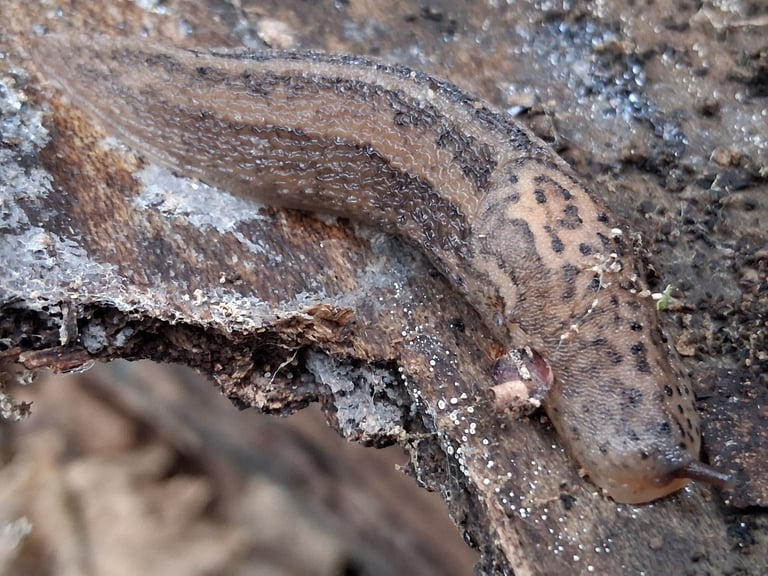
Setting anatomy aside, adults measure 60 to 140 millimeters in length. Coloration ranges widely, from yellow to black, but most individuals are brick-red, dirty orange, or brown, with noticeably darker tentacles.
Juveniles offer an easier route to identification than adults: young Arion vulgaris show longitudinal bands running along the body, a pattern absent in juvenile A. rufus. This shortcut has limits, though, since juveniles of other large Arion species, including Arion flagellus, also display longitudinal banding, so band presence alone confirms only that the animal belongs to this group of large banded Arionid slugs, not the exact species.
Distribution and Habitat
The native range of the Spanish slug remains unresolved. Genetic evidence, based on a higher incidence of rare alleles, points to an origin in France or Spain, revising earlier genetic work that had not adequately sampled those regions; the specimen used in Moquin-Tandon's original 1855 description is presumed to have come from France.
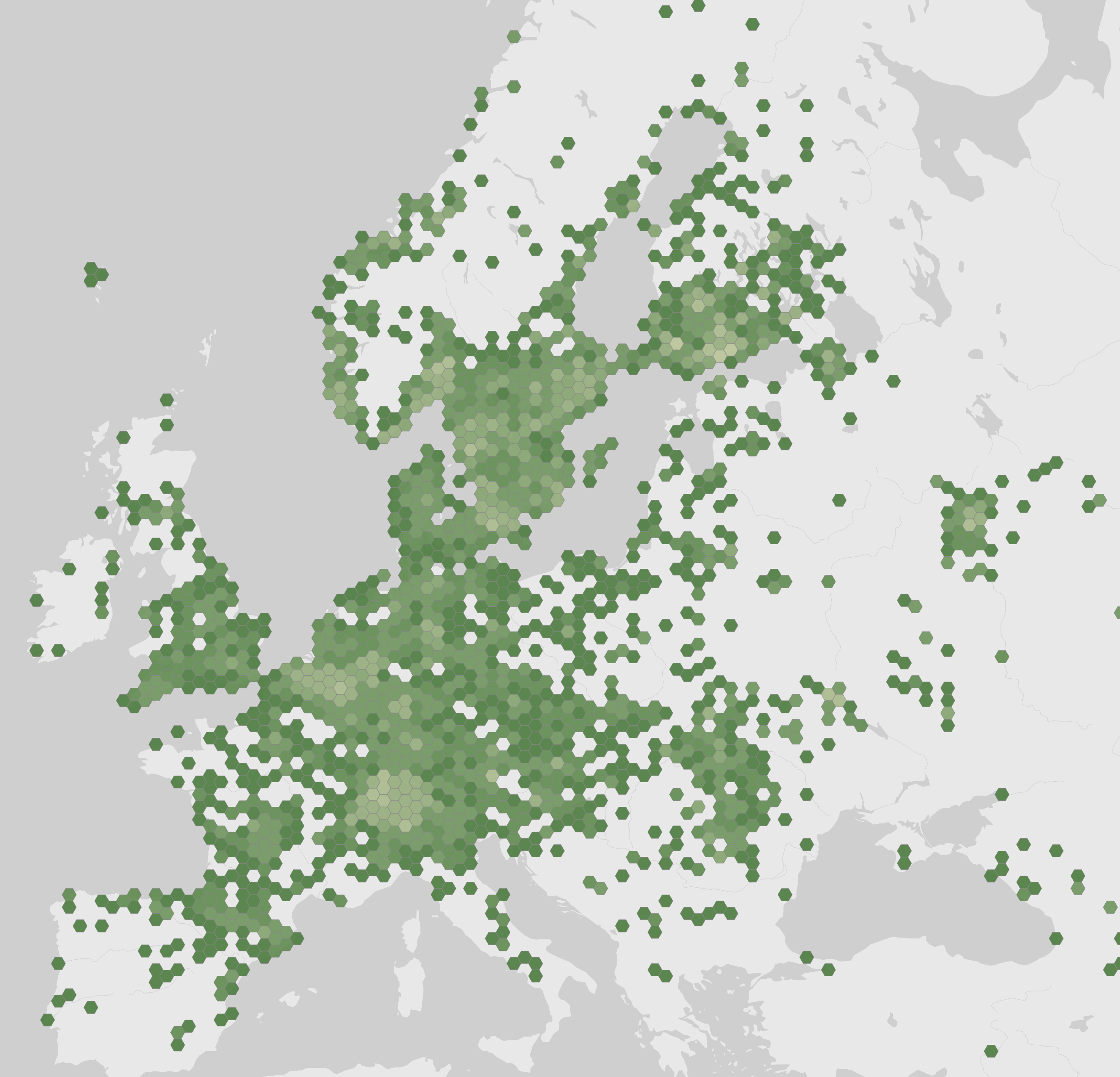
Outside this uncertain native area, the species has become one of Europe's most widely established invasive slugs, recorded across almost the whole of Western and Central Europe and extending into parts of Southern, Northern, and Eastern Europe. Its spread followed a clear chronology: first recorded in Great Britain in 1954, it later appeared in Switzerland by 1956, Italy by 1965, Germany by 1969, Sweden by 1975, Ireland by 1984, Norway by 1988, Finland by 1990, and continued eastward into Ukraine by 2007 and Romania by 2012, among many other countries. The first confirmed Asian records came only in 2022, from Armenia and Russia's Pacific coast, and it has also reached Canada since 2009 and Mexico. It has not yet established in the United States, though it is treated there as a potential serious pest threat to agriculture and natural ecosystems.
Monthly observation counts rise sharply from a low of around 250 sightings in January and February to a peak near 6,800 in July, staying high through June and August before declining through autumn. Because these figures come from presence records rather than population surveys, they should be read cautiously, but the pattern suggests the slug is most visibly active above ground during the warmer summer months.
Population and Ecological Role
Where it occurs, the Spanish slug can reach striking local densities, sometimes 50 individuals per square meter or more, and it ranges from farmland at low elevation up to 1,700 meters in the Swiss Alps, using river and lake margins, forest edges, and valley or meadow forests alongside cultivated land. As a pest of agriculture and horticulture, it feeds on a broad range of growing plant parts and decaying vegetation, and it will opportunistically eat carrion, including squashed members of its own species.
Its life cycle runs on an annual rhythm: mating begins in July, with egg-laying starting some weeks later in late summer. Clutches, averaging about 70 eggs, are laid on the soil surface or in crevices as deep as 10 centimeters, and a single adult typically lays around 400 eggs across its lifetime. Eggs hatch from autumn through spring, but neither eggs nor slugs survive temperatures below −3°C, so overwintering success depends entirely on finding shelter; most adults die off before winter frosts arrive.
Population density fluctuates considerably from year to year, and in the Czech Republic this variation tracks spring and early-summer weather rather than winter severity — a lack of rain combined with high soil temperatures tends to suppress numbers, linking the slug's ecological impact directly to seasonal moisture rather than cold.
Cultural Significance
The genus name Arion traces back to Greek mythology, where Arion was a divine, swift horse born of Poseidon and renowned for both speed and the ability to speak — a figure that reflected the deep cultural importance of horses in ancient Greek warfare, sport, and myth. Beyond this shared name, no documented folklore, symbolism, or artistic tradition specifically surrounds the slug itself; its cultural footprint today is defined almost entirely by its reputation as an agricultural nuisance rather than by any inherited mythological meaning.
Fun Facts
- The scientific name Arion echoes the legendary Greek horse Arion, a divine, speaking steed born of Poseidon, though the naming has nothing to do with the slug's own biology.
- A single adult Spanish slug can lay around 400 eggs over its lifetime, spread across multiple clutches of roughly 70 eggs each, laid on the soil surface or tucked into crevices up to 10 centimeters deep.
Conservation status
- LC
- NT
- VU
- EN
- CR
Least Concern
Ecology
Behavior
- Nocturnal
- Scavenger
Habitat
- Forest
- Freshwater
- Grassland
- Disturbed Ground
Diet
- Omnivore