Limax maximus is a carnivore as well as a detritivore: it actively pursues and eats other slugs, chasing them down at a top speed of about 15 centimeters per minute. Known as the great grey slug or leopard slug, it belongs to the keeled slug family Limacidae and ranks among the largest members of that group, second only to Limax cinereoniger.
Native to Europe and Mediterranean Africa, it has since spread to almost every inhabited continent and is currently assessed as Least Concern by the IUCN. Its size, distinctive leopard-like spotting, and unusual courtship behavior make it one of the more recognizable and well-studied land slugs in the world.
Identification and Appearance
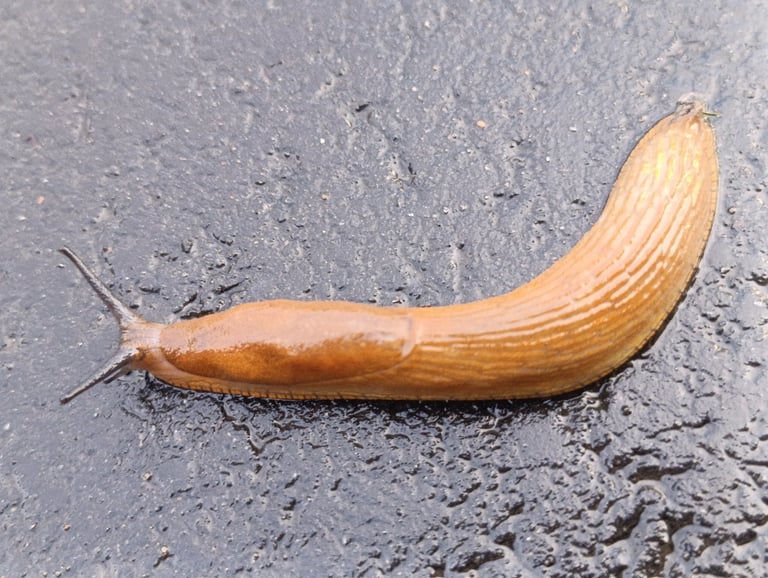
The short keel running along the tail, formed by roughly 48 rows of raised, detached tubercles, is one of the clearest field marks separating Limax maximus from smoother-bodied slugs. Adults reach 10 to 20 centimeters in length, with a rounded body that narrows into this keeled tail.
Body color ranges from pale grey and ash to brownish or yellowish-white, overlaid with black longitudinal streaks or spots in a pattern that varies considerably between individuals. The shield, an oblong structure covering about a third of the body and forming roughly an 80-degree angle when the animal moves, is always marked with bold black mottling, giving rise to the common name leopard slug. The sole of the foot is a uniform ash or yellowish tone, edged with a pale fringe bearing a row of tiny blackish tubercles. The tentacles are notably long and slender, and the reproductive pore sits near the base of the right upper tentacle.
Beneath the shield lies a reduced, internal calcitic shell only about 13 millimeters long and 7 millimeters wide, oblong-oval and whitish, visible as a firm patch through the skin. This shell is not useful for distinguishing Limax maximus from other Limacidae, since shell shape does not differ diagnostically between species in this family. The mucus the slug produces is colorless and iridescent but only mildly adhesive, unlike the thicker mucus of some other slug species.
Over a dozen named color varieties exist, including serpentinus, vulgaris, cellarius, johnstoni, maculatus, ferrussaci, obscurus, fasciatus, rufescens, and cornaliee, but these have no real taxonomic weight and simply reflect the wide natural variation in spotting and background color within the species.
Distribution and Habitat
Limax maximus is native to Europe and the Mediterranean countries of North Africa, including Egypt, Algeria, and Morocco, but it has since become established almost worldwide. It now occurs across the rest of Europe, in Mozambique and South Africa, in five of Canada's ten provinces and 46 of the 50 United States, in Mexico, in parts of South America including Argentina, Brazil, Chile, and Colombia, across China, Japan, and India, and in Australia and New Zealand.
The species favors gardens and damp, shady hedgerows and woodland, sheltering by day beneath stones, fallen timber, or other dark, moist cover. It shows a strong attraction to human dwellings, readily settling into damp cellars and outbuildings, though in Ireland this tendency is largely absent and the slug instead stays confined to woods and similar natural sites, occasionally turning up close to the high-water mark on the seashore.
Monthly observation counts peak sharply in June, July, and August, with the highest single-month total around 16,000 records, and drop to their lowest in December and January at roughly 2,200 to 2,600 records. Since these figures reflect presence observations rather than actual population size, they should be read as evidence of when the slug is most often seen and reported, likely tied to warmer, more active periods, rather than a measure of how abundant it is.

Behavior and Lifestyle
Limax maximus is strictly nocturnal, emerging at night to feed and forage while spending daylight hours hidden in crevices, under stones, or beneath fallen wood. It is not especially active or prolific compared to other slugs, and it is not gregarious, generally living and foraging alone rather than in groups.
A strongly developed homing instinct governs its nightly routine: after ranging out to feed, an individual typically returns to the same particular crevice or chink it had previously claimed as shelter. When alarmed or resting, the slug simply withdraws its head within the shield rather than contracting its whole body, and it is said to expand the shield when irritated.
The species is also capable of associative learning, including classical conditioning and aversion learning, and it can detect deficiencies in its diet, such as the experimental removal of the essential amino acid methionine from its food. This suggests a level of behavioral flexibility and sensory discrimination that is notable for a slug.
Hunting and Diet
Limax maximus actively hunts other slugs, pursuing them at a top speed of about 15 centimeters per minute until it catches and consumes them, making it one of the few slug species known to prey on its own kind in this deliberate way. This predatory behavior sits alongside its role as a detritivore, since it also feeds on dead plant material and fungi, cleaning up decaying matter in its environment.
This combination of hunting and scavenging plant debris makes it functionally omnivorous. The species is significant enough as a plant-feeder that the Institute of Food and Agricultural Science in Florida lists it as a major agricultural pest, reflecting the impact its foraging can have on cultivated plants alongside its predatory habits.
Reproduction and Life Cycle
Courtship in Limax maximus is unusually elaborate for a slug: as hermaphrodites, two individuals circle and lick one another for hours before mating. Following this extended courtship, the pair climbs into a tree or other elevated spot and, still entwined, lowers itself on a thick strand of mucus suspended in midair.
While hanging together on this mucus thread, both slugs evert their white, translucent penises from the gonopores located on the right side of the head, entwine the organs, and exchange sperm simultaneously. After mating, each participant goes on to lay hundreds of eggs, completing a reproductive strategy built around mutual, aerial copulation rather than simple ground-level pairing.
Population and Ecological Role
No population size or trend figures are documented for Limax maximus, but its ecological role is shaped heavily by the parasites and pathogens it hosts and transmits. The nematode Agfa flexilis lives in its salivary glands, Angiostroma limacis inhabits its rectum, and it can also carry Angiostrongylus costaricensis. The species is frequently infested by the parasitic mite Riccardoella limacum, which swarms over its body and invades its respiratory cavity.
Of particular concern to public health, Limax maximus can serve as an intermediate host for Angiostrongylus cantonensis, a nematode that normally infests rat lungs but can cause meningitis in humans. People can be exposed if slugs are accidentally eaten along with improperly washed vegetables such as lettuce, or if slugs are undercooked, a risk that has expanded as this nematode has spread beyond its original tropical range into other regions.
Fun Facts
- More than a dozen named color varieties of Limax maximus exist, including serpentinus, vulgaris, johnstoni, and cornaliee, though these have no formal taxonomic status.
- The internal shell beneath the slug's shield was known to Pliny the Elder, and ancient physicians once used it for its carbonate of lime content.
- That internal shell measures only about 13 millimeters long, a small fraction of the slug's own body length of up to 20 centimeters.
- The slug's mucus is colorless and iridescent but only mildly sticky, unlike the thicker mucus produced by many other slug species.
- Limax maximus can learn through classical conditioning and can even detect when an essential amino acid, methionine, is missing from its food.
Conservation status
- LC
- NT
- VU
- EN
- CR
Least Concern
Ecology
Habitat
- Coastal
- Woodland
- Urban
- Disturbed Ground
Behavior
- Nocturnal
- Predator
- Solitary
Diet
- Omnivore