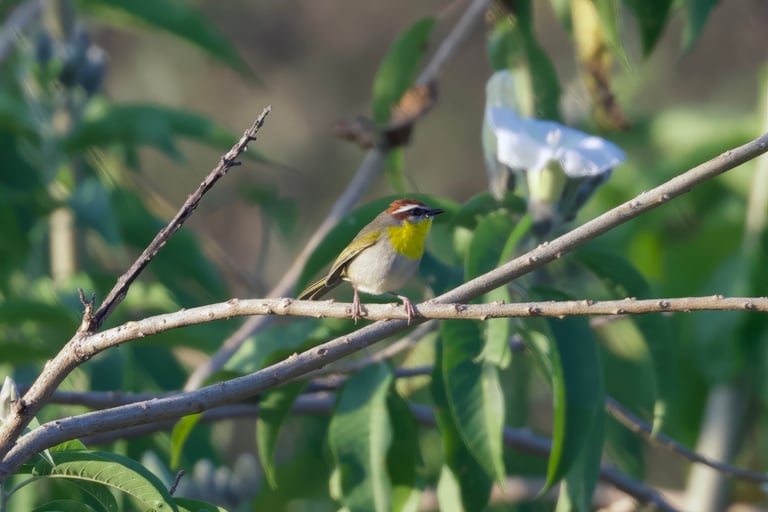
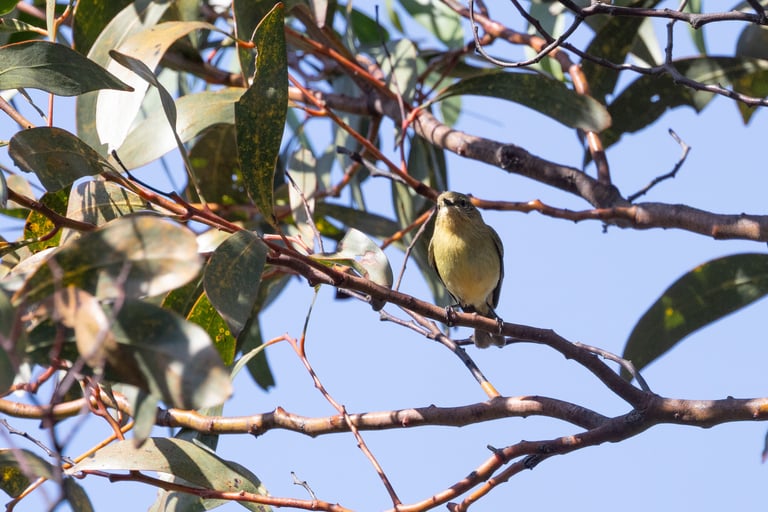
The hermit warbler probes for insects while hanging upside-down from the tips of conifer branches, much like a chickadee. It is a small New World warbler in the family Parulidae, breeding across much of the west coast of the United States and migrating to winter in Mexico and Central America, with some birds remaining in southern California. The species is currently listed as Least Concern.
Its combination of a bright yellow head, secretive habits, and dependence on tall coniferous forest makes it a distinctive target for birders along the Pacific coast.
Identification and Appearance
The hermit warbler's most useful field mark is its largely yellow head, contrasting with a dark gray back and white underparts streaked black on the flanks. Two diagonal white wing bars mark the wings. Both sexes measure about 14 cm (5.5 in) in length, weigh between 8.5 and 14.2 g, and have a wingspan of about 20 cm (7.9 in).
Males show a solid dark black throat, while females have much less black on the throat and immature birds lack a black throat entirely, making throat pattern a reliable way to age and sex individuals in the field.
Distribution and Habitat
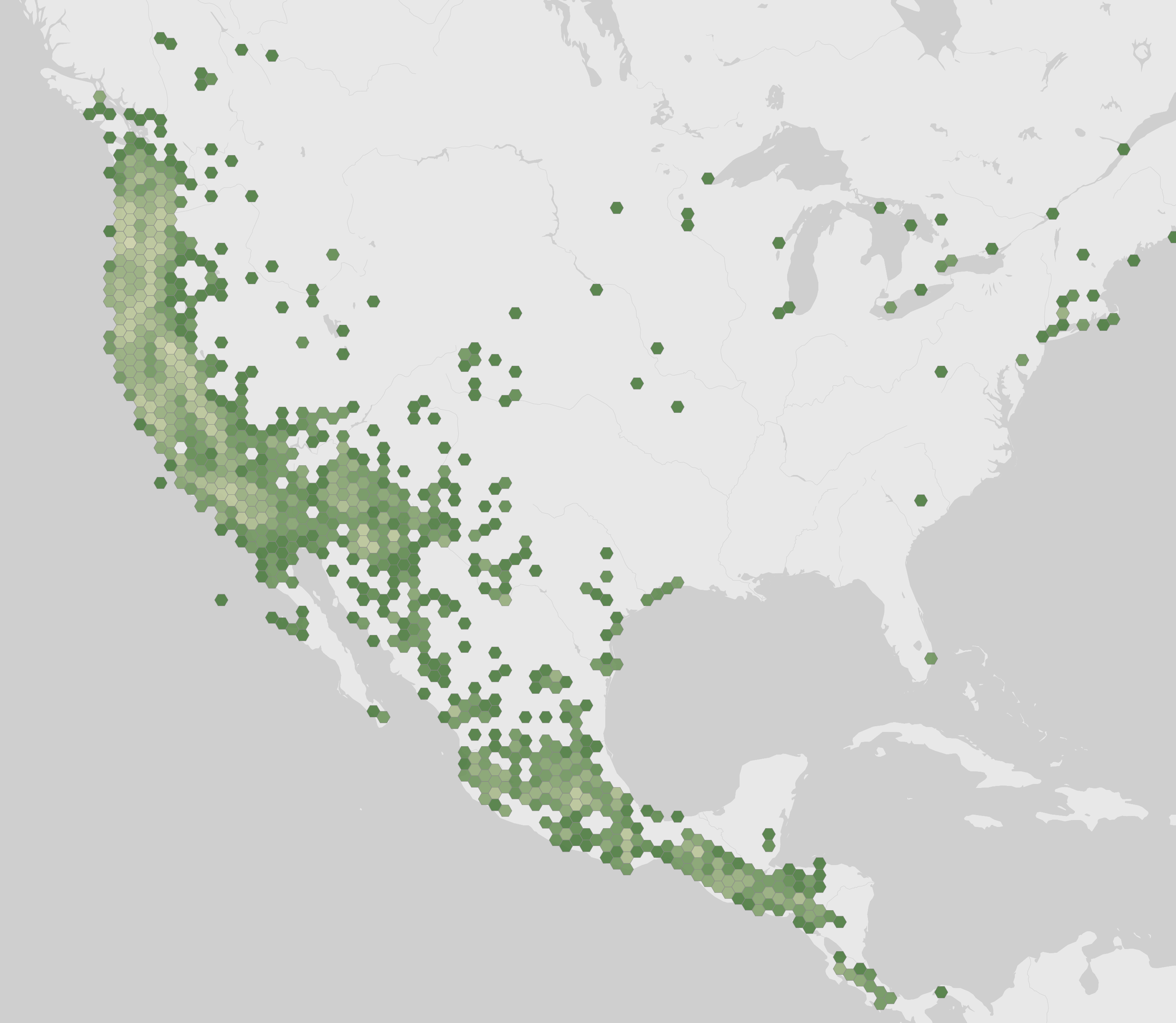
The hermit warbler breeds across most of the west coast of the United States, extending north to Washington, and favors dense, open coniferous forests including tall Douglas fir, pine, and redwood stands, as well as wetter nesting habitats and mountain terrain. Its breeding range covers roughly 339,000 square kilometers.
Some individuals winter in southwestern California, but most migrate to Central America, reaching as far south as Panama. During migration the species turns up in a wider variety of habitats, including deciduous woods, water-lined wooded areas, desert oases, and even suburban settings.
Monthly observation patterns show a pronounced rise in late spring, consistent with birds becoming more detectable during the breeding season, though these counts reflect presence rather than abundance.
The breeding range is expected to shift north and east with climate warming, likely losing ground in Northern California and parts of Oregon, Washington, and Canada, while facing greater risk from heat waves and nesting-season flooding.
Diet and Nutrition
The hermit warbler feeds almost entirely on insects and spiders, like most warblers. It forages actively in conifer canopies, often hanging upside-down from the ends of branches, chickadee-style, to probe needle clusters and twig tips for hidden prey.
Nesting and Breeding
Females build neat, cup-shaped nests from stems, grass, twigs, and pine needles, placing them near the tip of a branch high in a conifer tree. A clutch typically contains three to five white eggs heavily spotted with brown and lilac markings.
Fun Facts
- The hermit warbler is known by many names across languages, including Einsiedelwaldsänger in German and chipe cabeciamarillo in Spanish.
- The oldest recorded hermit warbler lived to about 9.1 years, though this maximum lifespan record likely reflects an exceptional individual rather than a typical lifespan.
Photos
Photographs from via iNaturalist, licensed under CC0 1.0., by Wendy McCrady via iNaturalist, licensed under CC BY 4.0., by cello caruso-turiello via iNaturalist, licensed under CC BY 4.0., by Brooke J. via iNaturalist, licensed under CC BY 4.0., and by Daniel Patterson via iNaturalist, licensed under CC BY 4.0., credited on each photo.
Ecology and classification
Classification
- Phylum
- Chordata
- Class
- Aves
- Order
- Passeriformes
- Family
- Parulidae
- Genus
- Setophaga
- Species
- Setophaga occidentalis