Few animals have a stranger reputation in medicine than Hirudo medicinalis, the European medicinal leech. This segmented worm is a blood-feeder whose saliva contains an anticoagulant that keeps a wound open while it feeds.
The species belongs to the family Hirudinidae within the phylum Annelida, the group that also includes earthworms. It is an amphibious freshwater animal found across almost all of Europe and into Asia as far as Kazakhstan and Uzbekistan. Its natural range has shrunk sharply, and the IUCN now lists it as Near Threatened.
The leech matters for two reasons. It shows how a small aquatic animal can shape human medicine, and its decline shows how overharvesting and drainage can strip a species from much of its former range.
Identification and Appearance
The three saw-like jaws and the mark they leave are the most useful field marks. Each jaw carries roughly 100 sharp edges, and the bite leaves an inverted Y inside a circle. Leeches with this mark are likely to be Hirudo medicinalis.
Fully grown adults reach up to 20 centimeters in length. The body is green, brown, or greenish-brown, with a darker upper side and a lighter underside. A thin red stripe runs along the back.
Like most leeches, the body is soft and flattened, with two suckers, one at each end. The front sucker holds the jaws and teeth and is used for feeding. The rear sucker is used mainly for gripping and leverage.
Each adult is a hermaphrodite, so it has both male and female reproductive organs. Sex cannot be told apart by appearance.
Distribution and Habitat
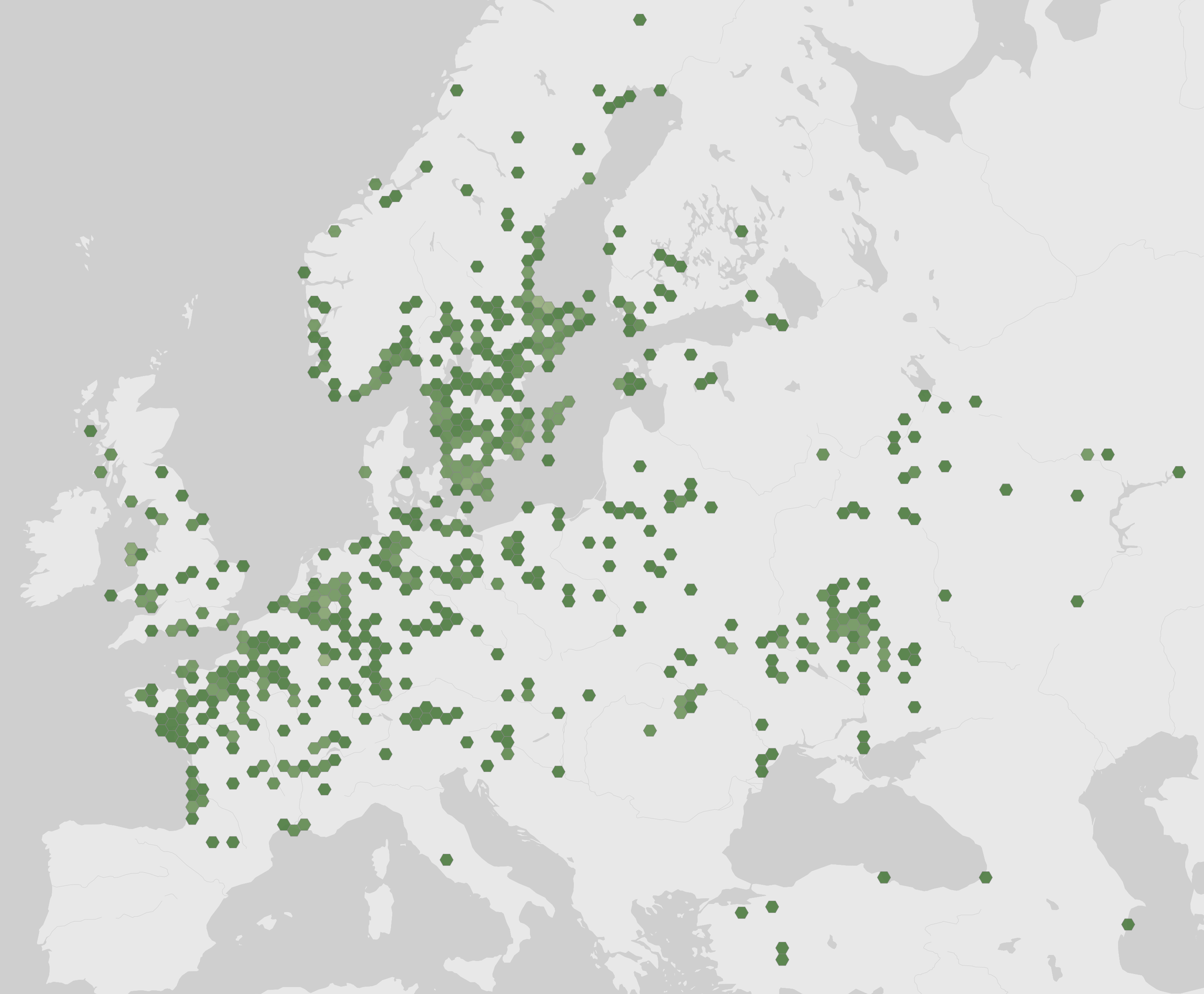
Hirudo medicinalis occurs across almost the whole of Europe and extends into Asia as far as Kazakhstan and Uzbekistan. In temperate climates it prefers muddy freshwater pools and ditches with plenty of weed growth.
The species is amphibious and needs both land and water, but it lives only in fresh water. A typical home is a small pond with a muddy bottom, edged with reeds, and shared with frogs, toads, or newts for at least part of the year. Leeches prefer water rich in nutrients, a condition known as eutrophic. In ponds without amphibians, grazing livestock are thought to supply the leech's food.
The species has different habitats in different places. On Romney Marsh in Kent, large populations live in the shallow edges of deep gravel pits and in ditches that cross grazing marshland. In Cumbria, leeches live in shallower water that warms quickly to about 20°C, a temperature the water must reach for at least part of the year for leeches to survive.
Most observations of the species fall between April and September, with the clearest peak in June.
Behavior and Lifestyle
The leech moves in two ways. In water, it contracts its longitudinal muscles in a wave-like motion that pushes it forward. On land, it loops, much like an inchworm, attaching alternately by its front and rear suckers.
During the day, a resting leech lies under large objects on the shoreline, partly out of the water. It senses its surroundings through light, heat, and moisture, and it responds strongly to moving shadows above. This shadow response is strongest when the leech is hungry, since a passing shadow often signals a mammal nearby.
A dark shadow can also trigger an alarm response in which the leech stops breathing for a moment. The leech becomes less sensitive to stimuli while it is feeding and mating. At these times, its rear end can be cut off without stopping the behavior it is performing.
The species is largely solitary in its daily routine and gathers in suitable ponds, where it hunts and mates. Its movement between water and land follows the availability of hosts and suitable moist shelter.
Diet and Nutrition
Hirudo medicinalis is a blood-feeding parasite. Adults feed on the blood of mammals, and their feeding is what makes them so distinctive.
A leech attaches to its host with its two suckers and bites through the skin. As it bites, it injects an anesthetic so that the host does not notice, along with an anticoagulant that keeps the wound open during the meal. Its three jaws move back and forth while it feeds, which usually takes about 20 to 40 minutes. The bite leaves a tripartite, star-shaped scar on the host.
A full meal can increase the leech's body size eight to eleven times. It then digests the blood slowly over about six months, which is why it feeds only about once every six months. Certain bacteria in its gut keep the blood from decaying during this long digestion. When food is scarce, the leech can survive for more than six months by digesting its own tissues.
Young leeches feed on frogs instead of mammals, because their jaws are not yet strong enough to cut through mammalian skin.
Reproduction and Life Cycle
Hirudo medicinalis breeds once a year, during a season that runs from June through August. Unlike most other leeches, it stays fertile for several years.
Mating takes place on land. Two leeches attach to each other on their undersides using a mucus secretion. Because each leech is a hermaphrodite, both partners can transfer sperm. Fertilization is internal, and sperm is injected into the partner through an extendable copulatory organ.
After mating, a cocoon forms around the clitellum, the thickened band of the body. The cocoon slips off the front of the leech, carrying the eggs. The egg sac is laid in damp soil, usually just above the shoreline.
About 14 days later, the eggs hatch. The young emerge as fully formed miniature adults, which then need frogs for their first meals.
Conservation and Threats
The medicinal leech is rare across its European range and has disappeared from much of its former territory. Overharvesting for medicinal use in the past century is the main cause of its decline. Loss of its habitat through the drainage of wetlands has added to the pressure.
Horses were once the leech's preferred hosts. As horses were replaced by motor vehicles and mechanical farm equipment, fewer animals came to the leech's water, and artificial water supplies for cattle changed the wetlands it depended on. A possible decline in frog populations also matters, since young leeches cannot feed on mammals for their first two meals.
The IUCN lists the species as Near Threatened. It is legally protected across nearly all of its natural range. Under CITES, it is listed in Appendix II, so international trade, including in parts and derivatives, is regulated by the CITES permit system. In the United States it has no special federal status.
In the United Kingdom, as few as 20 isolated populations may remain. The largest, at Lydd in England, is estimated to hold several thousand individuals, and 12 sites have been designated Sites of Special Scientific Interest. Small transplanted populations also exist in several countries outside the species' natural range, including the United States.
Cultural Significance
For centuries, the medicinal leech was used to remove what was thought of as "bad blood" from sick patients. Around 1850, this practice fell out of favor, but the species has since returned to medical use.
Today, leeches are used to relieve pressure and restore circulation in tissue grafts, where blood can build up, such as in reattached severed fingers and ears. The anticoagulant in leech saliva is also studied for surgeries that require an incision to stay open. Its saliva contains antibiotic and anesthetic compounds that may prove useful in future medical treatments.
Photos
Photographs from via iNaturalist, licensed under CC0 1.0., by Ewan Shilland via iNaturalist, licensed under CC BY 4.0., by uxbridgebirder via iNaturalist, licensed under CC BY 4.0., by Samuel Paitreault via iNaturalist, licensed under CC BY 4.0., by Viktor Strenada via iNaturalist, licensed under CC BY 4.0., by Luke via iNaturalist, licensed under CC BY 4.0., and by Dmitry Ivanov via iNaturalist, licensed under CC BY 4.0., credited on each photo.
Ecology and classification
Habitat
Behavior
- Semi-aquatic
Classification
- Phylum
- Annelida
- Class
- Clitellata
- Order
- Arhynchobdellida
- Family
- Hirudinidae
- Genus
- Hirudo
- Species
- Hirudo medicinalis
Sources
- GBIF Species names and classification
- iNaturalist Photos
- Wikidata Common names and conservation status
- Wikipedia Summary extract
- Encyclopedia of Life Habitat, diet and behavior traits
- Animal Diversity Web Animal habitat, behavior and diet
- GloBI What it eats, what eats it, parasites and pollinators
- Wardeh et al. 2015 (EID2)