The horned grebe can dive underwater for up to three minutes, covering 150 to 200 meters in search of prey, yet on land it can barely walk because its legs sit so far back on its body.
This small waterbird of the family Podicipedidae belongs to the order Podicipediformes and is currently classified as Vulnerable. Two subspecies exist: Podiceps auritus auritus, breeding across northern Eurasia from Iceland to the Russian Far East, and P. a. cornutus, breeding across Canada and parts of the United States. Its striking seasonal transformation, from golden-horned breeding plumage to plain black-and-white winter dress, along with its steep recent population decline, make it a species worth close attention.
Identification and Appearance
The most distinctive feature of the horned grebe is its breeding plumage: bright, erectable golden "horns" set against a black head, paired with chestnut-red flanks and neck. The species measures 31 to 38 centimeters long, has a wingspan of 55 to 74 centimeters, and weighs between 300 and 570 grams.
It has a moderately long neck, a flat forehead, and a straight, pointed beak with a white tip. In breeding dress, the crown and back are black, the lores and upper chest chestnut brown, and black fan-shaped cheek feathers frame the face beneath the golden tufts. The belly remains dull white year-round.
In non-breeding plumage the horns disappear entirely and the bird turns mostly black and white: white neck, chest and cheeks contrast with a dull black-grey back and crown, the border between crown and cheek running in a straight line behind the eye. Males are slightly larger and brighter than females, though the two sexes are generally hard to tell apart in the field.
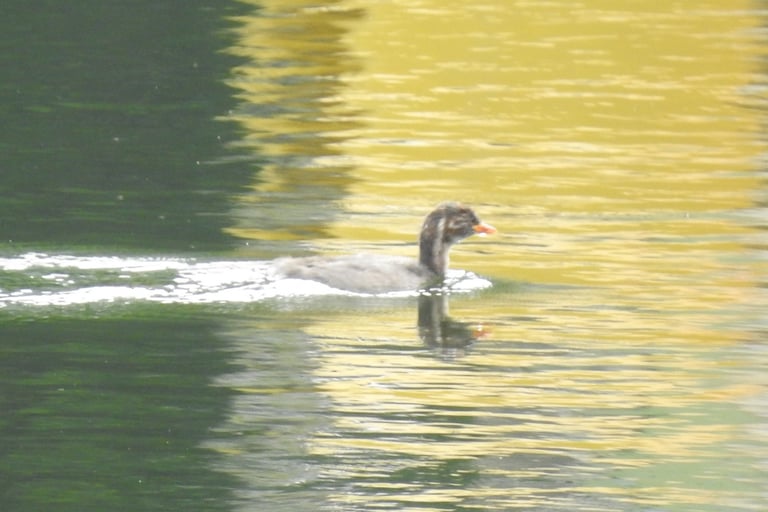
Juveniles resemble non-breeding adults but appear duller, with a brownish tinge to the back, a less distinct crown-cheek border, and a paler beak. Chicks are fluffy with a grey back, white belly, and bold black-and-white facial and neck stripes.
Distribution and Habitat
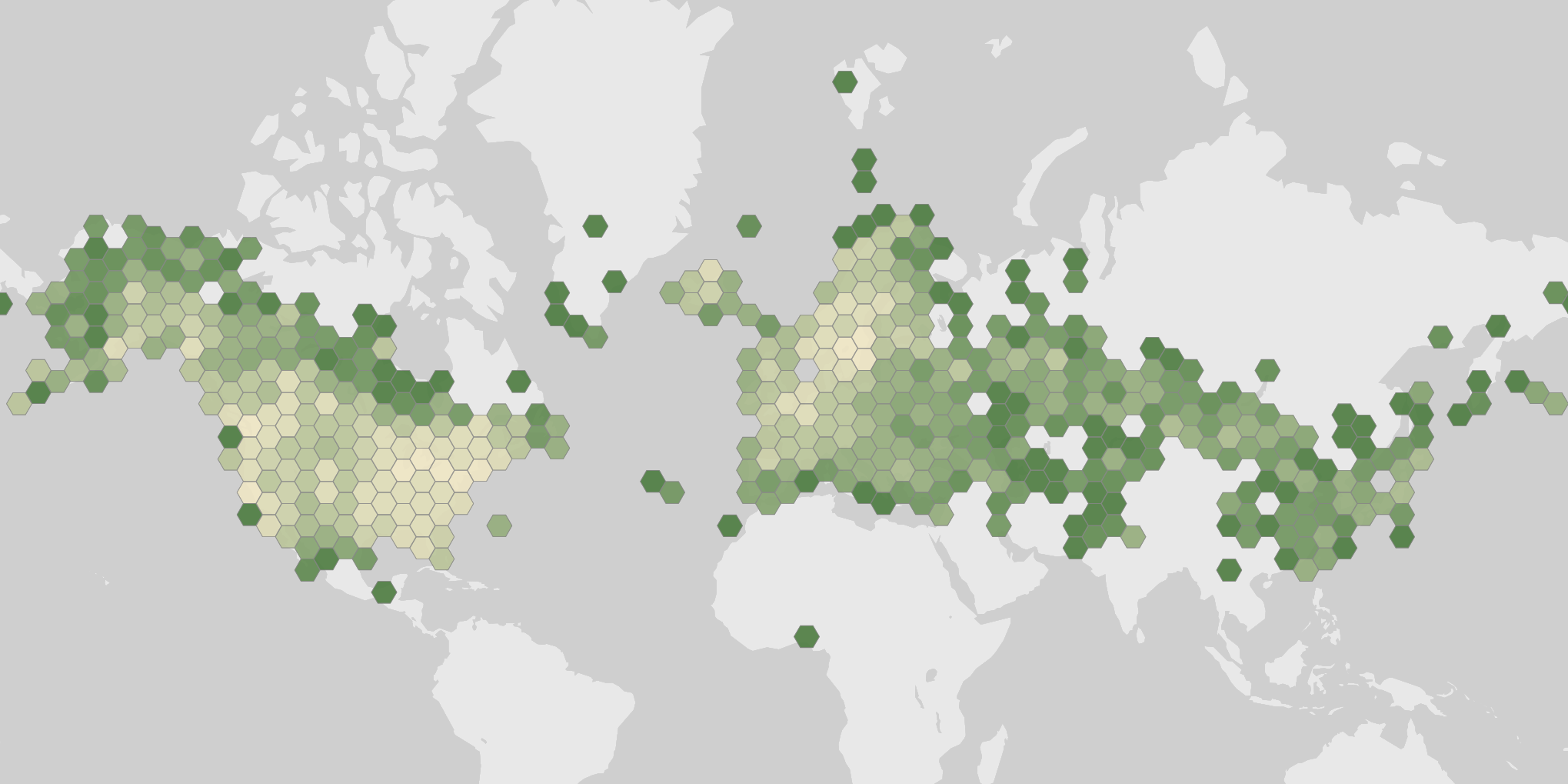
The horned grebe occupies an extensive range across the Northern Hemisphere, breeding across boreal, subarctic and temperate zones including prairies and parklands in North America and Eurasia. Breeding habitat consists of shallow freshwater ponds, marshes and lake-edge bays generally under 2.5 meters deep, with submerged vegetation and marginal stands of sedges, rushes and bulrushes bordering open water, features that provide nest material, anchorage and cover for young.
During migration the species stops over on lakes, rivers and marshes before moving to marine wintering grounds along protected bays, estuaries and exposed coastal shores, occasionally also gathering on large freshwater lakes, as noted in parts of Norway.
A small, unmapped population was reported in Greenland in 1973, though later authors have not confirmed it. Monthly observation patterns show peaks in spring and again in autumn, consistent with migratory movement between breeding and wintering grounds, though these counts reflect presence rather than actual population size.
Behavior and Lifestyle
Horned grebes are accomplished swimmers and divers, able to stay submerged for up to three minutes and cover 150 to 200 meters per dive, and they can even adjust their buoyancy to control how high they float on the surface. This aquatic mastery comes at a cost on land, where their far-back leg placement leaves them nearly unable to walk.
Taking flight requires a running start along the water's surface, after which the birds fly swiftly with rapid wingbeats, neck and feet outstretched and head angled downward. The species is migratory, breeding on inland lakes and relocating to coastal waters for winter, typically migrating alone and at night.
During the breeding season horned grebes are strongly territorial, defending home ranges that typically span 330 to 30,000 square meters. Outside the breeding season they tend toward solitary habits, a shift reflected in their generally quiet, largely silent demeanor except when breeding.
Communication
Horned grebes rely on a mix of elaborate physical displays and vocalizations, most tied to forming and maintaining pair bonds, and to defending territory and broods. Paired birds sometimes trill together in duet.
Their advertising call is a loud, nasal "aaarrh" that descends in pitch and ends in a trill, with variant calls used during copulation, alarm, and other breeding ceremonies. Chicks begin with a trilled peeping call similar to a domestic chick's, which matures into adult-like chittering as they grow.
Vocal activity peaks sharply during breeding, territory establishment, and defense, then quiets considerably during autumn migration and at wintering sites.
Diet and Nutrition
Horned grebes hunt by diving underwater, capturing prey with quick pursuit before either swallowing small items on the spot or surfacing to manipulate larger ones before eating them. Their diet shifts seasonally: aquatic arthropods dominate in summer, while fish and crustaceans become more important in winter.
Leeches, tadpoles, salamanders and occasional plant material round out the diet, and mollusks are taken on wintering grounds. Like other grebes, horned grebes routinely swallow feathers, which are thought to help cushion the digestive tract against sharp fish bones.
Nesting and Breeding
Courtship in horned grebes unfolds through four distinct ceremonies: the discovery ceremony, the weed ceremony, the head-shaking ceremony, and the triumph ceremony. The discovery ceremony opens with an upright advertising posture, erect horns, and the loud advertising call, followed by bouts of penguin dance and mutual preening to confirm species, sex and compatibility.
In the weed ceremony, both birds dive to retrieve weeds, rise in synchrony, and come together breast-to-breast before swimming side by side carrying the vegetation, sometimes repeating this weed-rush several times. The head-shaking and triumph ceremonies follow in already-established pairs, and copulation always takes place on the floating platform nest the pair builds together.
Pairs nest solitarily or in loose colonies of roughly 20 pairs, each spaced apart, anchoring their floating nests of wet plant material to standing vegetation in shallow water. Eggs are laid between April and September, peaking in June, with females producing a single clutch of three to eight whitish, brownish or blue-green eggs that quickly become stained by the nest material. Both parents share incubation over 22 to 25 days.
Chicks can swim and dive within days of hatching but are brooded and kept warm by their parents for up to 14 days, often riding on a parent's back tucked between wing and body. Young become independent at 20 to 25 days old, take their first flight around 55 to 60 days, and reach sexual maturity by about two years old.
Population and Ecological Role
Horned grebes influence the populations of the invertebrates, fish and amphibians they consume, and they compete with certain fish species for aquatic invertebrate prey in the lakes and marshes they share.
Conservation and Threats
The horned grebe was uplisted from Least Concern to Vulnerable by the IUCN in 2015 following widespread population declines, triggering conservation and research action plans. The global population has fallen by 30% over the last three decades, with the decline reaching 79% in North America, where the total population is estimated between 200,000 and 500,000 individuals; the Eurasian population is far smaller, at 12,900 to 18,500 mature individuals.
The principal threats are habitat loss and degradation, particularly drought-related wetland loss and wetland and grassland drainage, which accounted for about 5% of global habitat loss between 1985 and 2001. Human disturbance, forestry operations near breeding sites, fluctuating water levels, and the stocking of lakes with rainbow trout that compete for aquatic insects all add further pressure. Oil spills, pesticide accumulation, plastic and lead ingestion, and entanglement in fishing nets also take a toll.
Regional declines can be severe: the western Canadian population is listed as a species of special concern, the breeding population on the Magdalen Islands is listed as endangered, and the small breeding population in northern Scotland fell to just 26 pairs in 2021, a 58% decline over the previous 26 years.
Cultural Significance
Horned grebes have no documented cultural significance or notable effect on humans beyond occasional accidental sightings recorded far outside their normal range, such as a single record in Calabria, southern Italy.
Fun Facts
- Horned grebes cannot simply flap into the air from a standstill; like other grebes, they must run along the water's surface to build enough speed for takeoff.
- Once airborne, they fly swiftly with rapid wingbeats despite their ungainly start.
Photos
Photographs from via iNaturalist, licensed under CC0 1.0., by Константин Селивёрстов via iNaturalist, licensed under CC BY 4.0., by ikelman via iNaturalist, licensed under CC BY 4.0., by Adam Leigh via iNaturalist, licensed under CC BY 4.0., by Юля и Ваня «Чай» via iNaturalist, licensed under CC BY 4.0., by Matt Berger via iNaturalist, licensed under CC BY 4.0., by tcantrell52 via iNaturalist, licensed under CC BY 4.0., by Merrcurys via iNaturalist, licensed under CC BY 4.0., by Timothy McNitt via iNaturalist, licensed under CC BY 4.0., by Laura Maskell via iNaturalist, licensed under CC BY 4.0., by Jonathan Curley via iNaturalist, licensed under CC BY 4.0., and by Josh Noseworthy via iNaturalist, licensed under CC BY 4.0., credited on each photo.
Ecology and classification
Classification
- Phylum
- Chordata
- Class
- Aves
- Order
- Podicipediformes
- Family
- Podicipedidae
- Genus
- Podiceps
- Species
- Podiceps auritus
Sources
- GBIF Species names and classification
- iNaturalist Photos
- Wikidata Common names and conservation status
- Wikipedia Summary extract
- Animal Diversity Web Animal habitat, behavior and diet
- AnAge Longevity
- AVONET Bird mass, habitat, migration, diet and range size