A splash, then nothing — the little grebe lives up to its scientific name, Tachybaptus, built from the Greek words for "fast" and "to sink under." One moment it is paddling on the surface, the next it has vanished into the water without a ripple.
This small water bird, also called the dabchick, belongs to the grebe family, Podicipedidae, and ranges across freshwater lakes and ponds through much of Europe, Asia and Africa. The IUCN lists it as Least Concern, reflecting a wide range and no major population crisis. Despite its unassuming size, its quick-vanishing dives and secretive nesting habits make it one of the more entertaining birds to watch on a quiet pond.
Identification and Appearance
The clearest field mark in summer is the little grebe's rich, rufous neck, cheeks and flanks, paired with a bright yellow gape at the base of its pointed bill. This combination is unmistakable and separates breeding adults from almost anything else on the water.
It is a genuinely small bird, weighing around 174 grams, with a compact, rounded body and a short, dagger-like bill suited to snatching prey. In winter, the rufous tones fade to a dirty brownish grey, and the bird takes on a buff-colored plumage with a darker back and cap, along with a distinctive fluffy, "powder puff" rear end that aids identification even at a distance.
Juveniles look different again: they have a yellow bill tipped with black, along with black-and-white streaking on the cheeks and neck sides. As young birds mature, the bill gradually darkens until it turns fully black in adulthood, mirroring the shift from juvenile to adult plumage.
Beyond plumage, the breeding call is a useful clue to identity — a trilled, repeated "weet-weet-weet" or "wee-wee-wee" that sounds remarkably like a horse whinnying, given singly or as a duet between paired birds.
Distribution and Habitat
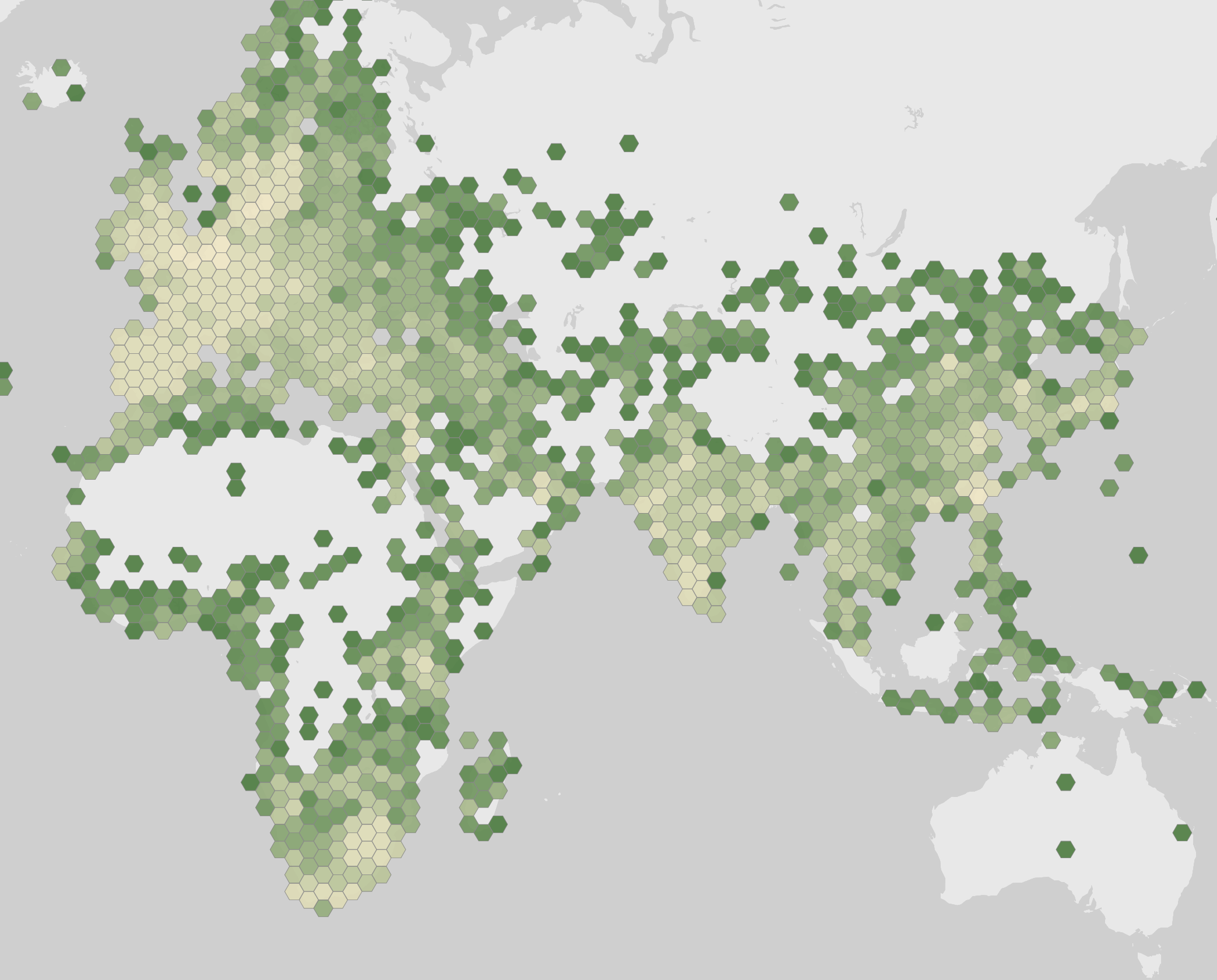
The little grebe breeds in small colonies wherever there is a lake or good-sized pond with plenty of vegetation, across Europe, much of Asia as far as New Guinea, and most of Africa. Almost any lowland freshwater body will do: park ponds, flooded gravel pits, reservoirs, and slow rivers all support resident pairs.
Outside the breeding season, birds shift toward more open or coastal water, and the species occasionally turns up in small coastal bays and estuaries. True migration is limited mostly to populations in areas where standing water freezes over in winter, forcing birds to relocate to unfrozen water.
Monthly observation counts show the highest tallies in January and December, both exceeding 250,000 records, with a noticeable dip to around 143,000 in June. Because these are presence observations rather than population counts, the pattern likely reflects birds being easier to spot in open winter waters and harder to detect while hidden in breeding vegetation during early summer, rather than an actual shift in abundance.
Behavior and Lifestyle
The little grebe is a strong swimmer and an exceptional diver, chasing fish and aquatic invertebrates underwater and slipping into dense vegetation to hide from danger. Its legs are set far back on its body, an adaptation that makes it a powerful swimmer but leaves it almost unable to walk on land.
Because of this, it nests right at the water's edge rather than venturing onto shore. A typical clutch holds four to seven eggs, and when an adult leaves the nest it often covers the eggs with weeds, a simple trick that helps hide them from predators.
Chicks are capable of leaving the nest and swimming almost as soon as they hatch. In their first days, they are frequently seen riding on the backs of swimming adults, a behavior that keeps them safe and warm while they build strength. In India, breeding is timed to the rainy season, showing how the species adjusts its schedule to local conditions.
Fun Facts
- The little grebe was first described by Peter Simon Pallas in 1764 as Colymbus ruficollis, with the Netherlands recorded as its type locality.
- In 1853, German naturalist Ludwig Reichenbach created the genus Tachybaptus specifically to house this species, at the time known as Colymbus minor.
- The little grebe is now one of five species classified within the genus Tachybaptus.
- Its scientific name blends two languages: Tachybaptus comes from Ancient Greek for "fast" and "to sink under," while ruficollis is Modern Latin for "red-necked."
- The bird's common nickname, "dabchick," nods to its habit of quickly dabbing under the water's surface and disappearing from view.
Conservation status
- LC
- NT
- VU
- EN
- CR
Least Concern
Ecology
Habitat
- Wetland
- Coastal
- Freshwater
Behavior
- Predator
- Aquatic
- Social
Diet
- Piscivore
Photos
SourcesGBIFiNaturalistWikidataWikipediaEncyclopedia of LifeAnAge