Humans build political states, trade networks, and belief systems that let billions of unrelated individuals cooperate, a scale of social organization no other primate approaches. Bipedalism, minimal body hair, and an unusually large and complex brain gave Homo sapiens the physical and cognitive tools to develop language, culture, and technology.
As a mammal in the primate order, Homo sapiens is the most abundant and widespread primate species on the planet, occupying nearly every terrestrial habitat from dense forests to open plains and dense cities. What makes the species worth studying is not any single trait but the way biology and culture reinforce each other, turning curiosity about the world into science, philosophy, and mythology.
Identification and Appearance
The clearest field mark separating humans from other apes is upright, two-legged walking paired with skin that is largely bare of visible hair. Where chimpanzees and other great apes retain thick body hair, humans carry a similar density of hair follicles but grow mostly short, wispy vellus hair that is practically invisible, exposing skin dotted with roughly two million sweat glands.
Adult size varies with sex and population: average height worldwide is about 171 cm (5 ft 7 in) for men and 159 cm (5 ft 3 in) for women, with average body mass around 77 kg (170 lb) for men and 59 kg (130 lb) for women. Height has risen across generations, likely from improved nutrition, healthcare, and living conditions, while stature can shrink again in old age.
The body itself is barrel-shaped rather than funnel-shaped like other apes, an adaptation that supports the deep breathing needed for upright walking and running. Teeth are proportionately small and crowded, with unusually short, flush canines and a dental formula shared with other Old World primates; the third molars are being lost evolutionarily, and many people never develop them. Vestiges of a more arboreal past remain in a small tail bone, a vestigial appendix, flexible shoulder joints, and grasping hands with opposable thumbs.
Differences from other apes go beyond appearance: humans smell, hear, and digest proteins differently, and their long-distance running ability — aided by thin body hair and efficient sweating — is unmatched among primates, even though most apes and many other animals easily outpace humans over a short sprint.
Distribution and Habitat
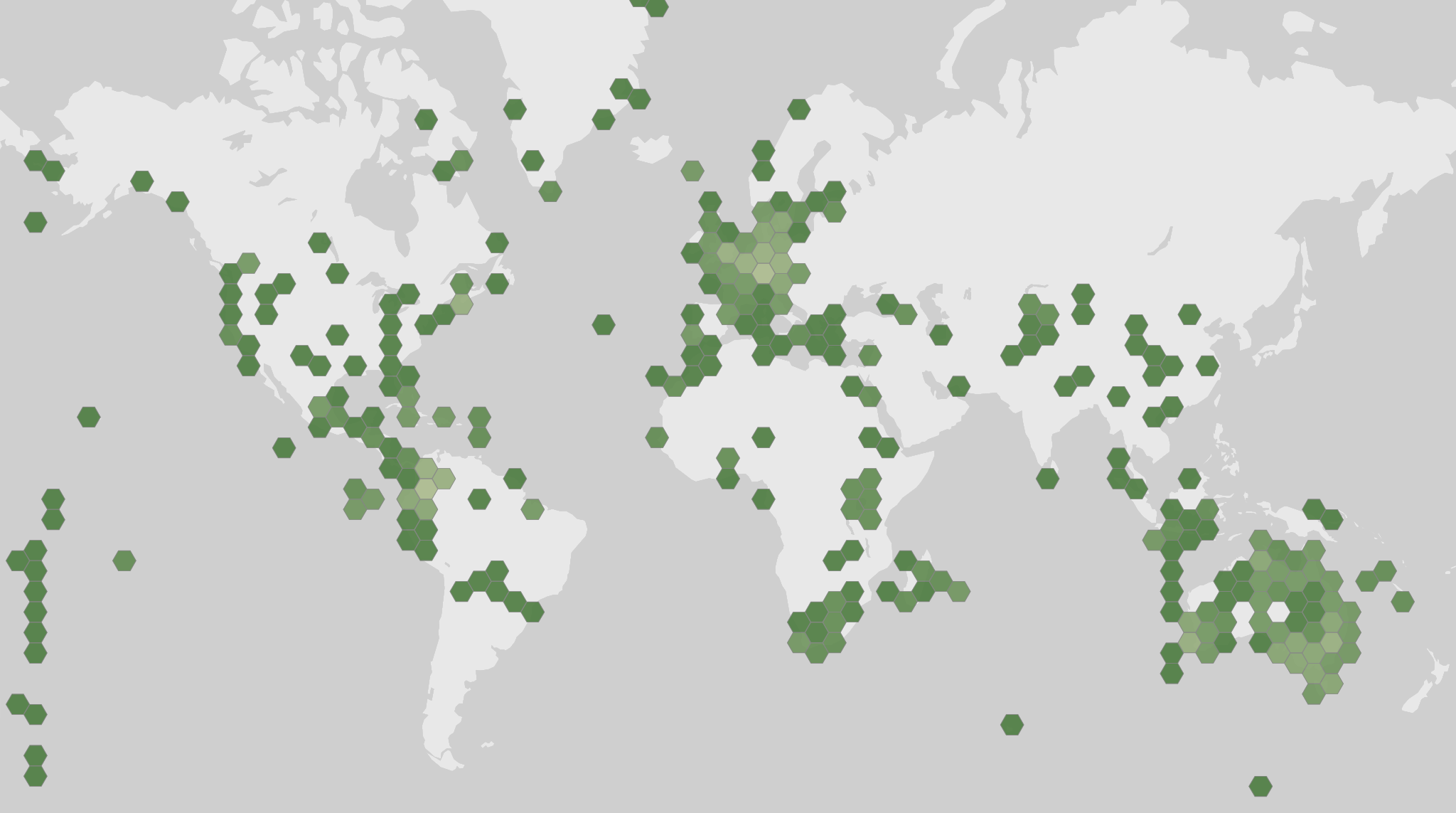
Humans occupy essentially every terrestrial habitat on Earth, from tundra and taiga to deserts, savannas, grasslands, forests, rainforests, and mountains, as well as marshes, swamps, and riparian and estuarine zones. Boats and other technology extend the species into intertidal, littoral, and open aquatic habitats mainly to gather food.
Beyond natural habitats, humans have created entirely new ones — urban, suburban, and agricultural landscapes — that support only a reduced set of other species able to tolerate heavy modification. Caves are also used as habitat in some regions.
Presence-observation data recorded across a full year shows counts ranging from a low of 411 in June to a peak of 4,665 in November, with a secondary rise in March. These figures reflect where observations were logged, not actual population size or density, so the November peak should be read as a pattern in recorded sightings rather than evidence of seasonal movement.
Behavior and Lifestyle
Human behavior shifted fundamentally around 10,000 years ago, when the rise of agriculture replaced a nomadic hunter-gatherer lifestyle for most populations. That shift concentrated people into permanent settlements and eventually cities, reshaping economies and the relationships between different human groups.
Most humans are diurnal and highly social, living in nested groups from families and kinship networks up to entire political states, often organized around dominance hierarchies. Some populations remain nomadic or migratory, following resources or seasons, while the majority are sedentary within a defined home range that varies enormously in size and use from one population to another.
Tool use is one of the most defining human behaviors. Early populations shaped specialized tools — chisels, knife blades — from stone, bone, antler, and ivory, and this drive toward technological innovation continues today. Alongside tools, humans developed complex art, symbolism, and eventually written language, extending behavior far beyond immediate survival needs.
Communication
Vision dominates human perception and signaling: color vision is excellent, though acuity drops sharply in low light, and visual cues support much of everyday communication. Sound is used just as heavily, most notably through language — one of the most complex communication systems in the animal kingdom, with extraordinary diversity across human populations.
Touch carries particular weight in close social bonds, reinforcing relationships that language alone cannot. Smell and taste are moderately developed and help evaluate food and gather information about the environment and other people, including through chemical signals such as pheromones.
The evolution of complex language is considered a hallmark of the species. While archaic humans could already produce complex language, the anatomy of Homo sapiens appears to have evolved specifically to favor the fine sound production that modern speech requires.
Diet and Nutrition
Diet in humans is omnivorous and highly variable, shaped far more by regional availability and culture than by fixed biology. Animal foods eaten across human populations include birds, mammals, amphibians, reptiles, fish, eggs, insects, mollusks, and crustaceans, while plant foods span leaves, roots, tubers, seeds, grains, nuts, fruit, and, in some cultures, nectar, pollen, and algae.
Some cultures restrict themselves to vegetarian diets built around plant protein sources, while others rely heavily on animal foods; fungi and microbes also contribute, most visibly through fermentation used to make beer, bread, and cheese.
Extensive food preparation and storage — caching food for future use — sets human foraging apart from most other animals, allowing populations to buffer against seasonal shortages and process otherwise difficult-to-digest ingredients.
Reproduction and Raising Young
Mating systems vary widely across human cultures, spanning monogamy, polyandry, polygyny, and polygynandry, and breeding can occur at any time of year rather than being tied to a fixed season.
Gestation lasts about 40 weeks, long for a primate whose newborns are nonetheless altricial — helpless and highly dependent at birth. Typically a single infant is born; twins occur occasionally and higher-order multiples rarely. Females can theoretically conceive again as soon as 10 months after a previous birth, though actual birth intervals are usually much longer and shaped by nutrition and cultural practice.
Newborns require intensive, long-term care, provided mainly by the mother through weaning but frequently supported by other relatives and unrelated members of the community — a cooperative breeding pattern unusual among primates.
Human young pass through an extended adolescence in which they learn essential skills and cultural knowledge before becoming independent, often remaining part of the same social group as their parents; a mother's social standing can itself shape the status of her offspring.
Population and Ecological Role
Humans function as top predators across most ecosystems they inhabit, even though they are occasionally preyed upon by large carnivores such as tigers. Beyond predation, the species reshapes the habitats and species interactions around it more broadly than any other organism, largely through deliberate habitat modification.
Humans host numerous internal and external parasites, including the human body louse, human flea, and bed bug, and some researchers link the evolution of human hairlessness to reducing these ectoparasite loads. The species has also built lasting relationships with commensal species such as house mice and rats, and with domesticated species including dogs, pigs, cattle, sheep, goats, chickens, horses, and crops such as corn, rice, wheat, and soy.
Conservation and Threats
The IUCN Red List classifies humans as Least Concern, and the species carries no special status under the US Federal List, CITES, or Michigan's state list — reflecting a global population that is large and still growing rather than at risk of extinction.
Human populations are not tracked by conservation agencies the way wildlife is, but some regional or isolated groups can decline due to economic disadvantage, disease, habitat degradation, emigration, and the erosion of local culture.
The species' own success has driven a broader environmental cost: population growth, industrialization, land development, overconsumption, and fossil fuel combustion have caused pollution and environmental destruction that is contributing to an ongoing mass extinction of other species. Humans have proven able to extend their range into extreme environments — deep sea, polar research stations, and even continuous habitation aboard the International Space Station since 2000 — using technology rather than biological adaptation, since tolerance for temperature and other extremes remains narrow without it.
Cultural Significance
Trade is often cited as a behavior that set Homo sapiens apart from other hominins: early humans used long-distance exchange networks to move goods such as obsidian and ideas, fueling cultural growth and supplementing food supplies when hunting was poor — networks that, as far as the evidence shows, Neanderthals never developed.
Economic life began with gift-giving before shifting toward barter and early commodity money, first in the form of cattle and, more widely, cowrie shells, long before the invention of coins, paper currency, and electronic money. Economics as a field of study now examines how human societies divide scarce resources, a division that today includes stark inequality — the eight richest individuals hold wealth equal to that of the poorest half of the entire human population.
Fun Facts
- Humans still carry anatomical vestiges of a more arboreal ancestry, including a small tailbone and a vestigial appendix.
- The combined carbon biomass of all living humans in 2018 was estimated at about 60 million tons, roughly ten times the biomass of all non-domesticated mammals combined.
- It took over two million years of human prehistory for the population to reach one billion around 1800, but only 207 more years to reach seven billion in 2011.
- Since 2000, humans have maintained a continuous presence in space aboard the International Space Station.
- Bubonic plague outbreaks starting in the 6th century AD, including the Black Death, are estimated to have killed 75 to 200 million people across Eurasia and North Africa.
- Most humans alive today, about 61%, live in Asia, while only around 0.5% live in Oceania.
- By 2018, 55% of humans lived in urban areas, up from just 751 million people in 1950.
Ecology
Habitat
- Forest
- Grassland
- Urban
- Desert
Behavior
- Territorial
- Social
- Diurnal
- Migratory
Diet
- Omnivore
Photos
SourcesGBIFiNaturalistWikidataWikipediaAnimal Diversity WebAnAge