Imleria badia has spent much of its scientific life under someone else's name. First described by Elias Fries in 1818, it was reclassified as Xerocomus badius in 1931, and many field guides and databases still list it that way today. Molecular phylogenetics has since shown that Xerocomus is polyphyletic and that this species is not closely related to the true Xerocomus group at all, which is why it now sits in its own genus, Imleria.
Commonly called the bay bolete, it is a pored mushroom in the family Boletaceae, order Boletales, within the kingdom Fungi. It is assessed as Least Concern, reflecting a wide range and no major documented decline. Beyond the taxonomic tangle, it is worth knowing for a very visible trait: its flesh and pores turn blue at the slightest touch, a reaction that has made it both a distinctive find in the woods and a mushroom some cooks find visually off-putting.
Fruiting Body and Identification
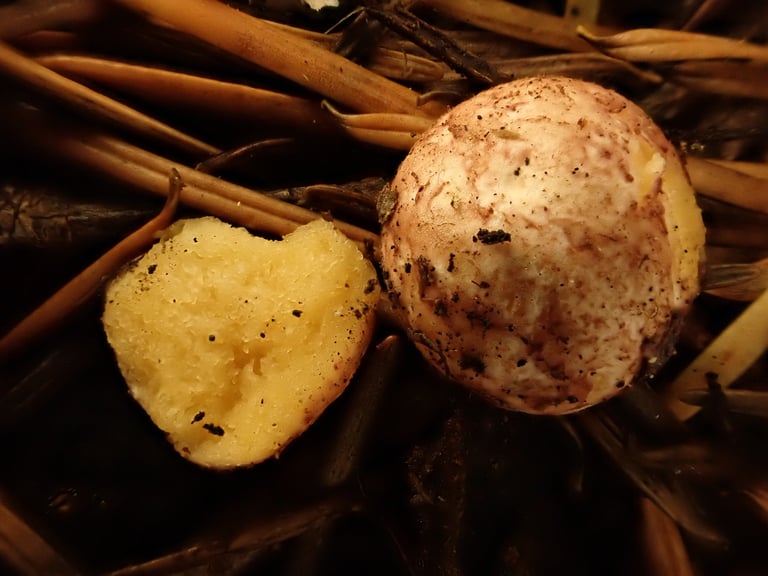
The most reliable field mark is the bruising reaction: the cream to olive-yellow pores and the pale flesh near the cap-stipe junction turn dull blue to bluish-grey when cut or pressed, though the change can be faint and fades over time. This staining, combined with the cap color and stipe shape, separates it from most other boletes encountered nearby.
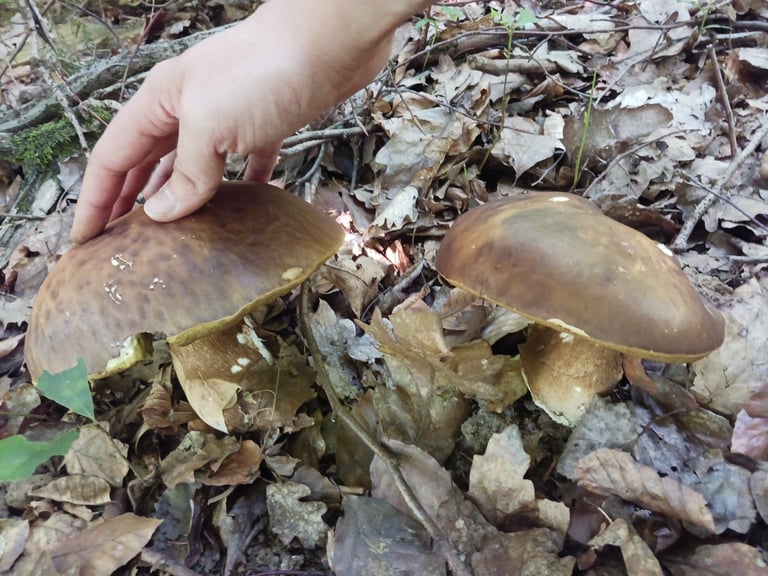
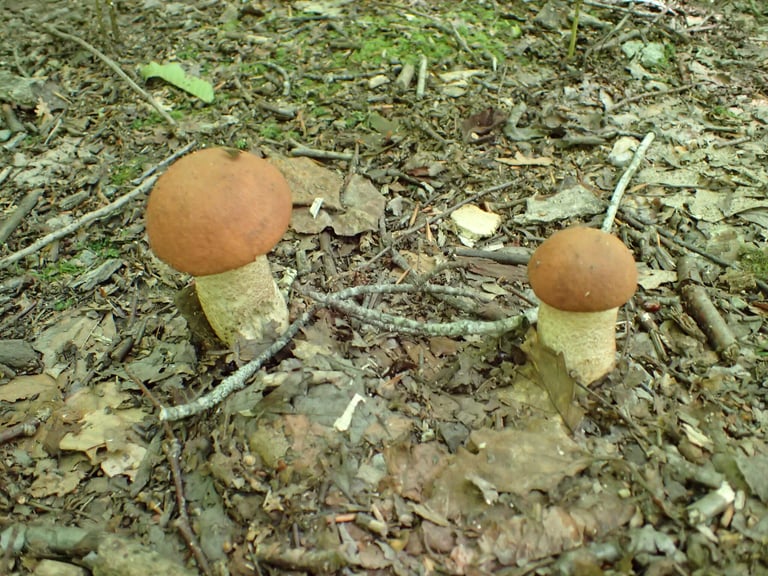
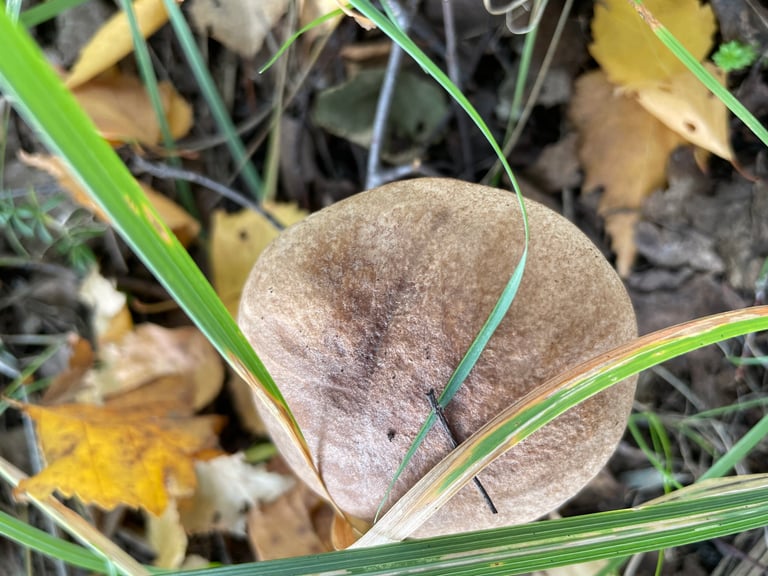
The cap is chestnut to dark brown, almost spherical in young specimens before broadening to as much as 10 cm across. Its margin is acute and its surface velvety when young, becoming slightly sticky with age or moisture; the cuticle clings tightly to the flesh beneath and is hard to peel away. Underneath, the tubes run 0.8 to 1.5 cm long and are adnate to slightly depressed where they meet the stipe, opening into pores that start circular and become angular with age, packed one to two per millimeter.
The flesh is whitish to yellowish, with a brownish-pink or reddish-brown layer just under the cuticle; it is firm when young and softens under the cap with age, and has a fruity smell. The stipe measures 4 to 9 cm long and 1 to 2 cm thick, paler than the cap and sometimes tinged rose, with faint longitudinal ridges, a fine powdering, and a net-like reticulation at the apex. Unlike many boletes, it stays slim and cylindrical rather than swelling into a bulb, and toughens as the mushroom matures.
The spore print is olive to olive-brown, with smooth, slightly ventricose spores measuring 10 to 14 by 4 to 5 μm. Two named varieties exist: macrostipitatus, with a grey-orange cap and longer spores, and glaber, with a smooth stipe. Spot tests aid identification: ammonium hydroxide turns the cap cuticle greenish to bluish, and dilute potassium hydroxide turns the pores golden brown. Similarly colored species include Boletus projectellus, which is more robust with a reticulated stipe and larger spores, and Austroboletus gracilis, which lacks the blue bruising and has a pore surface that starts white rather than cream.
Distribution and Habitat
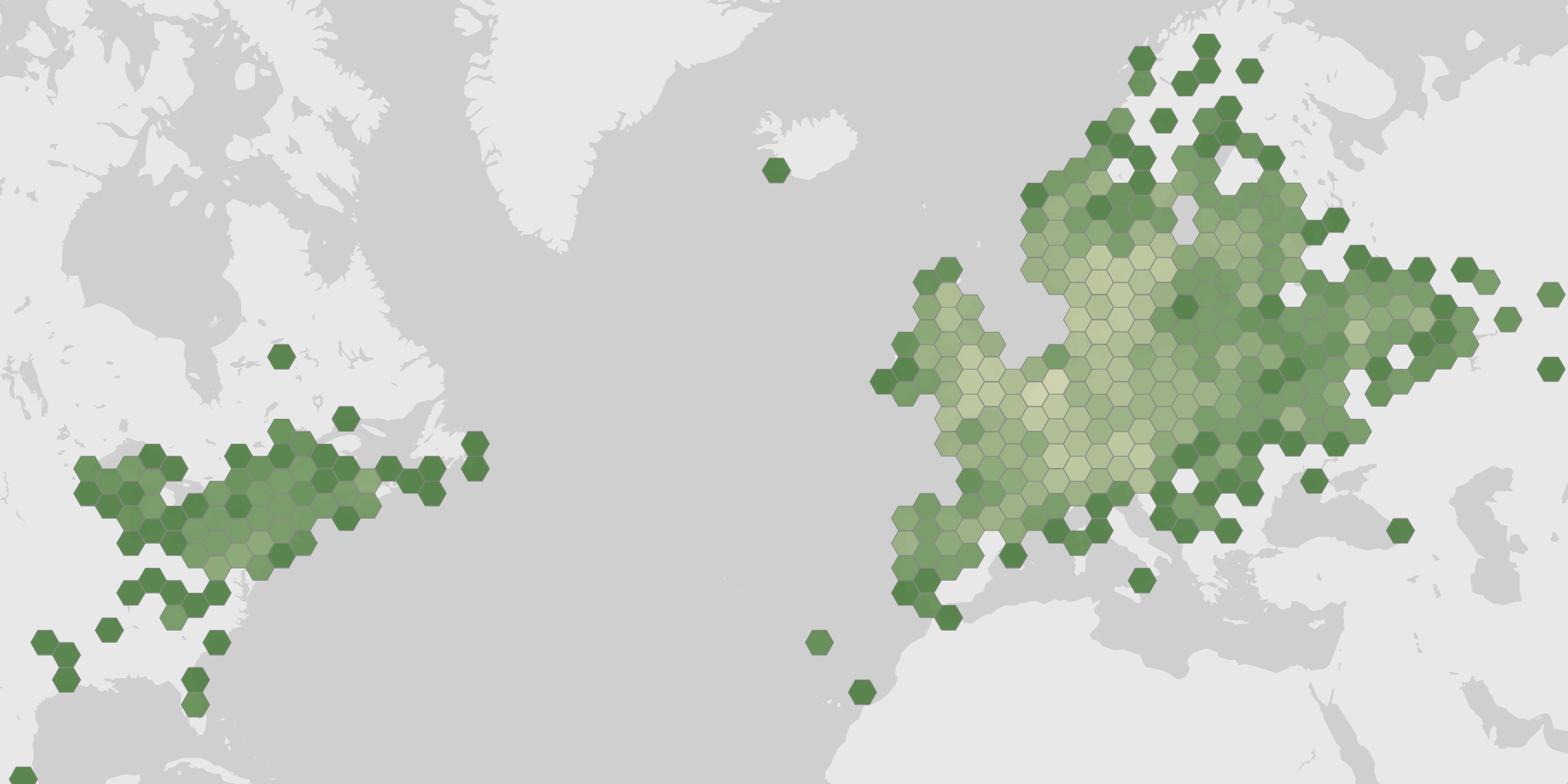
The bay bolete is common across Europe, most abundant in the British Isles from August to November, and its range extends east to the Black Sea region of Turkey. In Asia it has been recorded in Jordan, mainland China, and Taiwan. In North America it ranges from eastern Canada west to Minnesota and south to North Carolina, fruiting from July to November, and it also occurs in central Mexico. The variety macrostipitatus is found from eastern Canada south to Maine and New York, while glaber is restricted to the Atlantic Maritime Ecozone of eastern Canada.
It favors coniferous woodland and, less often, mixed forest, growing under white pine, spruce, and hemlock as well as under deciduous trees such as beech. Fruit bodies appear singly or scattered on the ground or on decaying stumps, often hidden under pine needles and ferns, and can also turn up in grassy or mossy patches near forest edges. It avoids calcareous, chalky soils and tends to fruit most heavily three or four days after rain in warm weather, especially in humid, shady highland areas.
Monthly observation data show a sharp rise from summer into a peak in the fall, with the highest counts recorded in what corresponds to October and strong numbers through September and November. These figures are presence records rather than a measure of abundance or population size, but the pattern lines up with the known August-to-November fruiting window described for European populations.
Ecology and Relationships
The bay bolete is primarily mycorrhizal, forming ectomycorrhizae with trees such as Norway spruce (Picea abies) and Monterey pine (Pinus radiata), though it also shows some saprophytic tendencies it can draw on under certain conditions. Its mycorrhizae with spruce have unusually active hyphal sheaths and a high capacity to store nitrogen, phosphorus, potassium, magnesium, iron, and zinc, making the fungus well suited to acidic, nutrient-limited stands.
Fruit bodies attract fewer insects than many other boletes, but they are eaten by oribatid mites such as Carabodes femoralis, Nothrus silvestris, and Oribatula tibialis, as well as by squirrels.
Several microbial pathogens damage the fruit bodies and have affected populations in China, including soft rot caused by Pseudomonas aeruginosa and black mould caused by species of Mucor, Sepedonium, Paecilomyces, and Diasporangium.
Uses and Cultural History
The bay bolete is often treated as a lesser relative of the cep, Boletus edulis, but some authorities, including Italian cook and restaurateur Antonio Carluccio, rate it a choice edible in its own right, noting a milder flavor than its better-known cousin. It can cause allergic reactions in some people, and its blue bruising can look unappealing raw, though the discoloration disappears once white flesh is cooked. Younger specimens are considered best for eating and, unusually for a bolete, can even be eaten raw; older ones are better suited to slicing and drying. Because the pores readily absorb water, wiping rather than washing is recommended, and the mushroom can be fried in butter, paired with meat or fish, frozen, dried, or pickled in cider vinegar, wine, or olive oil for later use in sauces and soups.
Foraging traditions built around the species run deep in Central and Eastern Europe, where it has long been a staple of autumn mushroom collecting in countries such as Poland, Slovakia, and Germany.
Beyond the kitchen, the fruit bodies are used to make mushroom dyes. Depending on the mordant applied, they can yield yellow, orange, gold, or green-brown shades, and produce yellow with no mordant at all.
Fun Facts
- Elias Fries first described the species in 1818, but it spent much of the 20th century classified as Xerocomus badius before DNA studies placed it in its own genus, Imleria.
- Unlike most boletes, young bay bolete specimens can be eaten raw.
- Two named varieties exist: macrostipitatus, recognized by its grey-orange cap and shorter stipe, and glaber, which has a smooth rather than reticulated stipe surface.
- Mycologists use chemical spot tests to confirm identification: ammonium hydroxide turns the cap cuticle greenish to bluish, while potassium hydroxide turns the pores golden brown.
- The fruit bodies can be turned into natural dyes, producing yellow, orange, gold, or green-brown colors depending on the mordant used.
- Antonio Carluccio recalled picking bay boletes in the grounds of Blenheim Palace.
- In Poland, Slovakia, and Germany, gathering this mushroom is a long-standing part of autumn foraging traditions.
Conservation status
- LC
- NT
- VU
- EN
- CR
Least Concern
Ecology
Habitat
- Forest
- Woodland
- Mountain