The Indian grey hornbill is one of the few hornbill species found in many Indian cities, where it uses large trees along avenues. Its grey plumage and black or dark grey horn make it easy to pick out in the canopy.
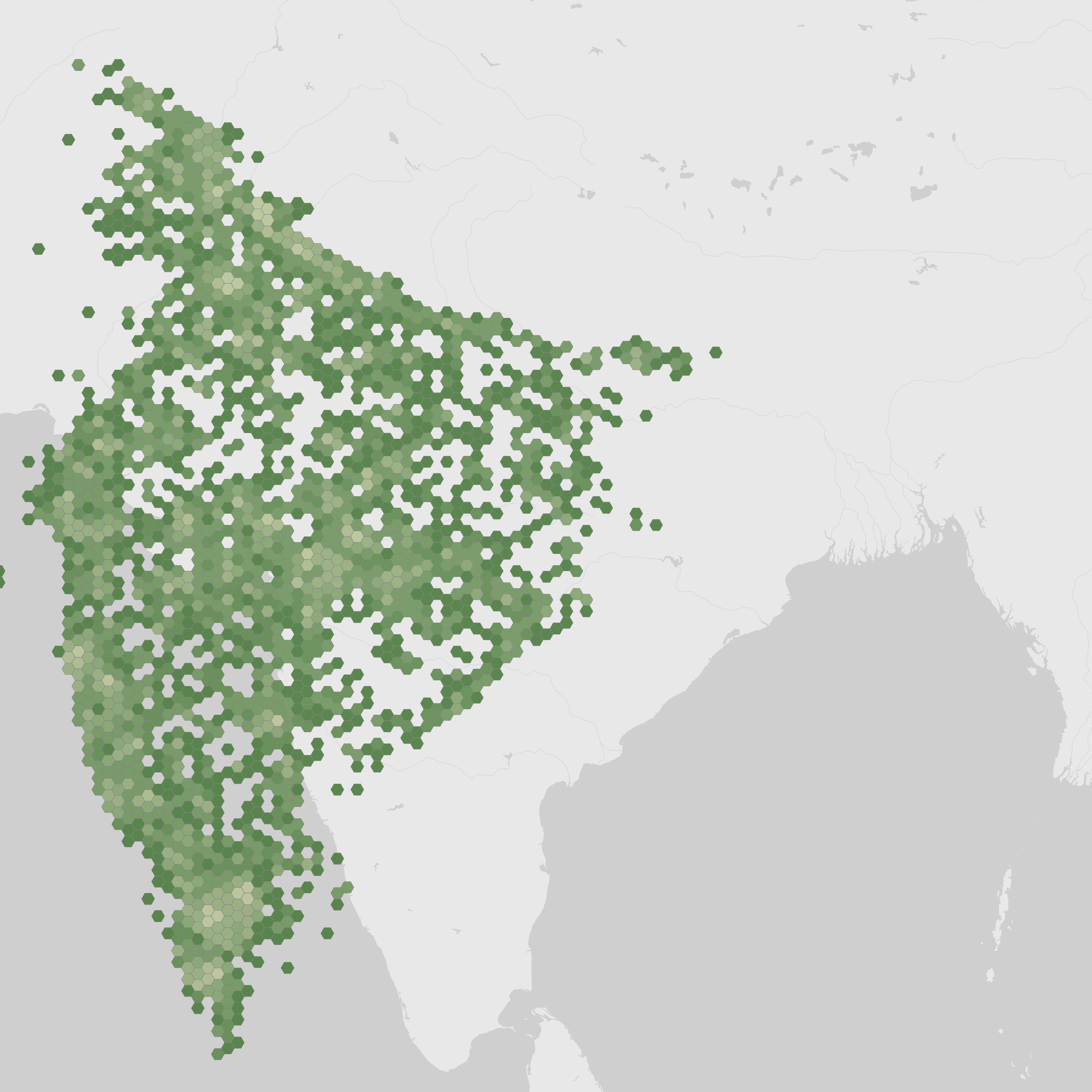
The species is found on the Indian subcontinent, from the foothills of the Himalayas southward. It covers a range of about , and its conservation status is Least Concern. Adults weigh about .
It is a common bird that is mostly arboreal and often seen in pairs, which makes it a good subject for anyone watching hornbills close to home.
Identification and Appearance
The Indian grey hornbill is a medium-sized hornbill, about 61 cm (24 in) long. Its short, pointed casque and grey body are the most useful marks in the field.
The upper parts are greyish brown, with a light grey or dull white belly. The ear coverts are darker, and there is a slight pale supercilium above the eye. The flight feathers are dark brown with whitish tips, and the tail has a white tip and a dark band near the end.
The male has a larger casque on a dark bill, and the culmen and lower mandible are yellowish. The bare skin around its eye is dark. The female has a more yellowish bill, with black on the basal half of the bill and on the casque, and the bare skin around her eye is sometimes pale reddish.
Juveniles lack a casque, and the bare skin around their eyes is dull orange. Adults of both sexes have a red iris and eyelids with eyelashes.
Distribution and Habitat
The Indian grey hornbill occurs mainly on the plains, up to about 2,000 ft (610 m). It ranges from the foothills of the Himalayas southward, with the Indus system marking its western edge and the Ganges Delta its eastern edge.
It uses woodland and is found even in cities with old avenue trees. Its range is semi-open country rather than dense forest, and it is one of the few hornbills that adapts well to towns.
In the Himalayan foothills, it also lives in Dharamsala town in Himachal Pradesh, at about 1,500 to 1,600 m, where it is present in summer and the rainy season from May to September. It does not overlap much with the Malabar grey hornbill of the Western Ghats.
After vanishing from Gujarat's Gir forests more than 60 years ago, the species was reintroduced there and has bred successfully for four straight years.
Behavior and Lifestyle
The Indian grey hornbill is almost completely arboreal. It spends most of its time in the trees and only rarely comes to the ground, mainly to pick up fallen fruit, dust bathe or collect mud pellets during nesting.
It is usually found in pairs or small groups. Its flight is heavy, with steady flapping interspersed with glides. Pairs and groups take part in social activities such as bill-grappling and aerial jousting.
It is sedentary, although it may make local movements in the drier western part of its range.
During the nesting season from April to June, the pair uses a tree hollow, which may be enlarged to suit. The female seals the entrance and remains inside while the male feeds her through a small vertical slit.
Photos
Photographs from via iNaturalist, licensed under CC0 1.0., by apoorva sr via iNaturalist, licensed under CC BY 4.0., by Mittal Gala via iNaturalist, licensed under CC BY 4.0., by Ashwin via iNaturalist, licensed under CC BY 4.0., by Piyush Marwadi via iNaturalist, licensed under CC BY 4.0., by Srivatsan Ramkumar via iNaturalist, licensed under CC BY 4.0., by Ajay via iNaturalist, licensed under CC BY 4.0., by haemanthus via iNaturalist, licensed under CC BY 4.0., by Mitul and Vijul Singh via iNaturalist, licensed under CC BY 4.0., and by Jahnavee Palsodkar (she/her) via iNaturalist, licensed under CC BY 4.0., credited on each photo.
Ecology and classification
Classification
- Phylum
- Chordata
- Class
- Aves
- Order
- Bucerotiformes
- Family
- Bucerotidae
- Genus
- Ocyceros
- Species
- Ocyceros birostris
Sources
- GBIF Species names and classification
- iNaturalist Photos
- Wikidata Common names and conservation status
- Wikipedia Summary extract
- AVONET Bird mass, habitat, migration, diet and range size