A tiny bird weighing only about 8.6 grams, the Indian White-eye (Zosterops palpebrosus) is instantly recognizable by the bold white ring encircling its eye, a feature that gives the entire family its name.
This small passerine is a resident breeder across open woodland and scrub of the Indian subcontinent, ranging west into Arabia and east toward Myanmar, and it carries an IUCN status of Least Concern. Its renaming from the former "Oriental white-eye" reflects a recent taxonomic split that makes this name more geographically precise, and its sociable, nectar-sipping habits make it a familiar sight to birdwatchers throughout its range.
Identification and Appearance
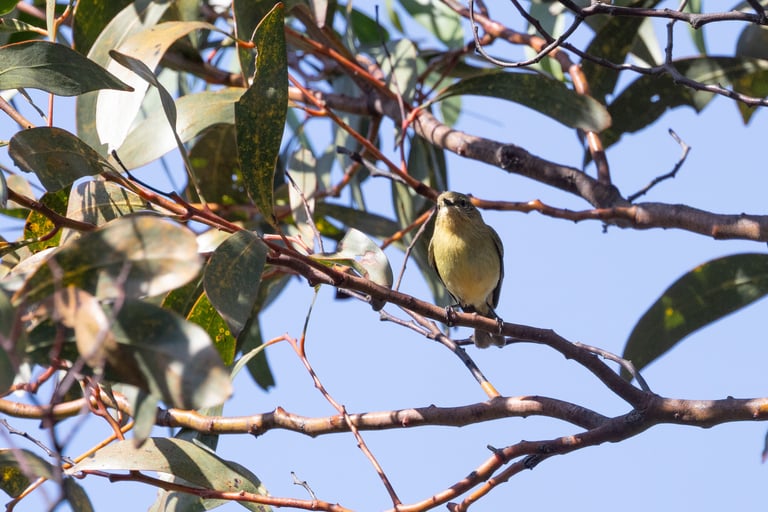
The single best field mark is the crisp white eye-ring, set against yellowish-olive upperparts and a yellow throat. The bird is small, measuring about 8 to 9 centimeters long and weighing roughly 8.6 grams.
The belly is whitish-grey, though some subspecies show yellow instead, and the sexes look alike, offering no visual cue for telling males from females. About eleven subspecies are recognized across its range, varying subtly in bill length, brightness of green above, and the amount of brown tinge on the flanks — the Western Himalayan occidentis form, for instance, is darker green above with browner flanks, while salimalii has a shorter bill and brighter yellow-green plumage.
In Sri Lanka, the local race egregia is smaller and brighter than the endemic Sri Lanka White-eye (Zosterops ceylonensis), a similar species confined to the island's central hills. The wider Zosterops group itself remains taxonomically unsettled, with some island populations—such as one on Flores, Indonesia—sitting closer to the pale white-eye than to this species.
Distribution and Habitat
This species occupies an enormous range, spanning roughly 6,380,000 square kilometers from Arabia and Oman across northern India to China and Myanmar. It favors a wide span of habitats, from scrub to moist forest, and occasionally enters mangrove stands such as those around Karachi, Pakistan, where island populations tend to live a more insect-heavy lifestyle.
It is only scarce in the driest desert tracts of western India. Presence observations recorded through the year show counts staying fairly steady, with a gentle rise in the early months and a dip through the mid-year period, though these figures reflect where the bird has been seen rather than how many exist.
A feral population that appeared in San Diego, California, in the 1980s was later eradicated, showing the species' capacity to survive well outside its native range when displaced.

Behavior and Lifestyle
Indian White-eyes are highly social, moving in flocks that forage and call together, only breaking apart as the breeding season approaches. They are strongly arboreal, rarely coming down to the ground, and call frequently while foraging with a soft, nasal contact call.
Breeding runs from February to September, peaking in April, when pairs build a compact, hammock-like cup nest of cobwebs, lichen, and plant fiber wedged into a branch fork — a task finished in about four days. Two pale blue eggs are laid a day or two apart, hatch after roughly 10 days, and the chicks fledge about 10 days later, with both parents sharing brooding duties.
The birds sometimes mob palm squirrels near the nest, though being small, they generally stay on the defensive against predators such as the bat Megaderma lyra and the white-throated kingfisher. They also steal nesting material from other birds' nests and have even been seen feeding the chicks of paradise flycatchers. Though weak fliers, they can be swept long distances by storms, which is how a population ended up establishing itself in California before being trapped out with call playback and decoys.
Fun Facts
- The species carries endoparasitic blood parasites of the genus Haemoproteus and Dorisa, though these rarely prove fatal.
- A drawer of white-eye study skins held at a major English museum was destroyed when the building was bombed and burned during World War II.
- Though considered mainly insectivorous, individuals sometimes show a yellow poll on the forehead from pollen, occasionally leading observers to misidentify them.
Photos
Photographs from via iNaturalist, licensed under CC0 1.0., by Tandin Wangdi via iNaturalist, licensed under CC BY 4.0., by Wolfgang Ahlmer via iNaturalist, licensed under CC BY 4.0., by haemanthus via iNaturalist, licensed under CC BY 4.0., by rajesh rocky via iNaturalist, licensed under CC BY 4.0., by Srivatsan Ramkumar via iNaturalist, licensed under CC BY 4.0., by Mitul and Vijul Singh via iNaturalist, licensed under CC BY 4.0., by Navaneeth Sini George via iNaturalist, licensed under CC BY 4.0., by Aryan K via iNaturalist, licensed under CC BY 4.0., by sunnyjosef via iNaturalist, licensed under CC BY 4.0., by Ashwin A via iNaturalist, licensed under CC BY 4.0., and by Jahnavee Palsodkar (she/her) via iNaturalist, licensed under CC BY 4.0., credited on each photo.
Ecology and classification
Classification
- Phylum
- Chordata
- Class
- Aves
- Order
- Passeriformes
- Family
- Zosteropidae
- Genus
- Zosterops
- Species
- Zosterops palpebrosus
Sources
- GBIF Species names and classification
- iNaturalist Photos
- Wikidata Common names and conservation status
- Wikipedia Summary extract
- AVONET Bird mass, habitat, migration, diet and range size