The torn fibrecap, Inocybe lacera, looks like countless other small brown mushrooms scattered across a forest floor, yet it hides one of the most distinctive microscopic profiles in its genus. Despite its plain, unremarkable appearance, this species is poisonous, and identifying it reliably requires looking well beyond color and shape.
This fungus belongs to the family Inocybaceae within the class Agaricomycetes, and it grows across Europe and North America. Several documented varieties exist, including a dwarf form and a North American variant with unusually variable spore sizes, adding a layer of complexity to a mushroom that otherwise looks entirely ordinary at first glance.
Fruiting Body and Identification
The most reliable way to identify Inocybe lacera is microscopically, through its long, smooth, subcylindrical spores, typically 11 to 15 by 4.5 to 6 micrometers, a feature shared by only a small group of related species. In the field, it presents as a classic "little brown mushroom": a convex cap 1 to 3 centimeters across with a small umbo, snuff-brown in color, fibrillose and scaly in texture, with a margin that curves inward and often splits, giving the species its common name.
The stipe stands 2 to 3 centimeters tall and 3 to 6 millimeters thick, brown and slightly bulbous at the base but lighter near the apex, with the same fibrillose texture as the cap and no ring. The flesh is white, and the adnexed gills start white in young specimens before maturing to a clay-buff shade with white edges. The spore print is brown.
Under magnification, thick-walled, fusiform cystidia with apical encrustations confirm the species, alongside 4-spored basidia. The dwarf form, I. lacera var. subsquarrosa, has smaller spores and thin-walled cystidia, while the North American I. lacera var. heterosperma shows spores ranging from 5.5 to 15.5 micrometers in length.
Distribution and Habitat
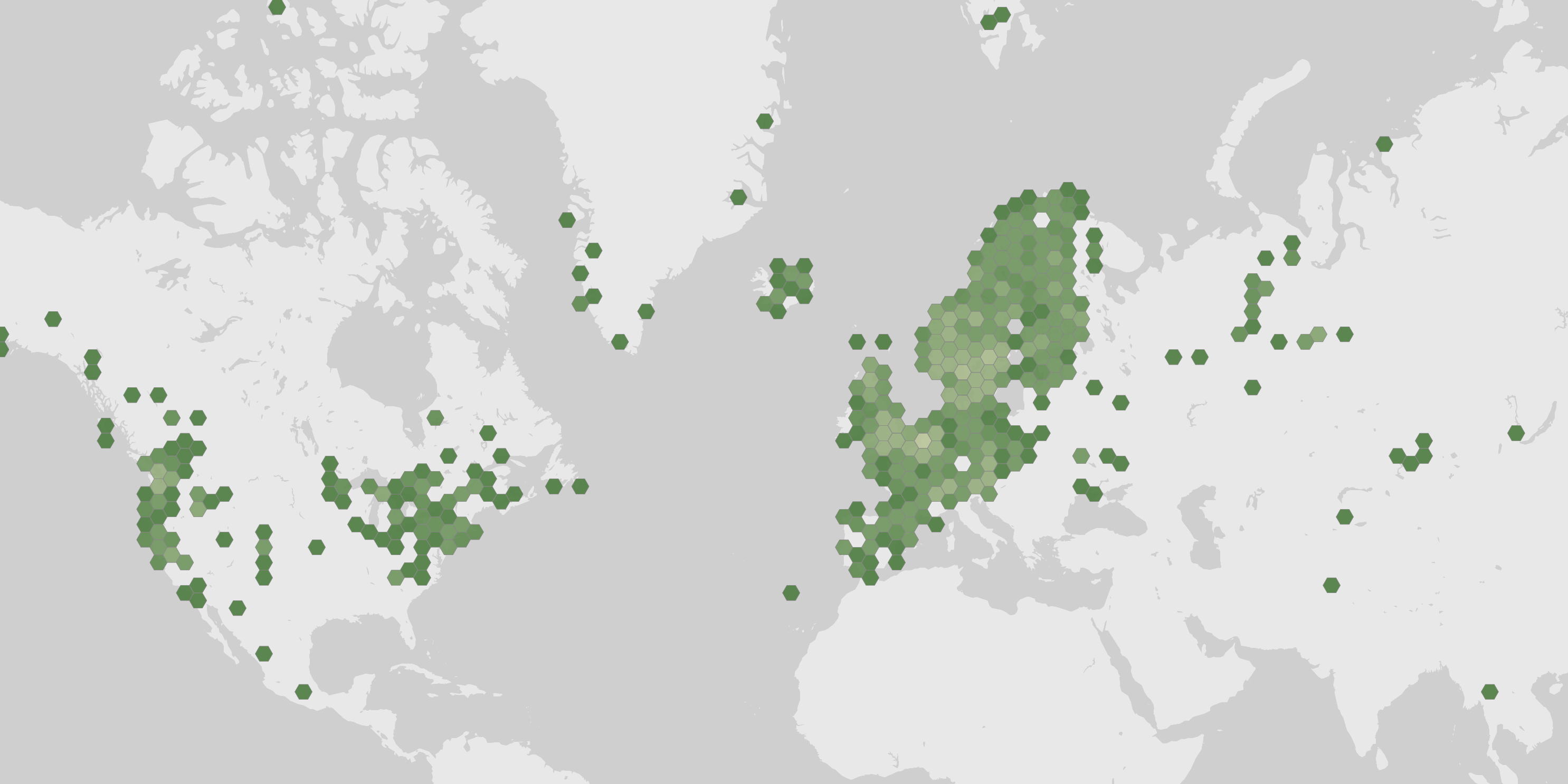
Inocybe lacera occurs throughout Europe and North America, most often on sandy soil in association with pine, though it also turns up in mixed woodlands with both conifers and hardwoods as a mycorrhizal partner. Fruiting bodies appear alone, scattered, or gregariously, and the species favors disturbed or open microhabitats: the edges of woodland paths, heathland, coastal dunes, and old, moss-covered fire sites are all recorded habitats. In parts of Montana, it has been found growing in spring beneath quaking aspen (Populus tremuloides), a departure from its more typical autumn fruiting pattern elsewhere.
Monthly observation data show a sharp rise from May onward, peaking in August with over 3,100 recorded observations before declining through autumn and dropping to low numbers by winter. Since these figures are presence records rather than measures of abundance or population size, they should be read only as an indication of when the species is most often noticed and reported, likely reflecting both peak fruiting and increased observer activity during warmer months.
Fun Facts
- Despite belonging to the order Agaricales, Inocybe lacera produces spores shaped more like those typical of the order Boletales, an unusual trait among its relatives.
- The species' common name, torn fibrecap, refers to the cap margin, which frequently splits as it expands.
- A dwarf form, I. lacera var. subsquarrosa, has smaller spores and thinner-walled cystidia than the typical variety.
- The North American variant, I. lacera var. heterosperma, shows an unusually wide range of spore lengths, from 5.5 to 15.5 micrometers.
- It is one of only a small group of related species with particularly long, cylindrical spores, most of the others in that group being found specifically on sand dunes.
Ecology
Habitat
- Coastal
- Forest
- Woodland
- Shrubland