A male Komodo dragon can grow to 3 meters long and weigh up to 150 kilograms, making it the largest lizard alive today. It belongs to the monitor lizard family Varanidae and survives only on a handful of Indonesian islands: Komodo, Rinca, Flores, Gili Dasami, and Gili Motang, with its largest population protected inside Komodo National Park.
The species is classified as Endangered, squeezed onto a shrinking string of islands by habitat loss, poaching of its prey, and a warming, rising sea. Few animals combine such raw physical power with such a narrow, fragile range, which is exactly what makes the Komodo dragon worth understanding closely.
Identification and Appearance
The single most reliable field mark is sheer bulk: no other living lizard approaches the Komodo dragon's size. An average adult male measures about 2.59 meters and weighs 79 to 91 kilograms, while females run smaller, averaging 2.29 meters and 68 to 73 kilograms. The largest verified wild individual reached 3.04 meters and 81.5 kilograms before eating, and captive animals have topped 3.1 meters and 166 kilograms with a full stomach.
The body is thickset and low-slung, carried on powerful clawed limbs, with a tail as long as the body itself. Around 60 serrated, blade-like teeth line the jaws, each up to 2.5 centimeters long; a 2024 study found their serrations and tips carry an orange, iron-enriched coating that keeps the cutting edge sharp. A long, deeply forked yellow tongue flicks constantly to sample scent in the air.
Skin is reinforced with bony plates called osteoderms, arranged in four distinct shapes: rosette, platy, dendritic, and vermiform, a pattern unique among monitor lizards. This natural armor is absent in hatchlings and juveniles and thickens with age, developing as adults compete over food and mates. The only unarmored patches on an adult's head surround the eyes, nostrils, mouth, and the light-sensing parietal eye on the crown.
Juveniles look and behave differently from adults: their teeth are barely recurved with weak serrations suited to an insect diet, and they lack the rugged osteoderm armor entirely. Their greenish, banded coloring and smaller, more agile build help them stay hidden and climb trees, a habit adults largely abandon once their size makes climbing impractical.
Distribution and Habitat
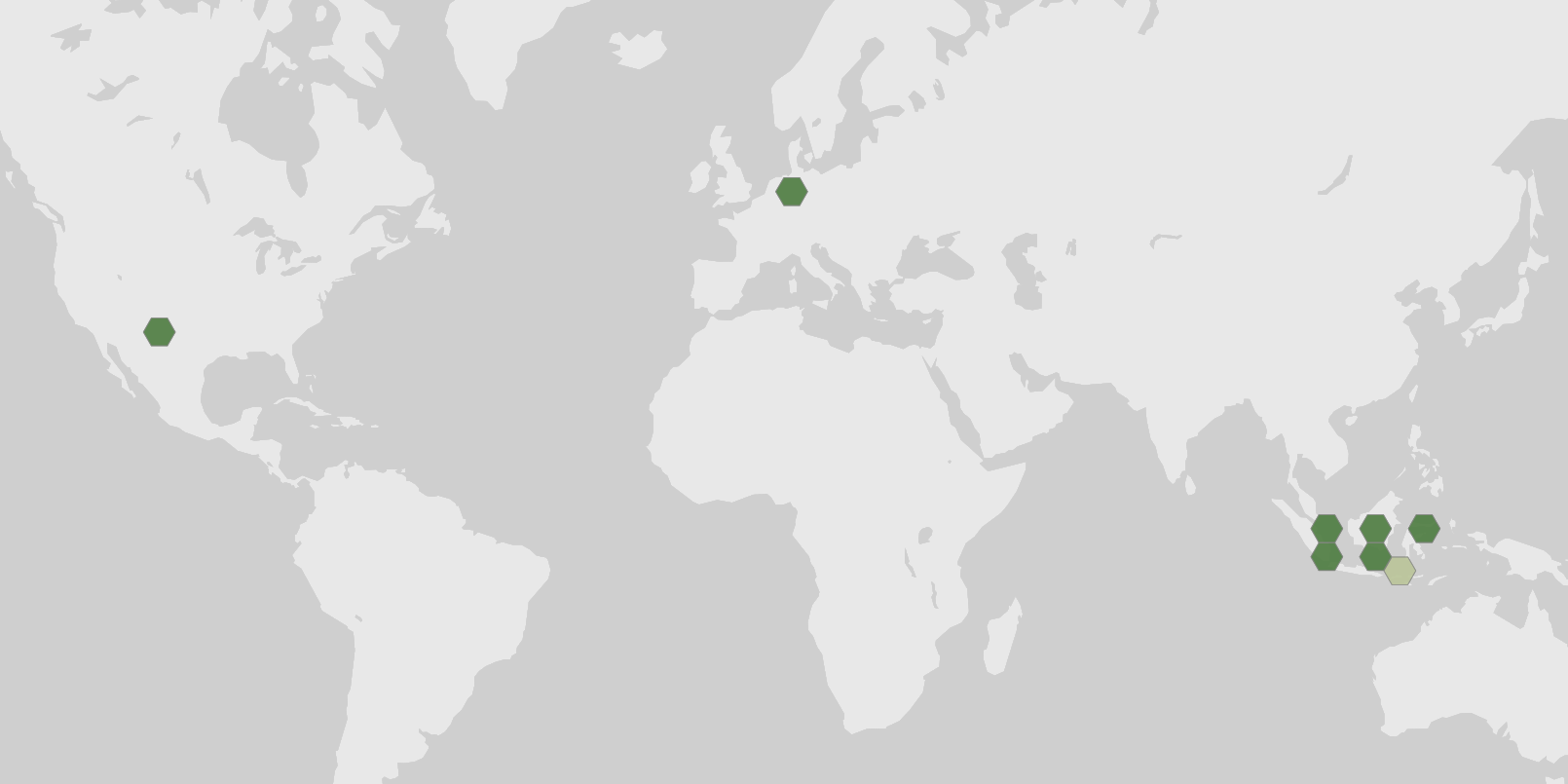
The Komodo dragon is confined to a small cluster of volcanic Indonesian islands: Komodo, Rinca, Flores, Gili Dasami, and Gili Motang, all within the Lesser Sunda chain. It ranges from sea level up to roughly 700 to 820 meters, favoring the lower monsoon forest and savanna belt rather than higher ground.
Adults live mainly in tropical savanna forest, open lowland grassland studded with tall grasses and bushes, but they also turn up on beaches, ridge tops, and dry riverbeds. Young dragons occupy a different world entirely: they stay arboreal, living in trees within forested patches until about eight months old, when the risk of being eaten by adults finally eases.
Monthly observation counts drawn from GBIF records rise through the year, from around 57 to 75 sightings in the first quarter to a peak of 158 and 177 in July and August, before falling back toward 70 to 105 by year's end. These are presence records rather than a population census, but the pattern hints at greater visibility or activity during the dry season months, which also coincide with the species' mating period.
Behavior and Lifestyle
Komodo dragons are solitary, ectothermic, and mostly diurnal, roaming home ranges that can span up to 1.9 square kilometers. These ranges are not defended and often overlap, but at a shared carcass a strict order takes hold: the largest males feed first, then smaller males and females, with juveniles descending from the trees only after the adults have finished.
Each dragon digs its own burrow, sometimes 1 to 3 meters wide, retreating into it at night and during the hottest part of the day. Sleeping in these burrows helps conserve body heat and cuts down the morning basking needed before activity resumes. Favored resting sites sit on ridges that catch cool sea breezes; dragons keep them cleared of vegetation and marked with droppings, using them as ambush points from which to surprise passing deer.
Despite their bulk, Komodo dragons can sprint up to 20 km/h in short bursts, dive to depths of 4.5 meters, and, as juveniles, climb trees skillfully using strong claws. Adults sometimes rear onto their hind legs, bracing with the tail, to reach prey that would otherwise be out of range.
Communication
Scent is the Komodo dragon's primary channel for finding food and other dragons, detected through constant flicks of its forked tongue rather than through vision or hearing alone. Its hearing is restricted to roughly 400 to 2,000 hertz, a narrow band compared with the human range of 20 to 20,000 hertz, so sound plays only a limited role in its daily life.
Dominance during feeding and mating is settled largely through tactile display: rival males wrestle each other upright, each trying to throw the other to the ground. Chemical signaling drives courtship, with females releasing a scent in their feces to announce readiness to mate; a male detects this, then responds with chin-rubbing and body-licking to confirm her receptiveness before pairing.
Hunting and Diet
A Komodo dragon hunting large prey relies on ambush rather than a chase, lying in wait near a ridge or trail before delivering a single powerful bite and then trailing the wounded animal until it collapses from blood loss or infection. Its saliva carries bacteria that speed this process, and researchers suspect a mild venom may also help subdue struggling prey, though the exact action of any Komodo venom has not been fully studied.
Adults take goats, pigs, deer, wild boar, horses, water buffalo, and even smaller Komodo dragons, though much of an adult's diet in practice is carrion, scavenged from animals that are already dead. A flexible skull and expandable throat let a dragon swallow enormous chunks of meat, and it eats almost the entire carcass, wasting very little.
Juveniles eat on a completely different menu: grasshoppers, beetles, small geckos, eggs, birds, and eventually small mammals, reflecting both their smaller size and their need to avoid competing with, or being eaten by, adults of their own species.
Reproduction and Life Cycle
Courtship begins with ritual combat: rival males grapple upright on their hind legs, sometimes vomiting or defecating beforehand, until one is thrown and pinned to the ground. The winner then flicks his tongue at the female to gauge her receptiveness, since females initially resist with claws and teeth and must be firmly restrained during mating; chin-rubbing, back-scratching, and licking follow as further courtship before the male mates using one of his hemipenes.
Mating occurs from May to August, and females lay their eggs in August or September, often in the nest mounds of orange-footed scrubfowl, which about 60% of females use, with the rest laid at ground level or in hilly terrain. Clutches average around 20 eggs, occasionally as many as 30, and incubate in the ground for 7 to 8 months. Females frequently dig several decoy nests to protect the real clutch from other dragons.
Hatchlings break free using an egg tooth that later falls off, emerging at roughly 46.5 centimeters long and about 105 grams. They face heavy predation, including from cannibalistic adults, and immediately head for the safety of trees, where they will spend much of their first several years. Sexual maturity arrives late: around 9 years for females and 10 for males.
Unusually for a lizard, Komodo dragons have been documented reproducing by parthenogenesis, laying viable eggs without any male contact, as recorded in captive females at London Zoo, Chester Zoo, and Sedgwick County Zoo in Kansas. Because the species uses a ZW chromosomal system rather than the mammalian XY system, these unfertilized eggs hatch exclusively into males.
Population and Ecological Role
Wild population counts have tracked a slow decline over recent years: an estimated 3,222 individuals in 2013, dropping to 3,092 in 2014 and 3,014 in 2015. Numbers have stayed relatively stable on the larger islands of Komodo and Rinca, while smaller islands such as Nusa Kode and Gili Motang have seen sharper drops, likely tied to shrinking prey availability. On Padar, the species disappeared entirely, with the last individuals recorded in 1975 after a collapse in large ungulate prey, most likely driven by poaching.
Within its ecosystem, the Komodo dragon operates as both a top predator and a scavenger, occupying a role held by few other animals on its islands. As a scavenger it clears recently dead animals from the landscape, while as a predator of deer, boar, and smaller dragons, including its own cannibalized young, it helps regulate prey populations that have few other large predators to contend with.
Conservation and Threats
The IUCN lists the Komodo dragon as Endangered, a status shaped by prey depletion, poaching, and habitat encroachment across its limited island range. Additional pressures include volcanic activity, earthquakes, fire, and tourism disturbance, while illegal poaching of the dragons themselves persists despite legal protection; in March 2019, Indonesian police intercepted a criminal network attempting to smuggle 41 young Komodo dragons out of the country through the port at Ende in Flores, reportedly destined for sale at up to 500 million rupiah each.
Climate change now ranks among the most serious long-term threats. Because Komodo dragons cannot move into higher-altitude terrain, aridification and sea-level rise threaten the low-lying valleys and habitats they depend on; projections suggest suitable habitat could shrink by anywhere from 8.4% to 71% by 2050 depending on the scenario, with populations on Flores potentially extirpated entirely and only Komodo and Rinca retaining dragons in the more severe projections. Some scientists dispute the severity of these projected impacts.
Protection efforts center on Komodo National Park, established in 1980 to safeguard populations on Komodo, Rinca, and Padar, alongside the later Wae Wuul and Wolo Tado Reserves on Flores. International commercial trade in Komodo dragons or their skins is banned under CITES Appendix I.
Cultural Significance
For centuries, Komodo dragons have been feared across local cultures and beyond, with tales of their deadly bite feeding into stories that may have helped inspire the mythical dragons that share their name. On Flores and neighboring islands, folklore traditions describe humans and dragons as connected by blood and destiny, a myth that reflects deep respect for the animal and its place in local cultural identity.
Today the Komodo dragon draws visitors and researchers alike: it is a major ecotourism attraction in eastern Indonesia and a continuing subject of scientific study, particularly into how the species carries lethal bacteria in its saliva without succumbing to infection itself.
Fun Facts
- Female Komodo dragons have laid viable eggs without ever mating, a process called parthenogenesis, documented in captive dragons at zoos in London, Chester, and Kansas.
- Because the species uses a ZW chromosome system instead of the mammalian XY system, unfertilized parthenogenetic eggs hatch only into males.
- Komodo dragons have just one ear bone, the stapes, limiting their hearing to roughly 400 to 2,000 hertz, a far narrower range than human hearing.
- Researchers have isolated an antibacterial peptide from Komodo dragon blood plasma, later synthesized into a compound called DRGN-1 that killed drug-resistant bacteria and fungi and promoted wound healing in lab tests.
- The oldest recorded Komodo dragon lived to 62 years old.
- Young dragons sometimes roll in feces and rest inside the intestines of a carcass to mask their scent from hungry cannibalistic adults.
Photos
Photographs from via iNaturalist, licensed under CC0 1.0., by anguspritchard via iNaturalist, licensed under CC BY 4.0., and by Fionn Ó Marcaigh via iNaturalist, licensed under CC BY 4.0., credited on each photo.
Ecology and classification
Classification
- Phylum
- Chordata
- Class
- Squamata
- Family
- Varanidae
- Genus
- Varanus
- Species
- Varanus komodoensis
Sources
- GBIF Species names and classification
- iNaturalist Photos
- Wikidata Common names and conservation status
- Wikipedia Summary extract
- Encyclopedia of Life Habitat, diet and behavior traits
- Animal Diversity Web Animal habitat, behavior and diet
- AnAge Longevity