The European green lizard suns itself openly on rocks, lawns, and low bushes across a vast stretch of Europe, from Slovenia and eastern Austria all the way to the Black Sea coasts of Ukraine and Turkey.
It is a large member of the lizard family Lacertidae, within the order Squamata, and is currently assessed as Least Concern by the IUCN. Its size, bold coloring, and habit of basking in plain sight on walls and embankments make it one of the more conspicuous reptiles anywhere within its range.
Identification and Appearance
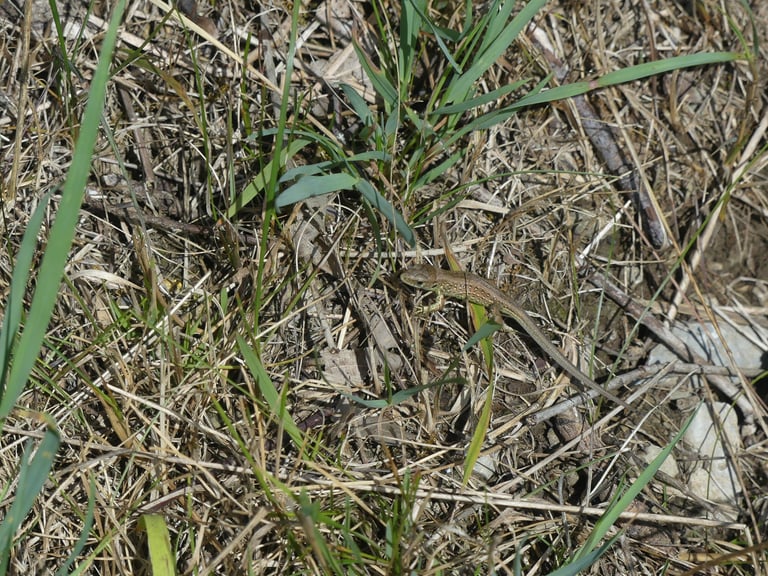
The clearest field mark is the male's uniform green body punctuated with small dark spots, most pronounced along the back, paired with a bluish throat that intensifies during the breeding season. Females share the bluish throat to a lesser degree but are more slender and typically show two to four light bands bordered by black spots rather than the male's solid green.
Lacerta viridis is a large lizard: the body reaches up to 15 centimeters (5.9 inches) from snout to cloaca, while the tail can run up to twice the body length, bringing the total length to as much as 40 centimeters (16 inches). Adults weigh around 15.7 grams.
The tail is also a defense tool. Like many lacertids, this species can shed it through autotomy to escape a predator's grip, later regrowing a replacement, though the new tail rarely matches the original in length or color.
The male's larger head and bolder, more uniform green set him apart from the female at a glance, while juveniles and subadults can be told apart by their more muted, patterned appearance before they mature.
Distribution and Habitat
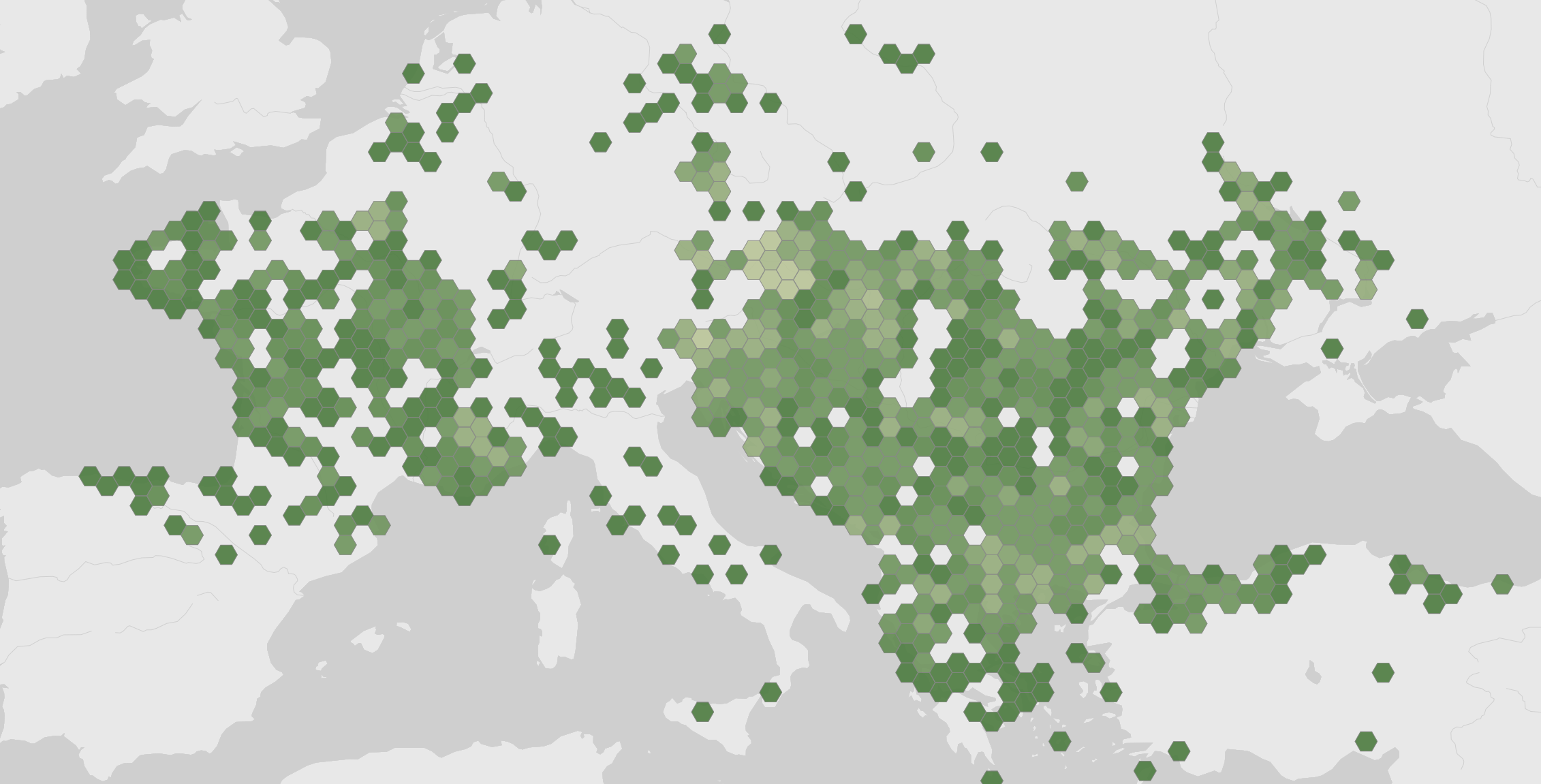
The European green lizard occupies a broad native range across southeastern and central Europe, from southern Germany, Austria, Hungary, the Czech Republic, and Slovakia through the extreme northeast of Italy, Slovenia, Croatia, Bosnia and Herzegovina, Serbia, Montenegro, Albania, North Macedonia, and Greece, eastward into southern Ukraine, Romania, Bulgaria, and western Turkey.
It is found from lowland habitats up to elevations of 2,200 meters (7,218 feet). Typical habitat is dense bushy vegetation in open woodland, hedgerows, field margins, embankments, and bramble thickets. In the northern part of its range it favors bushy heathland, while populations in the south tend to prefer damper locations.
Outside its native range, repeated introduction attempts have been made in Britain since the late 19th century, and a colony (identified as the related L. bilineata) has persisted at Bournemouth since the late 1990s; the same species also occurs in Jersey, where it may be native. The lizard has also been introduced to the state of Kansas in the United States.
Monthly observation counts rise sharply from March, peak in May, and fall away by autumn and winter, a pattern consistent with increased basking and surface activity during the warmer breeding months rather than any true measure of population size or complete range, since these figures reflect presence records rather than abundance.
Behavior and Lifestyle
This lizard lives close to the ground, moving through low, dense vegetation and basking in open, sunny spots early and late in the day to regulate its body temperature. Much of its daily rhythm centers on alternating between sun-warmed perches on rocks or lawns and cover within bushes and thickets.
Its diet is mostly insects and other small invertebrates, but it is opportunistic enough to also take fruit, birds' eggs, fledglings, small lizards, and even mice when the chance arises.
Breeding activity culminates in spring, when the female lays six to twenty eggs, which hatch after two to four months. Hatchlings emerge pale brown with a snout-to-vent length of just 3 to 4 centimeters (1.2 to 1.6 inches), reaching sexual maturity the following year, by which time they have roughly doubled in size.
Population and Ecological Role
As both predator and prey, the European green lizard plays a role on two sides of the local food web: it helps control populations of insects and other invertebrates while itself serving as a food source for a range of predators, including red foxes, badgers, domestic cats, birds of prey such as buzzards and kestrels, crows, and snakes such as adders.
This wide predator list, drawn from mammals, birds, and reptiles alike, reflects the lizard's exposure across the many open and semi-open habitats it occupies throughout its range.
Conservation and Threats
The IUCN lists the European green lizard as Least Concern, a status supported by its wide geographic range and the fact that it remains common across much of that range. It is considered an adaptable species, and no substantial threats have been identified over most of its distribution.
An exception is Turkey, where pesticide use may be affecting local populations, since the insects and other invertebrates that make up the bulk of its diet are vulnerable to agricultural chemicals.
Conservation status
- LC
- NT
- VU
- EN
- CR
Least Concern
Cultural Significance
The green lizard has carried sharply different meanings across cultures. In Egyptian and Greek mythology it was regarded as a symbol of good fortune, while the ancient Romans, observing the lizard disappear for months during hibernation, took its seasonal reemergence as a symbol of death and resurrection.
Elsewhere, the same animal took on an opposite reputation: in most cultures, the lizard has instead been cast as a symbol of evil, even linked to the devil.
The genus name also lends itself to Lacerta, a constellation charted by Johannes Hevelius, though this is a modern constellation with no ancient mythology of its own, distinct from the folklore attached to the living lizard.
Fun Facts
- The tail can grow to twice the length of the body, making up more than half of the animal's total length of up to 40 centimeters (16 inches).
- Newly hatched juveniles are pale brown and only 3 to 4 centimeters (1.2 to 1.6 inches) long, roughly doubling in size by the time they mature the following year.
- The species ranges from lowlands up to elevations of 2,200 meters (7,218 feet).
- Beyond its native range in southeastern Europe, populations have been introduced as far away as Kansas in the United States.
- Ancient cultures disagreed sharply on its symbolism: a sign of good fortune in Egypt and Greece, of death and resurrection to the Romans, and of evil in many other traditions.
Ecology
Habitat
- Wetland
- Woodland
- Shrubland
- Grassland
Behavior
- Predator
- Hibernating
- Diurnal
Diet
- Omnivore