Laetiporus sulphureus turns the trunks of aging hardwoods into blazing tiers of golden-yellow shelves, a color so vivid it gives the species its common names: sulphur polypore, sulphur shelf, and chicken-of-the-woods. It is a bracket fungus in the phylum Basidiomycota, order Polyporales, producing pore-bearing fruit bodies rather than gills on the underside of each shelf.
The species ranges across Europe and North America, appearing on a wide variety of hardwood hosts from oaks to willows. No conservation status has been assessed for it, and it remains a familiar sight wherever suitable host trees grow old and begin to decay.
Its bright color and reputed lobster-like flavor when cooked have made it one of the most recognizable and widely gathered wild fungi in the temperate world, though careful identification matters since related species can resemble it.
Fruiting Body and Identification
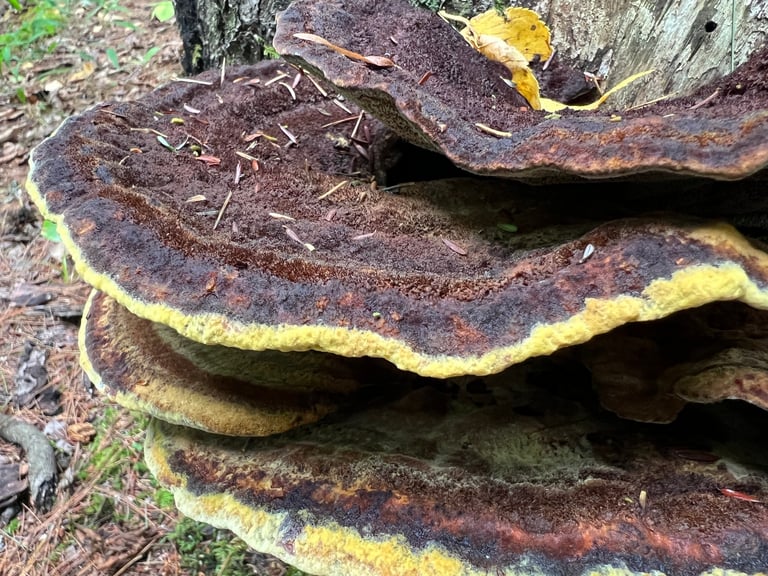
The fruiting body is the surest way to recognize Laetiporus sulphureus: it emerges directly from the trunk or branch of its host tree as a knob-like growth that soon expands into fan-shaped shelves, typically stacked in overlapping tiers. Fresh specimens are sulphur-yellow to bright orange with a suede-like surface texture, and each shelf can span anywhere from 5 to 60 centimeters across and reach 4 to 12 centimeters thick.
The fertile underside is sulphur-yellow and studded with small pores rather than gills, releasing a white spore print. When fresh, the flesh is succulent and exudes a yellowish, transparent juice, with a strong fungal aroma; within days it dries out and turns brittle.
As fruiting bodies age, the vivid yellow and orange tones fade to tan, beige, or pale grey, and the once-supple flesh becomes tough and crumbly.
Distribution and Habitat
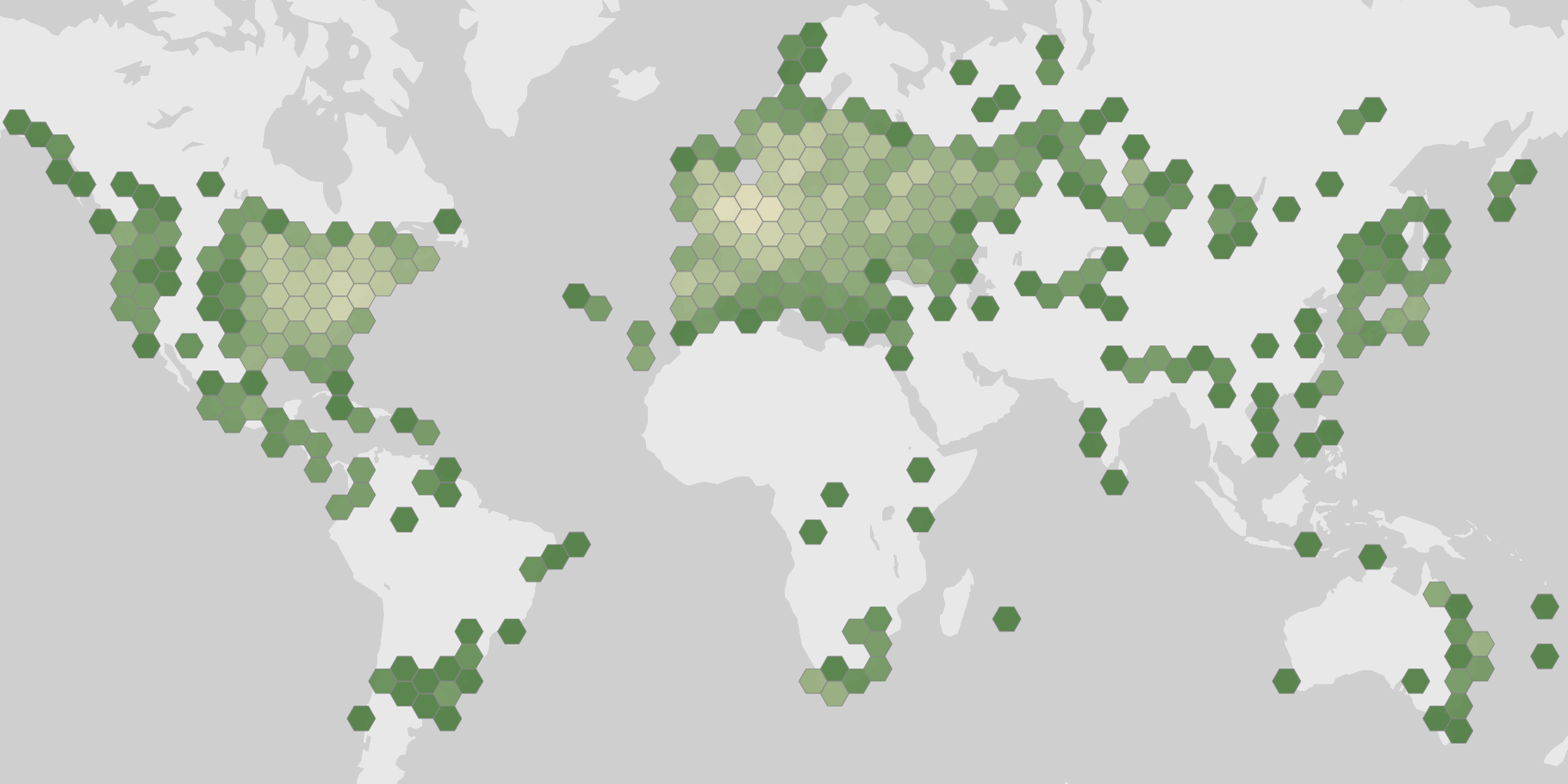
Laetiporus sulphureus occurs widely across Europe, where it fruits from April to November, and across North America, though on that continent its range may be largely confined to areas east of the Rocky Mountains.
It grows on dead or aging hardwoods and has been reported from a broad range of hosts, including oak (Quercus), cherry and plum (Prunus), pear (Pyrus), poplar (Populus), willow (Salix), black locust (Robinia), and beech (Fagus), occasionally also on conifers. In the Mediterranean region it typically appears on carob (Ceratonia) and eucalyptus.
Fruiting generally runs from August to October, sometimes beginning as early as June, and fruit bodies usually appear in clusters rather than singly.
Observation records show sightings concentrated between April and September, peaking sharply in August, with far fewer reports through the winter months. These figures reflect when observers happened to record the fungus rather than its true abundance or full range, but the pattern lines up with its known late-summer fruiting period.
Ecology and Relationships
Laetiporus sulphureus is a wood-decaying parasite that causes brown cubical rot in the heartwood of its host, attacking the roots, trunk base, and stem. Infected wood first discolors to yellowish or reddish tones before turning reddish-brown and brittle; in the final stages of decay it can be rubbed to powder between the fingers.
This rot progressively weakens standing trees from the inside, hollowing out the heartwood while the tree may otherwise remain alive for years afterward.
Beyond breaking down hardwood, the fungus also feeds wildlife directly: certain species of deer are known to eat its fruiting bodies.
Uses and Cultural History
People gather Laetiporus sulphureus for the table more than almost any other bracket fungus, prizing it under the names chicken-of-the-woods and, because many describe its flavor as similar to crab or lobster, lobster-of-the-woods. Only young specimens exuding clear to pale yellow watery liquid are considered good eating, and even then just the tender outer edges are taken, since older tissue turns tough and often harbors insects.
Cooks in Germany and North America hold the species in high regard, commonly sauteing it in butter or folding it into cream sauces served over toast or rice, according to the book Mushrooms in Color. Commercial cultivation exists but remains far smaller and less mechanized than that of Agaricus bisporus or oyster mushrooms.
Foraging for it remains largely a tradition of the wild rather than the farm: pickers search decaying logs and the base of mature trees, and folklore around its naming persists in different regions.
Fun Facts
- A single fruiting body found in the New Forest, Hampshire, UK, in 1990 weighed 45 kilograms (100 lb).
- Despite sometimes being called by folk names similar to "hen-of-the-woods," it is unrelated to Grifola frondosa, which carries that name.
- Certain species of deer feed directly on its fruiting bodies.
- It is sometimes cited as a "fungal ambassador species" at public mycology events and urban foraging walks.
- In some earth-based spiritual traditions it is regarded as a symbol of resilience and transformation.
- It can begin fruiting as early as June, well ahead of its typical August-to-October peak.
Ecology
Habitat
- Forest
- Woodland