The leatherback is the largest turtle alive and the heaviest reptile that is not a crocodilian, reaching up to 2.7 meters in length and weights around 420 kilograms. Unlike every other sea turtle, it carries no bony shell at all: its back is covered in oily flesh and flexible, leather-like skin, the trait that gives the species its name.
It belongs to the order Testudines and is the sole living member of its own family, Dermochelyidae, a lineage that split from all other sea turtles long ago. Found across tropical, temperate and even subarctic oceans, from Alaska and Norway to New Zealand and the Cape of Good Hope, the species is classified as Vulnerable, with some regional populations, such as the Pacific nesting groups, in far steeper decline. Its combination of extreme size, cold-water physiology and near-total dependence on jellyfish makes it one of the most unusual reptiles on Earth.
Identification and Appearance
The single clearest way to identify a leatherback is the absence of a hard shell: instead of scutes, thick leathery skin with tiny embedded osteoderms covers the body, crossed by seven raised ridges running from the neck to the tail. No other living sea turtle shares this feature.
Adults typically measure 1 to 1.75 meters in curved carapace length and 1.83 to 2.2 meters in total length, weighing between 250 and 700 kilograms; individuals in the Caribbean and French Guiana average closer to 340–384 kilograms. The largest verified specimen, found on a beach in Pakistan, measured 213 centimeters and weighed 650 kilograms. Hatchlings, by contrast, are barely larger than those of other sea turtles, averaging just 61.3 millimeters in carapace length and 46 grams in weight.
The body is teardrop-shaped and highly hydrodynamic, powered by the largest flippers, relative to body size, of any sea turtle; a large adult's front flippers can span 2.7 meters tip to tip, and neither pair carries claws. Coloring is dark grey to black across the back, with white-to-pink speckling scattered over the body, while the underside is paler in a countershading pattern. Instead of teeth, the leatherback has sharp points along the edge of its upper lip and backward-pointing spines lining its throat, both adaptations for gripping and swallowing slippery, soft-bodied prey.
Internally, the species carries adaptations for cold water rarely seen in reptiles, including thick brown adipose tissue, swimming muscles that function independent of temperature, and countercurrent heat exchangers around the flippers and trachea. Its leathery, non-rigid carapace is also thought to expand and contract with fat reserves, helping the turtle meet the insulation and energy demands of deep diving and long migration.
Distribution and Habitat
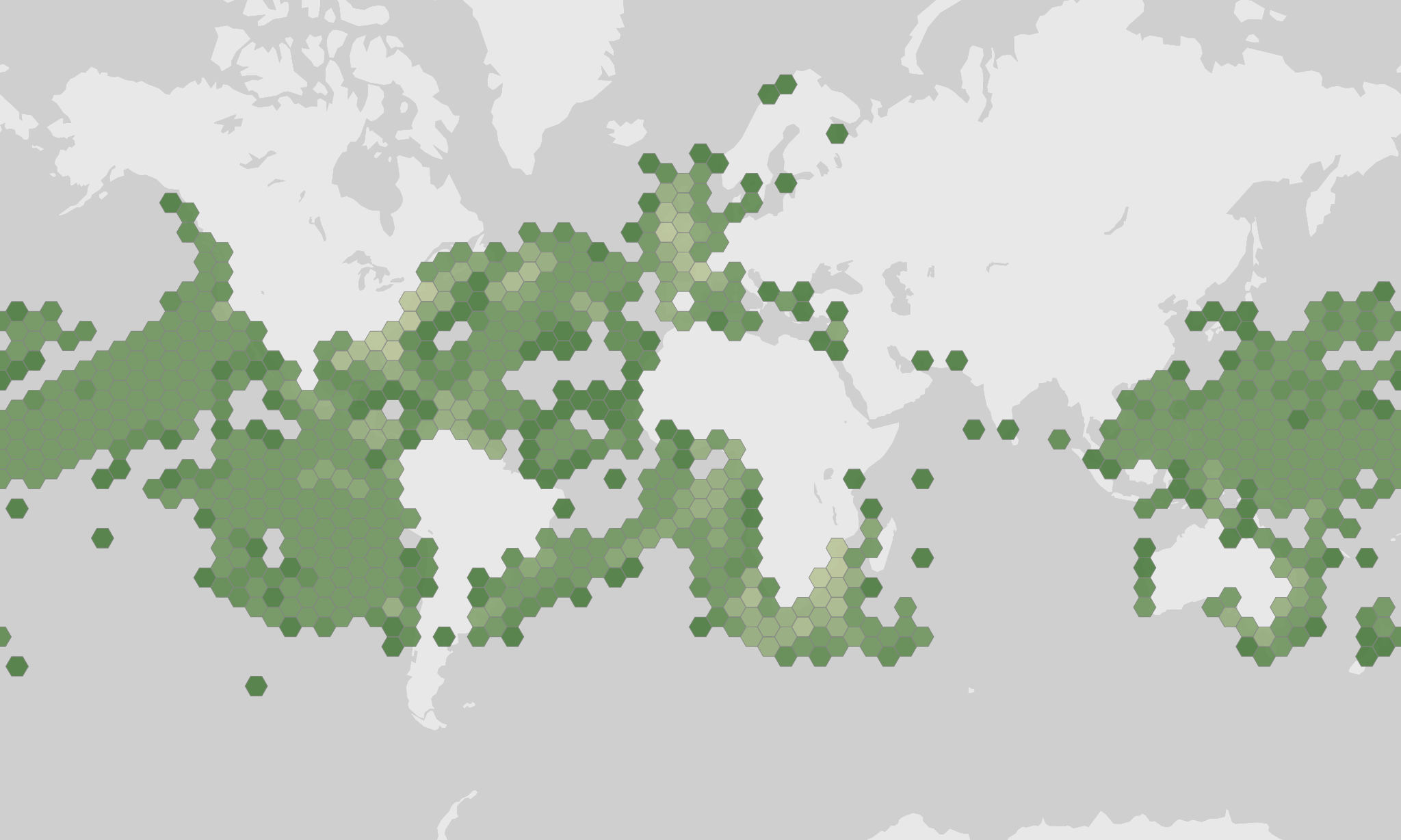
The leatherback has the widest range of any sea turtle, occurring in every tropical and subtropical ocean and extending well into the Arctic Circle, from as far north as Alaska and Norway to Cape Agulhas in Africa and the southern tip of New Zealand. Three genetically distinct populations are recognized, in the Atlantic, eastern Pacific and western Pacific, while Indian Ocean nesting populations remain largely unassessed.
The species is highly pelagic, spending most of its life far offshore in open water, though it moves into coastal waters when following concentrations of jellyfish. It has been recorded diving to depths of 1,230 meters, well below the photic zone, and one tracked individual completed a 20,000-kilometer foraging journey over 647 days between Indonesia and the United States. Turtles favor deeper water by day and shallower water at night, tracking the vertical movements of their jellyfish prey, a pattern that can carry them into water as cold as 0.4°C before they return to warmer surface layers to rewarm.
Nesting is restricted to a narrow set of tropical beaches, generally open, soft-sand mainland sites facing deep water rather than shores sheltered by coral reefs; the species does not nest in the far northern or southern waters where it feeds. GBIF observation counts show records in every month, rising from around 2,000 in January to a peak above 6,800 in July before tapering toward year's end; as presence records rather than abundance data, this pattern hints at seasonal detectability rather than a true population cycle.
Behavior and Lifestyle
Leatherbacks are largely solitary, coming together only briefly for mating and otherwise moving through the open ocean alone. Their most defining behavioral trait is long-distance migration, shuttling between cold-water feeding grounds rich in jellyfish and the warm tropical beaches where they hatched, a pattern documented across ocean basins, including turtles tagged in French Guiana later recaptured off Morocco and Spain.
Foraging behavior is built around locating dense patches of jellyfish and salps, which the turtles track by diving to depths where their prey concentrates during the day and following it upward at night. This strategy repeatedly forces leatherbacks into near-freezing water, and animals have been recorded actively hunting at 0.4°C before returning to surface water around 17.5°C to rewarm.
Juveniles spend more time in tropical waters than adults do, likely reflecting their lower tolerance for cold before they develop the full suite of adult heat-retention adaptations.
Hunting and Diet
Leatherbacks are carnivores that feed almost entirely on soft-bodied, gelatinous prey, chiefly jellyfish and salps, taken as they drift through open water. Lacking the powerful crushing jaws that other sea turtles use on hard-shelled prey, the leatherback instead has sharp-edged jaws suited to biting through soft tissue.
Once prey is caught, backward-pointing spines lining the esophagus prevent slippery jellyfish from slipping back out before they can be swallowed, an adaptation unique to handling this kind of food. Alongside jellyfish and salps, leatherbacks occasionally take small crustaceans, fish, cephalopods, sea urchins and snails, some of which may live as symbionts among jellyfish tentacles rather than being deliberately targeted.
Because jellyfish provide relatively little energy per bite, leatherbacks must consume large volumes; estimates of annual jellyfish consumption by a single adult range from roughly 1,000 to as much as 2,900–3,650 kilograms per year. This prey preference also drives much of the species' diving and migratory behavior, since jellyfish concentrations shift seasonally and with depth.
Nesting and Breeding
Leatherback courtship and mating take place entirely at sea, just offshore from the beaches where females intend to nest. Males gather near these sites before the nesting season, and a female likely signals her reproductive readiness through pheromones; males then use head movements, nuzzling, biting or flipper contact to assess her receptiveness, and multiple males typically mate with a single female. Males never come ashore and take no further part in reproduction.
Once mated, a female swims to shore at night, since her eyes are poorly adapted to daylight on land, and relies on the contrast between a dark, forested shoreline and the brighter, moonlit ocean to orient herself. She excavates a nest above the high-tide line with her flippers and lays a clutch that averages around 110 eggs, though as many as 50 percent may be yolkless and never develop; a nesting event, from landing to return to the water, takes roughly 108 minutes on average.
Females renest repeatedly within a single season, laying five to ten clutches roughly nine to ten days apart, then typically return to the same nesting region every two to three years. Breeding activity generally runs between April and November. Eggs are left uncovered by parental care after the nest is disguised with sand; hatchlings emerge and make their own way to the sea with no further protection from either parent, and females do not reach reproductive maturity until 5 to 21 years of age.
Population and Ecological Role
Global nesting estimates put annual female nesting numbers between 26,000 and 43,000, a steep drop from roughly 115,000 estimated in 1980, and Pacific nesting populations specifically have declined by an estimated 70 to 80 percent within a single decade. Because females can nest on more than one beach in a season, precise population counts remain difficult to obtain.
As a predator, the leatherback feeds mainly on jellyfish and other soft-bodied invertebrates; its effect on prey densities is not well quantified, but may once have been substantial before harvesting reduced turtle numbers. In turn, leatherback eggs and hatchlings form an important food source for a range of coastal predators near nesting beaches, and adult carcasses that wash ashore support short-lived scavenger communities involving flies, vultures and more than a dozen families of beetles.
Adults face few natural predators, though killer whales, great white sharks and tiger sharks occasionally take them, and nesting females are vulnerable to jaguars in the American tropics and saltwater crocodiles in Papua New Guinea. The species also hosts the barnacle Conchoderma virgatum as a commensal.
Conservation and Threats
The leatherback sea turtle is assessed globally as Vulnerable, though some regional populations, notably in the Pacific, are considered far more imperiled, with the U.S. Fish and Wildlife Service listing the species as Endangered and the IUCN rating certain subpopulations Critically Endangered. The most severe threat is commercial fishing, with turtles drowning after becoming trapped in nets and trawls or hooked and entangled on longlines and trap lines.
Egg harvesting by humans remains a significant additional pressure on nesting beaches, and ingestion of floating plastic debris, mistaken for jellyfish, is an increasing cause of death, with turtles found dead after their digestive tracts became blocked. In Malaysia, the once-largest nesting beach at Rantau Abang in Terengganu collapsed from around 10,000 nests per year to functional extinction, driven largely by decades of egg consumption and by early conservation efforts that inadvertently skewed hatchling sex ratios through poorly controlled incubation temperatures.
Protective measures include nature reserves at key nesting beaches, CITES Appendix I listing that bans international trade, some captive egg-incubation programs, and legislation such as the United States' 2004 Marine Turtle Conservation Act, which supports nesting habitat protection abroad. Use of turtle-exclusion devices on fishing gear remains inconsistent worldwide.
Conservation status
- LC
- NT
- VU
- EN
- CR
Vulnerable
Cultural Significance
Several Indigenous communities hold the leatherback as deeply significant. The Seri people of Sonora, Mexico, regard it as one of their five principal creators and hold ceremonies and fiestas when a turtle is caught and released, and members have formed the group Grupo Tortuguero Comaac to combine traditional knowledge with modern methods to manage and protect turtle populations they have watched decline.
In New Zealand, the leatherback carries spiritual significance for the Koukourārata hapū of Ngāi Tahu and more broadly across Te Ao Māori and Polynesian tradition; in 2021, the country's Department of Conservation laid a leatherback to rest in a hilltop cave dug according to the hapū's own protocols. In Malaysia's Terengganu state, the turtle serves as the state's emblem and appears widely in tourism promotion.
People also make direct use of the species: adults and eggs are eaten in some regions despite the flesh sometimes being toxic, and body oil is occasionally extracted for medicinal use and as a waterproofing agent.
Fun Facts
- A tracked leatherback swam roughly 20,000 kilometers from Southwest Papua, Indonesia, to the United States over a single 647-day foraging journey.
- The species can dive past 1,000 meters, a depth matched among diving air-breathing animals only by beaked whales and sperm whales.
- Leatherbacks have no teeth; instead they rely on sharp points along the jaw edge and backward-facing throat spines to grip and swallow slippery jellyfish.
- Hatchlings weigh only about 46 grams at birth, a tiny fraction of the roughly 420-kilogram size adults can reach.
- Unlike most sea turtles, leatherbacks often skip their exact hatching beach and choose another soft-sand site within the same region.
Ecology
Habitat
- Marine
- Coastal
Diet
- Carnivore
Behavior
- Predator
- Solitary
- Aquatic
- Migratory
Photos
SourcesGBIFiNaturalistWikidataWikipediaEncyclopedia of LifeAnimal Diversity WebAnAge