The American sweetgum can live to 400 years, and it is one of the most valuable forest trees in the southeastern United States. Its star-shaped leaves and hard, spiked fruit make it easy to recognize.
Liquidambar styraciflua is a deciduous tree in the family Altingiaceae. It was once placed in the Hamamelidaceae. It is native to warm temperate areas of eastern North America and to tropical montane regions of Mexico and Central America. Its conservation status is Least Concern.
The tree is valued for its symmetrical shape and its brilliant autumn color, which makes it a favorite in landscapes far beyond its native range.
Identification and Appearance
The most useful field mark is the leaf. Each leaf usually has five sharply pointed palmate lobes, with three in some leaves and seven in others. The leaves are glossy, leathery, and arranged alternately along the stem, not in opposite pairs. This separates the tree from maples, whose leaves can look similar.
In cultivation, the tree typically reaches 15 to 20 m. In the wild it can grow up to 45 m, with a trunk 60 to 90 cm in diameter on average. The bark is light brown tinged with red, sometimes gray with dark streaks, and deeply fissured with scaly ridges. Its branchlets are winged and pithy, first covered with rusty hairs and later turning red brown, gray, or dark brown.
Each leaf is 8 to 13 cm wide on average, on a petiole 6 to 10 cm long. The dark green leaves turn yellow, orange, red, and purple in autumn, with reds and yellows like those of maples and dark purples and smoky browns like those of ash. In the northern part of its range, frost often kills green leaves before they color.
The fruit is a hard, dry, spherical head 25 to 40 mm across, made of 40 to 60 capsules. Each capsule has a pair of spikes, for a total of 80 to 120 spikes. Fallen fruits are common beneath the trees and hang on the branches through winter.
Distribution and Habitat
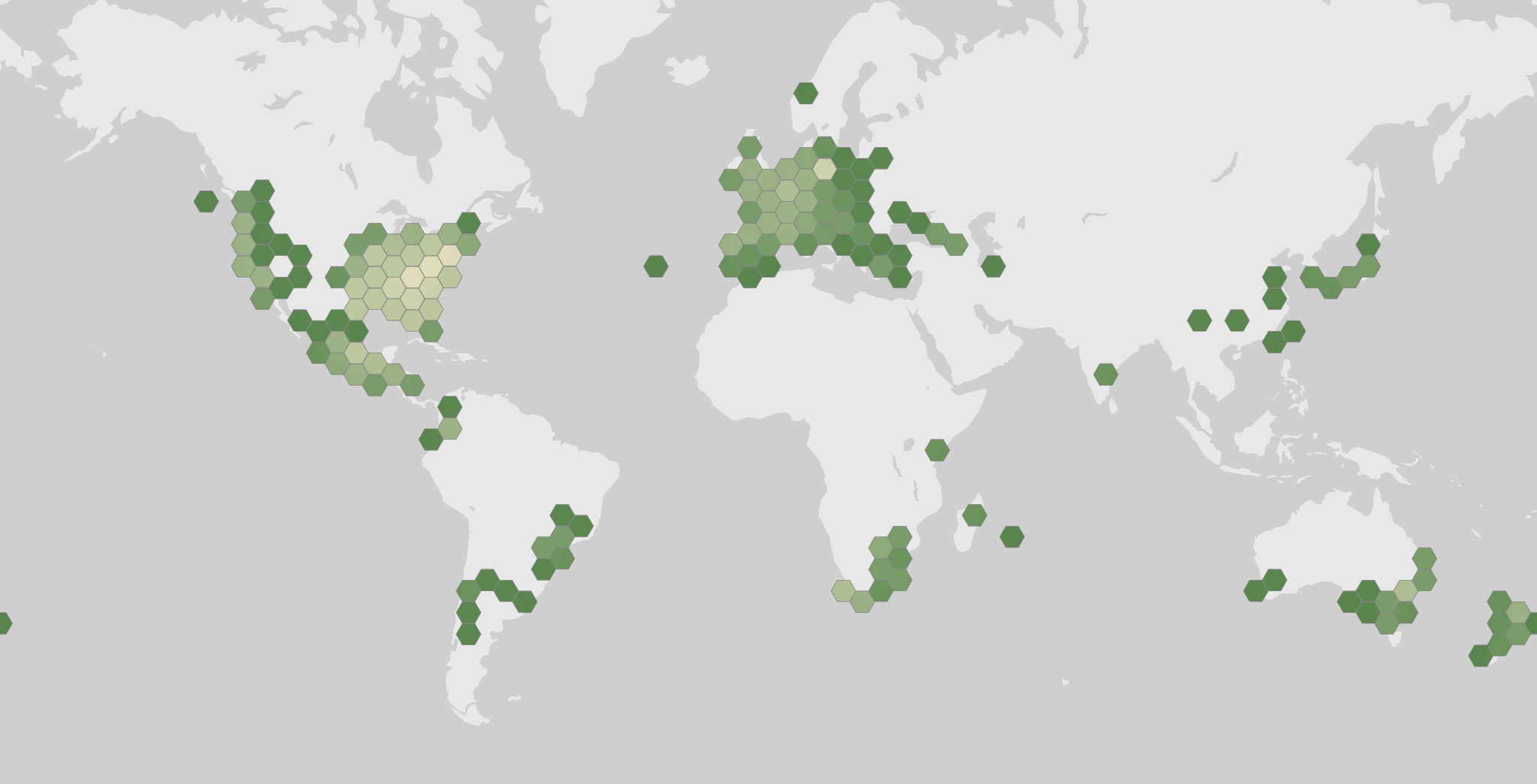
The species is native to lowlands from southwestern Connecticut south to central Florida, and west through central Ohio to Illinois, southern Missouri, and eastern Texas. It is one of the most common hardwoods in the southeastern and Mid-Atlantic United States. It does not occur in the colder highland areas of Appalachia or the Midwestern states.
In Mexico it grows from southern Nuevo León south to Chiapas. It also occurs in Guatemala, El Salvador, Belize, Nicaragua, and Honduras. In Mexico and Central America, it is a characteristic tree of cloud forests at middle elevations, where the climate is humid and more temperate.
The tree tolerates a wide range of soils. It grows best on moist alluvial clay and loam in river bottoms, but it also grows well on many Piedmont and Coastal Plain soils. Annual rainfall ranges from 1,020 mm in the north to 1,520 mm in the south, and frost-free days range from 180 in the north to 320 in the south.
The species also occurs in the Florida interior. Sightings of the tree peak in April.
Growth and Form
Liquidambar styraciflua is a tree with rapid growth and a perennial life cycle. It reaches a mature height of 30.5 m. Its trunk is typically 60 to 90 cm in diameter.
The crown is symmetrical and takes on an egg shape once the branches grow heavy, which usually happens after the first two years of cultivation. Ridged or winged branches add surface area that collects snow and ice, which can weigh down the crown.
Trees may live to 400 years. The wood is heavy and hard, with an interlocking grain, but it is difficult to season.
Cultivation and Care
The tree grows best in full sun to partial shade. It does not thrive in deep shade, and its growth is weaker there. It prefers moist, acidic loam or clay, with a soil pH between 4.5 and 7. It tolerates poor drainage, but chlorosis can develop on alkaline soil, especially where organic matter is low.
Drought tolerance is low, so the tree needs reliable moisture, especially in its first years. It is moderately salt tolerant.
The listed minimum temperature is -29.4 °C (-21 °F). In the northern part of its range and in colder planting areas, frost often kills green leaves.
Uses and Human Relationships
Sweetgum is one of the most important commercial hardwoods in the southeastern United States. Its wood is bright reddish brown, with nearly white sapwood and black grain in the heartwood. The wood is heavy, straight, satiny, and close-grained, and it takes a fine polish. It warps badly in drying and is too prone to decay for outdoor use.
The wood is used for furniture, interior trim, boxes and crates, cabinets, flooring, and veneer for plywood. Because it dyes black easily, it is sometimes used in place of ebony for inexpensive picture frames. It is also used to make chopsticks for the East Asian market.
The tree's gum resin, which gives the species its name, flows from the bark when it is wounded. It is known as liquid amber or copalm balsam and resembles turpentine. Traditional Chinese medicine has used the tree to treat diarrhea, coughs, and skin sores. Its seeds may be a renewable source of shikimic acid.
The tree is a popular ornamental and street tree, valued for its foliage and fall color. It is highly regarded in Bogotá, Colombia. In urban landscapes, its surface roots can damage paving and nearby structures, and its spiky fruit litters the ground.
Photos
Photographs from via iNaturalist, licensed under CC0 1.0., by Harrison Cole via iNaturalist, licensed under CC BY 4.0., by ashleyrsteel via iNaturalist, licensed under CC BY 4.0., by Jacob Weston via iNaturalist, licensed under CC BY 4.0., by Sandra Stewart via iNaturalist, licensed under CC BY 4.0., by Barry Stewart via iNaturalist, licensed under CC BY 4.0., by Val via iNaturalist, licensed under CC BY 4.0., by Shaun via iNaturalist, licensed under CC BY 4.0., and by Adam J. Searcy via iNaturalist, licensed under CC BY 4.0., credited on each photo.
Ecology and classification
Classification
- Phylum
- Tracheophyta
- Class
- Magnoliopsida
- Order
- Saxifragales
- Family
- Altingiaceae
- Genus
- Liquidambar
- Species
- Liquidambar styraciflua
Sources
- GBIF Species names and classification
- iNaturalist Photos
- Wikidata Common names and conservation status
- Wikipedia Summary extract
- Encyclopedia of Life Habitat, diet and behavior traits
- Plants of the World Online Native range, life form and climate (WCVP)
- USDA Plants US plants: growth habit and growing conditions
- GloBI What it eats, what eats it, parasites and pollinators
- DoPI