Unlike most owls, Athene noctua often hunts and perches in broad daylight, bounding through the air with a flight pattern that looks more like a woodpecker's than an owl's.
This small owl belongs to the family Strigidae and ranges across the temperate and warmer parts of Europe, the Palearctic as far east as Korea, and North Africa. It was introduced to Britain in the late 19th century and to New Zealand's South Island in the early 20th century, where it remains established today. The IUCN lists it as Least Concern, a reflection of its huge range and adaptability to farmland, villages and open countryside alike.
Its long association with humans, and with Athena, goddess of wisdom in Greek mythology, gives this compact, sharp-eyed bird a cultural profile larger than its size would suggest.
Identification and Appearance
The flattened facial disc above the eyes gives the little owl a permanent frowning or stern expression, its most distinctive field mark among small owls. The body is plump and compact with a short tail, a large head, and notably long legs. Adults measure about 22 cm (8.7 in) in length with a 56 cm (22 in) wingspan and weigh around 180 g, with males and females similar in size.
The nominate form, A. n. noctua, is white-speckled brown above and brown-streaked white below, with pale underparts marked by darker streaking. Yellow eyes and bold white "eyebrows" reinforce its stern look. Juveniles are duller overall and lack the white crown spots seen on adults.
In flight, the little owl shows a bounding, undulating pattern reminiscent of a woodpecker, quite different from the smooth glide typical of many other owls. Molt runs from July to November, with males beginning before females.
Distribution and Habitat
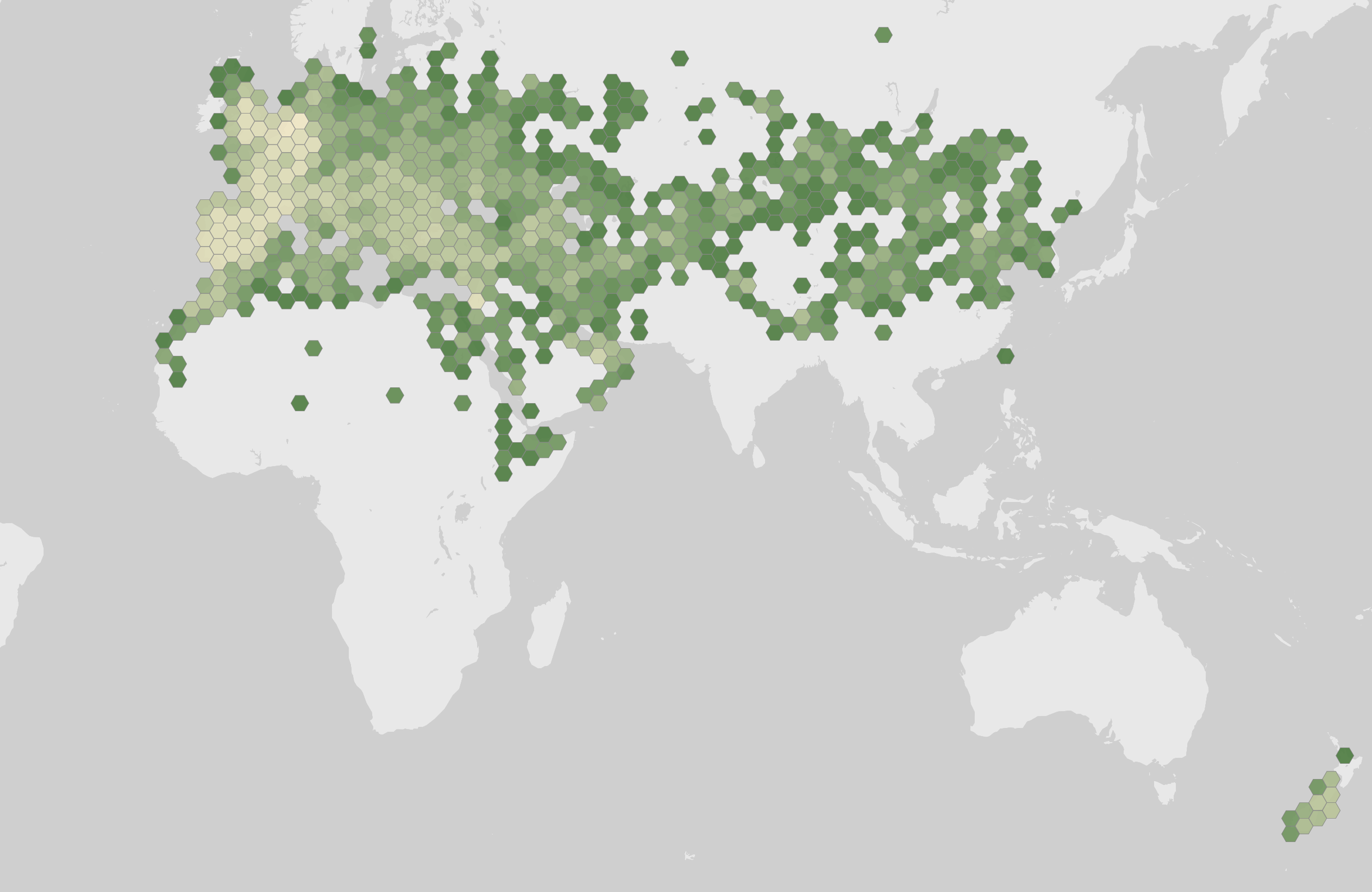
The little owl occupies an enormous range stretching from the Iberian Peninsula and Denmark eastward through the Palearctic to China, south to the Himalayas, and across North Africa from Mauritania to Egypt and into Arabia. Introduced populations have thrived in the United Kingdom, where the species now covers much of England and all of Wales, and in New Zealand's South Island following releases at Otago in 1906 and later at Canterbury; there it holds partial legal protection under Schedule 2 of the Wildlife Act 1953.
It is a sedentary, non-migratory bird that favors open, mostly dry country: farmland with hedgerows, orchards, woodland edges, steppe, stony semi-desert, dunes, quarries, rocky outcrops, and villages and suburbs. Rainfall reduces its hunting success, which helps explain its strong preference for drier climates. Elevation range is wide, from sea level up to 2,600 m typically, with an exceptional record at 3,600 m in Tibet; in Britain it stays mostly below 500 m.
Monthly observation counts show a clear rise through spring into early summer, peaking in May and June, before tapering off toward winter. This pattern most likely tracks breeding-season activity and observer effort rather than true population size, since these are presence records only, not abundance counts.
Behavior and Lifestyle
The little owl is sedentary and territorial, with individuals typically remaining close to their birthplace for life; average nest spacing between pairs is about 560 m. Home ranges shrink and stop overlapping during the breeding season, when energy demands from courtship, incubation and feeding nestlings force parents to hunt closer to the nest, then expand again in winter as scarcer food pushes birds to forage over wider, overlapping territories.
Intruding males are met first with territorial calls; if that fails, the resident owl attacks, sometimes making contact with its claws, and defends more vigorously against unfamiliar males than against known neighbors, whom it recognizes by voice. Despite this territoriality, direct aggression between neighboring owls is rare.
Daily behavior includes regular preening, dust or sand baths, and even bathing in the smoke rising from chimneys. When resting, the bird positions itself to hide its pale feathers, blending into its surroundings, and closes its eyes by raising the lower eyelid rather than the upper one. Activity peaks at dawn and dusk, though the species hunts and calls by day and night alike.
Life expectancy can reach about 16 years, but road mortality and harsh winters mean the average lifespan in the wild is likely closer to three years.
Communication
Little owls are highly vocal, with a repertoire of 22 to 40 distinct calls used for attracting mates, defending territory, sounding alarms and maintaining contact. On average a bird calls about 1.87 times per hour, totaling roughly 415 seconds of vocalizing hourly, with a pronounced "dusk chorus" and a smaller rise at dawn; calling drops sharply in winter and summer and peaks around courtship.
Male calls are louder and clearer than the shorter, higher-pitched calls of females, and pairs sometimes call in duet. When a predator is nearby, the birds fall silent until the danger passes, and neighboring owls learn to recognize each other's voices, reducing unnecessary territorial disputes.
Beyond sound, little owls use tactile signals: mates and even fledgling siblings preen and scratch one another and sleep in bodily contact to reinforce their bonds. Vision is comparatively weak for a bird of prey, but the species can distinguish colors including yellow, green and blue, and its hearing, tuned to 3–4 kilocycles per second, is sharp enough to pinpoint rodents in low light.
Hunting and Diet
Little owls hunt by watching from an elevated perch before dropping on prey, but they also run and hop across the ground, fly low to snatch prey on the surface, or take insects directly out of the air, switching styles to match whatever target presents itself. Hunting occurs mostly at dusk and night, though daytime hunts are common too.
Once caught, prey is carried in the beak or claws; females tend to carry prey by the neck while males more often grip it by the head. The diet is broad for a bird this size, drawn from at least 544 recorded prey species across the Palearctic, and includes small rodents such as mice, rats, voles and shrews, plus birds (often fledglings, including game-bird chicks), reptiles, amphibians, fish, earthworms, insects, mollusks and crustaceans. Pellet studies show mammals make up 20–50% of intake and insects 24–49%, with a small amount (up to 5%) of incidentally ingested plant matter.
Remarkably, little owls can overpower prey as heavy as themselves, and they cache surplus kills in holes for later use, a habit that helps buffer against lean periods.
Nesting and Breeding
Courtship begins when the male patrols and calls from his territory, a display that both deters rival males and attracts a mate. Once paired, the birds sit and fly together, and the female begins a "begging" call that prompts the male to bring her prey, a signal that enough food exists to support breeding. The male then shows the female several potential nest sites within his territory until she selects one, most often a cavity in a tree, cliff, wall, old building, riverbank or rabbit burrow.
Egg-laying can start as early as March and run into August with replacement clutches, though the main mating season runs from February to May depending on region. A clutch typically holds three to five white, glossless eggs, occasionally as few as two or as many as eight, each around 35.5 by 29.5 mm. The female incubates alone, sometimes beginning after the first egg is laid, while the male supplies her with food; incubation lasts 28 to 29 days.
After hatching, the female broods the chicks and distributes food the male delivers, and later both parents hunt and feed the brood directly. Young leave the nest at about seven weeks and can fly a week or two after that. There is usually one brood per year, but a second is possible when food is abundant, and chicks that build stronger energy reserves in the nest show much higher post-fledging survival.
Juveniles disperse an average of about 2,700 m, rarely more than 20 km, from their birth nest and reach breeding maturity at one year. Pairs often stay together year-round, sometimes for life, though the bond weakens somewhat after the young become independent between August and November.
Population and Ecological Role
Europe alone is estimated to hold between 560,000 and 1.3 million breeding pairs, and since the continent accounts for roughly 25–49% of the species' global range, the world population likely falls between 5 million and 15 million birds. This population is believed to be stable overall, even though regional declines have been documented in parts of Europe.
Ecologically, the little owl helps regulate populations of insects and small mammals that it preys upon, while itself serving as prey for larger predators. It hosts at least 67 known parasite species, including the blood parasite Leucocytozoon ziemanni and the ectoparasite fly Carnus hemapterus, along with two commensal moth species, Trichophaga tapetzella and Monopis laevigella, that live in association with it.
Conservation and Threats
The IUCN Red List classifies the little owl as Least Concern, a status supported by its very large range and an estimated global population in the millions. Even so, this masks a documented decline in numbers across parts of Europe, mirroring broader owl population trends on the continent.
The principal threats are the loss of suitable prey and nesting sites and the destruction of habitat by human activity. Because the species is familiar, abundant, easy to study and quick to respond to conservation measures, it has become a useful indicator for tracking rural owl declines more broadly.
Conservation efforts have centered on installing nest boxes, which have measurably boosted local numbers, and on improving food availability during the breeding season, alongside continued research into the underlying causes of decline.
Conservation status
- LC
- NT
- VU
- EN
- CR
Least Concern
Cultural Significance
In Greek mythology, the little owl traditionally accompanies Athena, goddess of wisdom, and later her Roman counterpart Minerva, often depicted perched on the goddess's shoulder as her guide and companion. This association made the bird a lasting symbol of wisdom, and by extension it has carried associations with democracy and vision between worlds in later folklore.
Beyond myth, the species has had practical value to people: because it feeds heavily on insects and small mammals, it helps control populations regarded as agricultural pests. Its presence also once drew predator species that people wanted to attract and catch, leading to little owls being trapped and carried on staffs as lures; historically, they were also kept and traded as pets.
Fun Facts
- Little owls prey on at least 544 different species across the Palearctic region, an unusually broad menu for a bird only about 22 cm long.
- They take dust baths, sand baths, and have even been observed bathing in the smoke rising from chimneys.
- Their hearing is tuned to sound frequencies of 3 to 4 kilocycles per second, sharp enough to pinpoint rodents moving in the dark.
- Hatching success runs as low as 49.3%, and fledging success as low as 46.6%, with food availability the single biggest factor in nest success.
- Little owls can overpower and carry prey as heavy as they are themselves.
- They host at least 67 recorded parasite species and share their nests with two commensal moth species that feed on debris there.
- Neighboring owls learn to recognize each other's individual calls, letting them save energy by reserving aggressive defense for unfamiliar intruders.
Ecology
Diet
- Carnivore
Behavior
- Predator
- Territorial
- Crepuscular
- Arboreal
Habitat
- Woodland
- Grassland
- Urban
- Desert
Photos
SourcesGBIFiNaturalistWikidataWikipediaAnimal Diversity WebAnAge