When a young tawny owl leaves its parents' territory, it faces a hard truth: if it cannot find an empty patch of woodland to call its own, it will most likely starve. This species is so rigidly territorial that available space, not food alone, sets the limit on how many owls a forest can support.
The tawny owl, or brown owl, is a stocky, medium-sized member of the owl family Strigidae, found across the woodlands of Europe and into western Siberia. It is classed as Least Concern by the IUCN, reflecting a large and generally stable or increasing population. What makes it worth a closer look is not just its familiar hooting call, but the extraordinary sensory toolkit and combative parenting behind that quiet woodland presence.
Identification and Appearance
The single best clue to a tawny owl is its large, rounded head with no ear tufts at all, set above a plain, dark-eyed facial disc that gives the bird a slightly blank, staring expression. This shape, combined with its stocky, broad-winged build, separates it instantly from eared owls sharing its range.
It is a robust bird, 37 to 46 cm long, with a wingspan of 81 to 105 cm and a weight ranging from 385 to 800 g. Females run about 5% longer and more than 25% heavier than males, an unusually strong size difference for a bird this size.
Plumage comes in two color morphs that can occur side by side in the same population: one rufous brown above, the other greyish brown, with intermediates also seen. Both morphs share whitish underparts streaked with brown, and feathers are replaced gradually between June and December rather than in one abrupt molt.
In flight, the tawny owl glides on rounded wings with fewer wingbeats than most other Eurasian owls, often at a greater height, and its takeoff is noticeably heavy and slow. Its size and squat, broad-winged shape distinguish it from the superficially similar great grey owl, Eurasian eagle-owl, and Ural owl, all of which are considerably larger. Its eyes have a 50 to 70% field overlap for strong binocular vision, and its asymmetrical ear openings, tilted and hidden beneath sound-transparent facial feathers, give it directional hearing about ten times more sensitive than a human's.
Distribution and Habitat
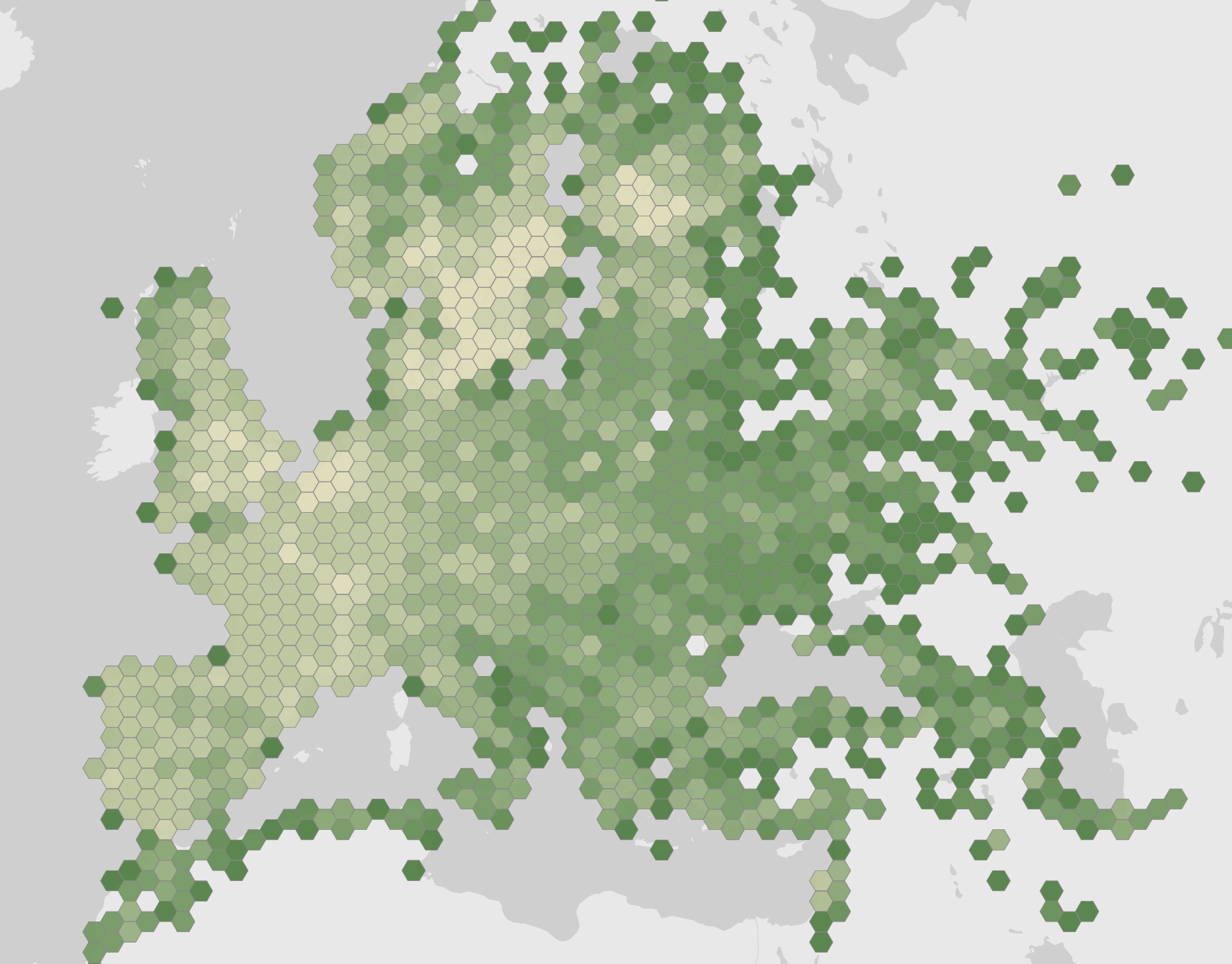
The tawny owl occupies a discontinuous band across temperate Europe, from Great Britain and the Iberian Peninsula east to western Siberia. It is notably absent from Ireland, likely due to competition from the long-eared owl, and only turns up as a rare vagrant in the Balearic and Canary Islands; further east, in the Himalayas and East Asia, its niche is filled by the closely related Himalayan owl.
It favors deciduous and mixed woodland, along with mature conifer plantations, hedgerows, parkland, churchyards, and farmland, generally seeking out sites with access to water. Urban parks, gardens, and cemeteries have let it colonize cities, including central London, though it tends to avoid urban sites with high nighttime noise. In winter it will shelter in disused buildings and rock cavities. The species is mainly a lowland bird in colder parts of its range but breeds up to 550 m in Scotland, 1,600 m in the Alps, 2,350 m in Turkey, and as high as 2,800 m in Myanmar.
The overall range covers at least 10 million km2, and the European population alone is estimated at 970,000 to 2,000,000 individuals. Trends are not fully quantified, but the range has expanded in Belgium, the Netherlands, Norway, and Ukraine, while numbers have declined in Finland, Estonia, Italy, and Albania. Monthly observation counts peak sharply in spring, rising from roughly 77,500 in January to a high near 129,000 in May before tapering off through summer and autumn; as presence records rather than population counts, this pattern most plausibly reflects seasonal detectability and breeding activity rather than an actual surge in owl numbers.
International trade in the species is regulated under CITES Appendix II, and in the United Kingdom it appears on the RSPB Amber List of Concern.
Behavior and Lifestyle
Tawny owls are primarily nocturnal, though they can be roused into activity during the day, and they fly with quick wingbeats and marked agility as they thread through trees in woodland; in open ground they switch to gliding or hovering on extended wings. Their flight is silent, thanks to soft-fringed feathers, letting them move through their territory undetected.
Territoriality dominates their lives. Pairs hold and defend the same ground year-round with only minor boundary shifts from year to year, advertising ownership through screeching calls, threat displays, and occasional mid-air fights. Territory size tracks prey availability: as little as 30 acres in dense woodland, an average of about 175 acres in more open beechwood, and up to roughly 255 acres in Norway, where prey density is low.
Nest defense is fierce and can be dangerous to people. Owls strike an intruder's head and eyes with sharp talons, and because their approach is silent, a threat may go unnoticed until it is too late to avoid.
Once independent, juveniles are forced out by this same territorial rigidity, dispersing from August to November to search for unclaimed ground of their own.
Communication
Tawny owls rely heavily on sound to organize their social lives. The female's shrill, repeated "ke-WICK" call serves as contact and, with frightening variations, as an alarm or aggression signal, while the male's mournful, ocarina-like song runs through a falling note, a pause, and a shivering series before ending on another falling note. Both sexes use a distinct "xylophone trill" during mating, and downy chicks beg for food with a thin "PSEE-ep" squeak.
This vocal system depends on exceptional hearing. The two ear openings differ in structure and sit asymmetrically on the head, with the left ear tilted downward to pick up sounds from below; tiny differences in when a sound reaches each ear let the owl pinpoint a caller, or prey, with precision roughly ten times sharper than human hearing. A movable pre-aural flap and sound-transparent facial feathers channel noise to the hidden ear openings.
Beyond acoustic signals, tawny owls also communicate and perceive their surroundings through visual and tactile cues, though vocal calls remain the dominant channel for marking territory, coordinating pairs, and directing young.
Hunting and Diet
A tawny owl hunts mainly by perching and watching, then dropping onto prey in a silent glide before pinning it with its feet and claws, sometimes finishing with a beak strike to the base of the neck. It will also beat its wings to flush small birds from cover and pursue them in the air, or fly low over grassland, marshland, or bushes to snatch roosting bats or incubating birds directly from their perches and nests.
Most of the diet consists of woodland rodents and other small mammals, supplemented by amphibians, birds, beetles, and worms. In urban settings, birds make up a much larger share of the menu, including species such as mallards and kittiwakes.
Mothers will hunt by day when feeding chicks, breaking from the species' usual nocturnal habit to keep up with the demands of a growing brood.
Prey is swallowed whole, and indigestible parts, mostly fur and bone, are later regurgitated as grey pellets found scattered around nesting trees, offering a direct record of what an individual owl has been eating.
Nesting and Breeding
Tawny owls reach breeding maturity at one year old and typically pair for life in a monogamous bond, though some males mate with more than one female. Pairing begins with an autumn ritual: in October or November males stake out territories while females locate nesting holes, and the pair roosts separately until courtship starts. As winter sets in, the male sways side to side near the female, raises and puffs his feathers to look larger, slides closer while grunting and clapping his wings, and she answers with screeches and quivering displays centered on the chosen nest site.
Nesting almost always happens in a tree hole, though old magpie nests, squirrel dreys, and holes in buildings or nest boxes are all used as substitutes. Breeding runs from January to July overall, starting in February in the south of the range but not until mid-March in Scandinavia.
Clutches of glossy white eggs, each about 48 by 39 mm and weighing 39 g, are laid mid-March to early May; typically 2 to 3 eggs, though as few as 1 or as many as 9 have been recorded. The female alone incubates for around 30 days until the eggs hatch into downy, altricial chicks that cannot yet care for themselves.
Chicks fledge after a further 35 to 39 days, often leaving the nest to hide on nearby branches up to ten days before that point. Parents keep provisioning the young for two to three months after fledging, and breeding success depends strongly on parental age, since older owls prove better at switching to alternative prey when preferred food runs short. Interestingly, grey-morph females breed less often than rufous-morph females but tend to raise offspring of higher fitness, suggesting plumage color tracks underlying individual quality.
Population and Ecological Role
As a top nocturnal predator in its woodland habitat, the tawny owl helps regulate populations of rodents and other small prey, and its presence can exclude smaller owl species, which struggle to coexist with it due to both direct predation and competition for food. In towns and cities, tawny owls also displace barn owls, taking over nesting sites in buildings that barn owls would otherwise use.
The species carries several blood parasites, including Leucocytozoon, Haemoproteus, and Trypanosoma, which reduce the fitness of infected birds and can influence breeding behavior. Rufous-morph owls, more exposed because they favor open habitats, suffer greater parasite loads than their grey counterparts, tying plumage color to a measurable ecological cost.
Conservation and Threats
The tawny owl is assessed as Least Concern by the IUCN, reflecting a wide range and a population considered stable to increasing across most of Europe, even as it has declined in Finland, Estonia, Italy, and Albania. International trade in the species is regulated under CITES Appendix II, though it carries no special protective status under UK or US wildlife law beyond that.
The most significant emerging threat is avian malaria, whose incidence in British tawny owls has tripled over the past 70 years in step with rising temperatures, climbing from just 2 to 3% infection in 1996 to 60% by 2010; each 1°C of warming appears to raise malaria rates two- to threefold. Predation on newly fledged young by mammals, especially red foxes, is also a major cause of early mortality, accounting for 36% of deaths between fledging and independence in one Danish study, with risk rising sharply for broods that fledge later in the season. Prolonged wet weather is another hazard, since heavy rain masks the faint sounds the owl relies on to hunt, and extended bad weather can lead directly to starvation.
No specific recovery program is described for the species, consistent with its currently secure status.
Conservation status
- LC
- NT
- VU
- EN
- CR
Least Concern
Cultural Significance
The tawny owl's scientific lineage carries mythological baggage: in Roman belief, the striges were said to shapeshift between women and birds, tied to dark magic and sorcery, while Pliny recorded the strix being invoked in curses and its feathers used in magic potions. Greek tradition cast the same bird as a monstrous omen of war and ill fortune, associations the Romans extended to link it with death and destruction.
That reputation as a bird of bad omen persisted into English literature. Shakespeare has the owl "hooting and shrieking" ominously at noon in Julius Caesar, and the critic John Ruskin wrote that the owl's cry was "always prophetic of mischief" to him, while William Wordsworth described the practice of calling to owls in his poem "There Was a Boy."
Beyond folklore, the tawny owl's practical relationship with people is modest: its main documented benefit is controlling populations of small animals that can act as agricultural pests, with no major other recorded human use.
Fun Facts
- Wild tawny owls have lived past 18 years, and one captive individual reached over 27, far beyond the species' typical five-year lifespan.
- Bird photographer Eric Hosking lost his left eye to a nest-defending tawny owl in 1937, an incident that gave his autobiography its title, An Eye for a Bird.
- Eurasian jackdaws have been recorded building their own nests directly on top of brooding female tawny owls, sometimes killing both the adult and her chicks.
- Despite its own fearsome reputation, the tawny owl is preyed on by larger birds, including Ural owls, Eurasian eagle-owls, goshawks, golden eagles, and common buzzards.
- Its hearing is sharp enough to let it catch prey by sound alone on a pitch-dark, overcast night in dense woodland.
Ecology
Diet
- Carnivore
Behavior
- Nocturnal
- Predator
- Solitary
- Territorial
Habitat
- Forest
- Woodland
- Mountain
- Urban
Photos
SourcesGBIFiNaturalistWikidataWikipediaEncyclopedia of LifeAnimal Diversity WebAnAge