When disturbed at its daytime roost, the Spotted Owlet doesn't simply fly off — it bobs its head and stares down the intruder, often while smaller birds mob it noisily from nearby branches.
This small, stocky owl belongs to the family Strigidae and breeds across tropical Asia, from North Pakistan to Southeast Asia. It is listed as Least Concern by the IUCN and has adapted remarkably well to human-altered landscapes, from farmland to city streets.
Its close relationship with the little owl, with which it forms a superspecies, and its striking variation across its range make it a fascinating subject for anyone curious about how a single species can thrive across such different environments.
Identification and Appearance
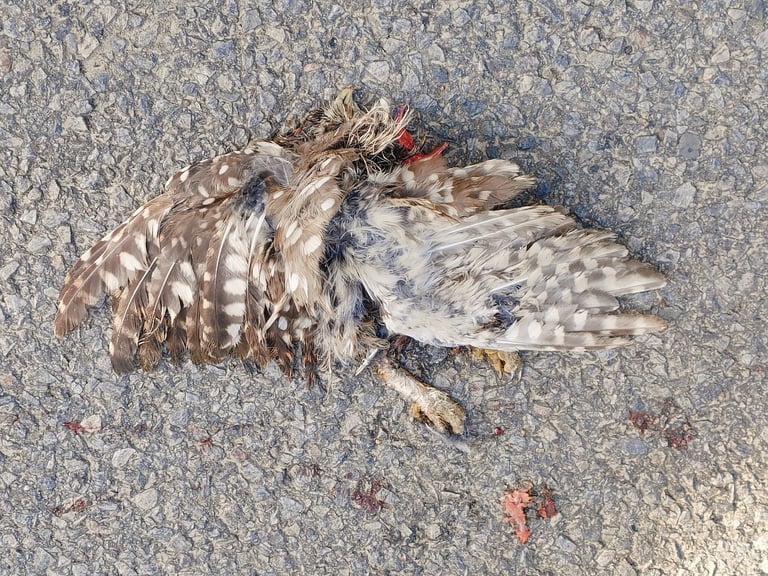
The most useful field mark is the combination of heavy white spotting on grey-brown upperparts with a white neckband and supercilium, set against a pale facial disc and yellow eyes. At barely 21 centimeters in length and weighing around 112 grams, it is a genuinely small and stocky owl.
The underparts are white, streaked with brown, and the overall impression is compact rather than sleek. Its flight is deeply undulating, a useful clue even at a distance when plumage details are hard to judge.
Sexes look alike, so plumage offers no clue to identifying males from females in the field. The species shows considerable clinal variation in size and color across its range: the nominate form is notably darker than paler forms, such as indica, found in drier regions.
Distribution and Habitat
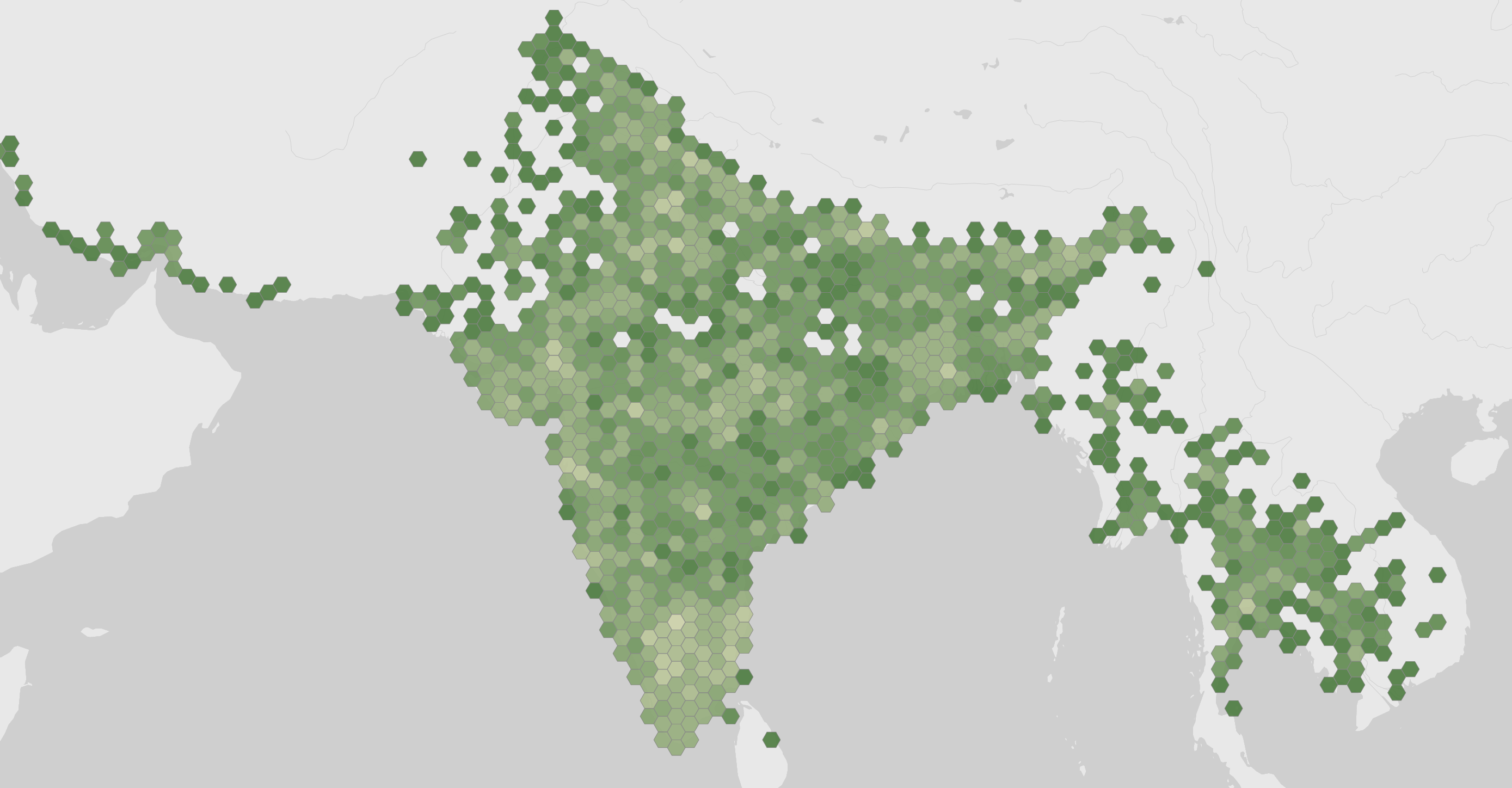
The Spotted Owlet occupies a very large range, estimated at over 5,210,000 square kilometers, stretching from North Pakistan through South Asia into Southeast Asia. It favors semi-open, human-modified landscapes rather than dense wilderness.
Its association with farmland and human habitation is a defining feature of its distribution. It roosts in the hollows of trees or in cavities in rocks and buildings, and this flexibility has allowed it to colonize cities alongside more traditional rural habitats.
Monthly observation patterns show higher counts in the early months of the year, tapering through mid-year and rising again toward year's end, though these figures reflect presence records rather than actual population size or a complete picture of its range.
Behavior and Lifestyle
Although classed as nocturnal, the Spotted Owlet is often active and visible by day, a trait that sets it apart from many strictly night-hunting owls. When flushed from a daytime roost, it responds with head-bobbing and a fixed stare rather than immediate flight, and its location is frequently given away by small birds mobbing it in the open.
Its vocal activity peaks at dawn and dusk, when it delivers a harsh, chuckling call described as chirurr-chirurr-chirurr ending in a chirwak-chirwak.
Physiologically, the species is unusual among owls: its pineal gland shows only a slight drop in melatonin at night, with a small rise in early afternoon, unlike the pronounced day-night swings seen in owls such as the barn owl. Seasonal changes in this glandular activity appear linked to environmental factors like temperature and humidity, hinting at a less rigidly nocturnal physiology than its classification suggests.
It is sedentary, staying within its range year-round rather than migrating.
Recordings
call, nocturnal flight call · India · Ujjal Kishor De · CC BY-SA
call · India · Sudipto Roy · CC BY-SA
Hunting and Diet
The Spotted Owlet hunts a wide variety of insects and small vertebrates, with the balance shifting by region and season. In Pakistan, insect prey dominates, while in the arid region of Jodhpur, rodents—especially those in the genus Mus—become more prominent prior to the breeding season, with other rodents such as Tatera generally avoided.
Beyond insects and rodents, the diet extends to bats, toads, and small snakes such as Ramphotyphlops braminus, along with scorpions and mollusks.
Proximity to human habitation appears to boost breeding success, likely because it increases the availability of rodents needed to feed growing chicks.
Nesting and Breeding
Breeding runs from November to April, preceded by courtship that includes bill grasping, allopreening, and ritual feeding. The female may call alongside the male, bob her head, and deflect her tail as an invitation, and the social structure around these displays is not fully understood—multiple males may copulate with a single female, and females sometimes attempt pseudocopulation, possibly as a form of displacement behavior.
Nesting takes place in cavities, often in competition with other hole-nesting species such as mynas, rollers, and parakeets, or sometimes in holes in vertical embankments. The nest cavity may be lined with leaves and feathers, or simply reuse an existing lining left by a previous occupant.
A typical clutch holds three or four spherical white eggs, each about 30.9 millimeters long, 26.3 millimeters wide, and weighing 11.6 grams. Incubation begins with the first egg laid, producing considerable variation in chick size within a single brood.
Hatchlings are fed insects such as cockroaches at first, moving on to small vertebrate prey like mice, and even a toad has been recorded as food for chicks in Gujarat. Chicks gain weight early on but lose some before fledging, and typically only one or two chicks survive to leave the nest, at about a month old.
Population and Ecological Role
The Spotted Owlet hosts several documented parasites, reflecting its role within a wider web of small-scale ecological interactions. These include the coccidian parasite Eimeria atheni, the ectoparasitic mite Neocheletiella athene, bird lice of the species Colpocephalum pectinatum, and the acanthocephalan parasite Apororhynchus chauhani, found in its intestine.
Cultural Significance
The species name brama traces back to the French name Chouette brame and is often said to pay homage to Brahma, the Hindu creator god, reflecting the owl's widespread presence across India. The genus name Athene honors the Greek goddess of wisdom, whose sacred bird was the owl.
In Hindu mythology, the owl is recognized as the vahana, or vehicle, of Goddess Lakshmi, symbolizing wisdom, patience, and the ability to perceive inner truth amid material prosperity.
Despite its loud, familiar calls making it well known to people, the Spotted Owlet has also been linked to folk beliefs about bad omens. These associations are not based in any scientific reality and are largely no longer believed in modern times.
Fun Facts
- The genus name Athene honors the Greek goddess of wisdom, while the species name brama is thought to reference Brahma, the Hindu creator god, tying the owl's scientific name to two very different mythological traditions.
- In Hindu mythology, the owl serves as the vahana of Goddess Lakshmi, associated with wisdom and the perception of inner truth.
- Despite being a common, familiar bird, its loud calls once fed folk beliefs about bad omens—superstitions with no scientific basis that have largely faded today.
Photos
Photographs from via iNaturalist, licensed under CC0 1.0., by Subir B. Shakya via iNaturalist, licensed under CC BY 4.0., by Jordan Zylstra via iNaturalist, licensed under CC BY 4.0., by Srivatsan Ramkumar via iNaturalist, licensed under CC BY 4.0., by Utain Pummarin via iNaturalist, licensed under CC BY 4.0., by apoorva sr via iNaturalist, licensed under CC BY 4.0., by Piyush Marwadi via iNaturalist, licensed under CC BY 4.0., by Shikha Sreenivas via iNaturalist, licensed under CC BY 4.0., by Ajay via iNaturalist, licensed under CC BY 4.0., by white_cheeked_barbet via iNaturalist, licensed under CC BY 4.0., by Sameer Kulkarni via iNaturalist, licensed under CC BY 4.0., by Harshjeet Singh Bal via iNaturalist, licensed under CC BY 4.0., and by @dineshphotography7797 via iNaturalist, licensed under CC BY 4.0., credited on each photo.
Ecology and classification
Classification
- Phylum
- Chordata
- Class
- Aves
- Order
- Strigiformes
- Family
- Strigidae
- Genus
- Athene
- Species
- Athene brama
Sources
- GBIF Species names and classification
- iNaturalist Photos
- Wikidata Common names and conservation status
- Wikipedia Summary extract
- Xeno-canto Audio recordings
- AVONET Bird mass, habitat, migration, diet and range size