The snowy owl can withstand temperatures as low as -62.5°C without visible distress and has survived a five-hour exposure to -93°C, an insulation feat matched by few animals on Earth.
It is a large owl of the true owl family, Strigidae, native to the Arctic tundra of North America and the Palearctic, and it is the only owl species with mainly white plumage. The IUCN lists it as Vulnerable, a status reflecting a population that has fallen far faster than once believed.
Few birds combine such striking looks with such a demanding lifestyle: a hunter that works equally well by day or night, walks and swims when needed, and can vanish into a snowfield simply by sitting still.
Identification and Appearance
The most useful field mark is the near-absence of visible ear tufts combined with mostly white plumage, a combination unique among owls; at a distance, a snowy owl can look like a pale rock or a lump of snow rather than a bird. Tiny tufts of about 20 to 25 mm, made of roughly ten small feathers, are usually held flat and are raised only occasionally, most often by a female sitting on the nest.
Adults weigh around 2 kilograms, and males and females differ sharply in pattern rather than size. Mature males tend toward plain white with only scattered dark spots on the ear-tufts, head, and wingtips; only 3 of 129 Russian museum specimens of adult males showed an almost total absence of dark spotting. Females are more heavily marked, with brown spotting and barring across the crown, flanks, and upper breast, and faint brown bars on the flight and tail feathers. Where plumage is ambiguous, the shape of the wing markings is the best clue: bars point to a female, spots to a male, though the darkest males and palest females can be nearly impossible to separate this way.
The eyes are bright yellow, and the head is relatively small with a shallow facial disc and simple ear structure, reflecting a lesser reliance on hearing than in many other owls. Chicks hatch grayish white, then turn dark gray-brown in their mesoptile down, a color that blends into the tundra's lichen-covered ground. As they near fledging, the plumage becomes mottled and mostly dark gray-brown above with a white face, and by then chicks can already be sexed to some degree from their emerging wing markings.
Aging and sexing remain imprecise even for experts. Some individuals lighten with maturity while others darken or stay unchanged over years of observation, and a molt can suddenly reveal heavy markings on a bird that once looked pale. Full adult-like dimorphism is usually not reached until the fourth or fifth molt.
Distribution and Habitat
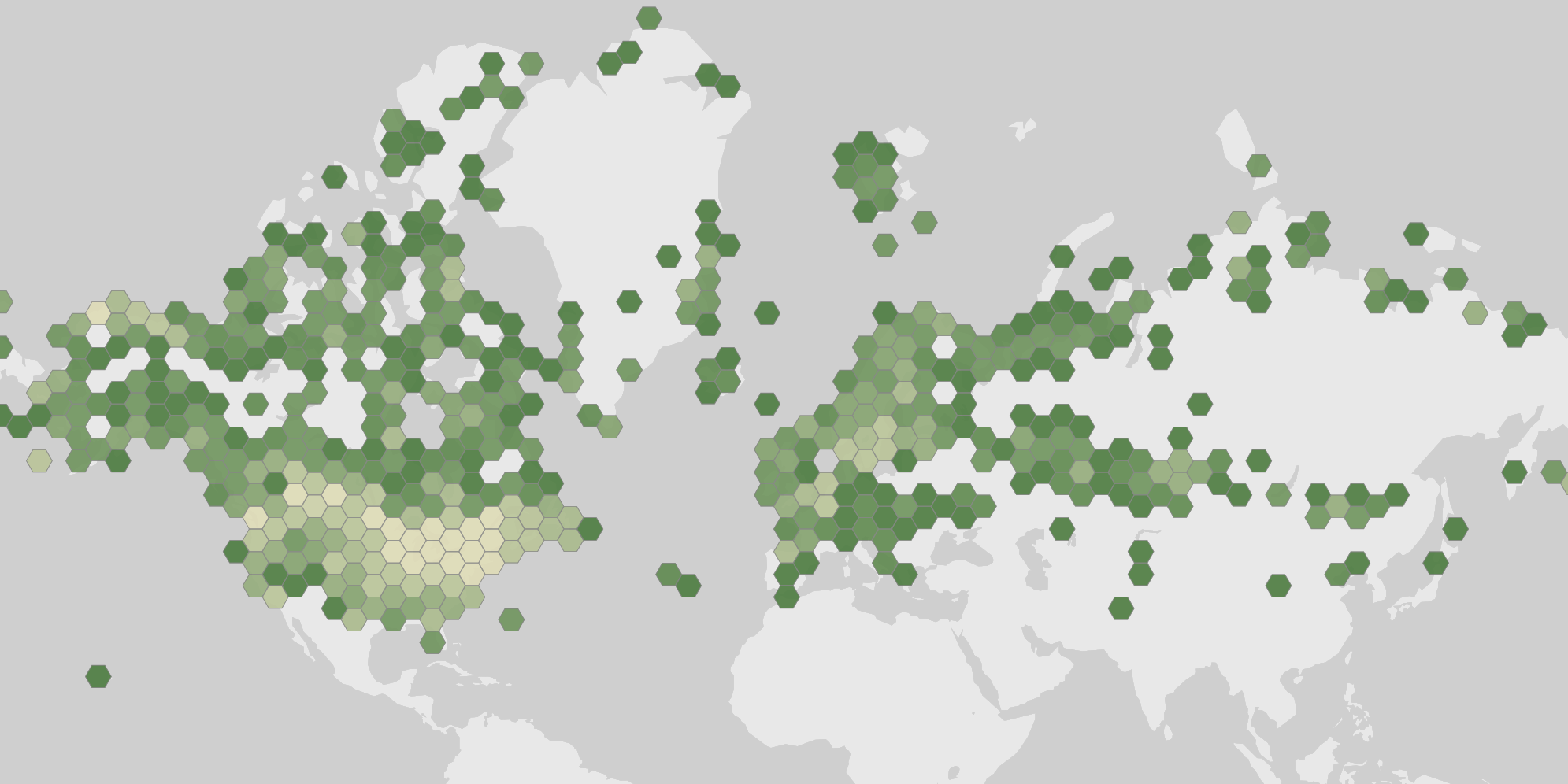
The snowy owl breeds across the circumpolar Arctic tundra, mainly north of 60° latitude, from northern Alaska and the Canadian Arctic Archipelago through Greenland to Svalbard, northern Scandinavia, and vast stretches of northern Russia including Novaya Zemlya, Severnaya Zemlya, the New Siberian Islands, and Wrangel Island. Nesting sites favor slightly elevated, dry ground with mosses, lichens, and rock, such as hummocks, ridges, and bluffs, usually below 300 meters elevation, though owls breeding inland in Norway have nested as high as 1,000 meters.
In winter, many owls move south, though the extent is irregular and hard to map; some birds instead stay in the Arctic, wintering along sea ice leads and hunting seabirds in polynyas. Regular wintering areas include southern Canada from British Columbia to Labrador, parts of northern Eurasia, and occasionally the Aleutians. In years following strong lemming breeding seasons, large numbers of young birds irrupt far south of the normal range, reaching as far as Georgia, Texas, California, and even Hawaii in North America, with major irruptions recorded in 2011–2012 and again, more strongly, in 2013–2014.
Monthly observation counts peak sharply in December and January (over 68,000 and 83,000 records respectively) and drop to a low in September, a pattern consistent with owls being far more visible and widely dispersed outside the breeding season; these figures reflect where the species has been recorded, not its abundance or full range. Beyond tundra and boreal edges, the owl also uses varied coastal habitat, including tidal flats, both for breeding and, at times, for winter hunting over marine ice.
Behavior and Lifestyle
Snowy owls are cathemeral, active during both day and night in a pattern that tracks their prey rather than the clock. In the near-continuous daylight of the Arctic summer, activity often peaks during the darkest available twilight, reported between 9 p.m. and 3 a.m. in Norway; in winter Alberta, tracked owls were busiest from 8 to 10 a.m. and 4 to 6 p.m., spending 98% of daylight hours perched and resting mid-day.
Unlike most owls, snowy owls spend much of their time on the ground, typically on a slight rise, a habit thought to reflect short, broad legs poorly suited to gripping branches. In winter they also perch on fenceposts, transmission towers, haystacks, and rooftops while hunting. Their flight uses fairly heavy, rowing wingbeats interspersed with glides, and displaying males perform an undulating flight before dropping almost vertically to the ground.
The species tolerates extreme cold; individuals have been recorded active at -62.5°C and survived five hours at -93°C, though possibly with strain on oxygen consumption by the end. During storms, both adults and young shelter behind rocks. They can swim if necessary, and flightless young have been seen swimming to escape predators, but adults rarely do so voluntarily.
Social structure is generally solitary outside breeding, though the birds are not strictly territorial year-round. In the run-up to nesting, owls alternate between searching for suitable ground and simply loafing, searching less when snow cover remains extensive.
Communication
The main call is a rough, barking sequence of two to six notes, krooh krooh krooh krooh, sometimes ending in an emphatic aaoow; researchers have documented as many as 15 distinct calls in mature birds. Males use this call from a perch or in flight both to exclude rival males and to advertise to females, and it can carry more than 3 kilometers and possibly as far as 10 to 11 kilometers across the thin Arctic air.
Females give a similar but higher-pitched or more guttural call, along with a disyllabic khuso, chirps, and screaming notes that resemble those of nestlings. Both sexes produce clucks, squeals, grunts, hisses, and cackles when excited, a hoarse keeea as an alarm call, and a raspy "watchman's rattle" transcribed as rick, rick, rick, ha, how, quack. A defending female may give a crowed ca-ca-oh, and beak- or tongue-clapping can signal irritation or threat.
Vocal activity is concentrated in the breeding season, which once led to mistaken reports of the species being silent; some calling has since been recorded in winter in the northern United States. Chicks begin with a soft, high-pitched begging call that grows into a wheezy scream by about two weeks old, and the shrill squeals given as they leave the nest around three weeks help mothers locate them.
Hunting and Diet
Snowy owls hunt primarily by sight rather than hearing, detecting movement from as far as 1.6 kilometers away, and typically hunt from an elevated watch-site: in Utqiaġvik, 88% of observed hunts began from a mound, rise, or telephone pole. Their sit-and-wait style resembles that of a buzzard, with long immobile spells broken by a sudden, fast pursuit once prey is spotted.
Several specialized techniques are recorded, including a dashing stoop that ends in a high-impact strike, a low "sweep" that grasps prey mid-flight, brief hovering in strong winds, and "snow plunging" to seize prey hidden under at least 20 centimeters of snow. Some individuals hover over water in a style close to an osprey's to catch fish, while at least one owl was seen lying on its belly beside a fishing hole to snatch fish directly.
Prey is caught and eaten on the ground, and small animals are swallowed whole, with indigestible bone, fur, and feather compacted into pellets regurgitated 18 to 24 hours later at regular perch sites. Larger prey, including night-migrating passerines and shorebirds, and even large or dangerous birds taken in flight, is often torn apart, usually starting with the breast or humerus muscle, which scatters remains and likely leads to under-counting of bigger prey in pellet studies. Snowy owls will also chase other predatory birds in flight to steal already-captured prey, and hunting success varies by experience: adult females in Alberta caught prey at notably higher rates than juvenile females.
Nesting and Breeding
Breeding is tied to the Arctic tundra north of 60°N, occasionally as far south as 55°N, across a total range of roughly 12 million square kilometers, though only about 1.3 million square kilometers see breeding attempts frequently, at intervals of no more than three to nine years. Because prey populations fluctuate so sharply, snowy owls are highly nomadic and will shift breeding grounds to follow lemming abundance rather than returning to fixed sites each year.
The mating system is overwhelmingly monogamous: of 239 recorded breeding attempts in Utqiaġvik, 232 were monogamous pairings and only 7 involved social bigamy, where one male bred with two females. In one Baffin Island case a bigamous male sired 11 fledged young across two nests; in Norway, two females mated to the same male nested 1.3 kilometers apart, and on Fetlar in Scotland one male bred with two females, one of them possibly his own daughter.
Known breeding strongholds include northern Alaska from the Arctic National Wildlife Refuge to Utqiaġvik, the Canadian Arctic Archipelago, northern Greenland, Svalbard, northern Scandinavia, and scattered sites across northern Russia and its Arctic islands. Breeding on Fetlar in the Shetland Isles between 1967 and 1975 marked a rare, short-lived nesting record for the British Isles, with females summering there as late as 1993 before the population faded to occasional winter visitors.
Snowy owls are long-lived for a bird of their size, with a maximum recorded lifespan of 28 years, giving individuals many breeding seasons across which to track shifting prey and habitat conditions.
Conservation and Threats
The snowy owl was uplisted to Vulnerable by the IUCN in 2017 after new survey and genetic data revealed that earlier population estimates had been drastically inflated. Prior figures of 200,000 to 290,000 individuals worldwide have given way to an estimate of only 14,000 to 28,000 mature breeding pairs, and during lemming crashes the number of nesting females can fall to as low as 1,700 globally, less than 10% of the population size once assumed.
The North American population has declined an estimated 52% since the 1960s, with one estimate placing the drop between 1970 and 2014 at 64%; a similar downward trend is suspected in Scandinavia, though harder to confirm. Of 438 banded snowy owls recovered dead, almost all identifiable causes traced back to human activity: 11.9% were shot, 7.1% were hit by vehicles, 5.5% were found dead or injured on highways, 3.9% collided with towers or wires, 2.7% were caught in traps, and 2.1% died in airplane bird strikes, with heavy airport activity posing an ongoing collision risk in Canada and likely in Siberia and Mongolia as well.
Regional numbers remain hard to pin down: European Russia may hold 1,300 to 4,500 breeding pairs and Greenland 500 to 1,000, while Sweden's monitoring agency has proposed classifying the species as extinct within Sweden in its 2025 Red List after no confirmed nesting since 2015. The species is listed under CITES Appendix II, regulating international trade in the birds and their parts, and Europe's regional Least Concern rating has not been updated since December 2020, leaving it out of step with the global Vulnerable status.
Conservation status
- LC
- NT
- VU
- EN
- CR
Vulnerable
Cultural Significance
The snowy owl is best known outside the Arctic as Hedwig, the pet owl of the title character in J. K. Rowling's Harry Potter books and films. Concern circulated in the media that the franchise's popularity might fuel illegal trade in snowy owls, but no strong evidence emerged of an increase in owls seized from the black market, even though wildlife centers reported receiving more snowy owls than usual during that period.
In Canada, the species holds official symbolic status as the harfang des neiges, the avian emblem of the province of Quebec.
Fun Facts
- In February 1886, a snowy owl landed on the rigging of the steamship Ulunda near the Grand Banks of Newfoundland, over 800 kilometers from the nearest land, and was later preserved at the Nova Scotia Museum.
- After especially good lemming years in North America, a higher proportion of snowy owls have been found using marine environments rather than inland tundra.
- Each owl's wing marking pattern is distinctive enough that, with close study, individual birds can sometimes be recognized on sight, much like a fingerprint.
- Despite the danger snowy owls pose to aircraft through bird strikes, no human fatalities from collisions with the species have ever been recorded.
Ecology
Habitat
- Marine
- Coastal
- Mountain
- Tundra
Diet
- Carnivore
Behavior
- Predator
- Solitary
- Migratory
- Crepuscular