The male European stag beetle carries a pair of mandibles that can stretch nearly as long as the rest of its body, making Lucanus cervus the largest beetle in Europe, with males reaching up to 7.5 centimeters in length. These jaws are not for feeding but for wrestling rival males in contests that echo the antler clashes of the deer that give the species its name.
A member of the beetle family Lucanidae, this insect lives across much of continental Europe and into parts of Asia, wherever old trees and decaying wood persist. Its status is listed as Near Threatened, a sign that a species so recognizable and widespread is nonetheless losing ground. Few insects have inspired as much folklore, art, and grassroots conservation effort as this one.
Identification and Appearance
The single best clue to identifying this species is the male's massive, antler-like mandibles, dark red-brown and unmistakable once seen. Body color is generally black with reddish elytra, and males show reddish mandibles as well. Size varies sharply between the sexes: males grow up to 7.5 centimeters long, while females reach only 3 to 5 centimeters and lack the enlarged jaws altogether.
Size also varies geographically. Beetles from Spain, Germany, and the Netherlands tend to run larger than those found in Belgium or the United Kingdom, a pattern likely tied to local conditions and food availability during the larval stage.
In Britain, female Lucanus cervus are frequently mistaken for the lesser stag beetle, Dorcus parallelipipedus. The lesser stag beetle is smaller, entirely black, and has a larger, squarer head. The two species can also be told apart by habit: Lucanus cervus larvae feed on wood below ground, while Dorcus parallelipipedus larvae feed on wood above ground.
Distribution and Habitat
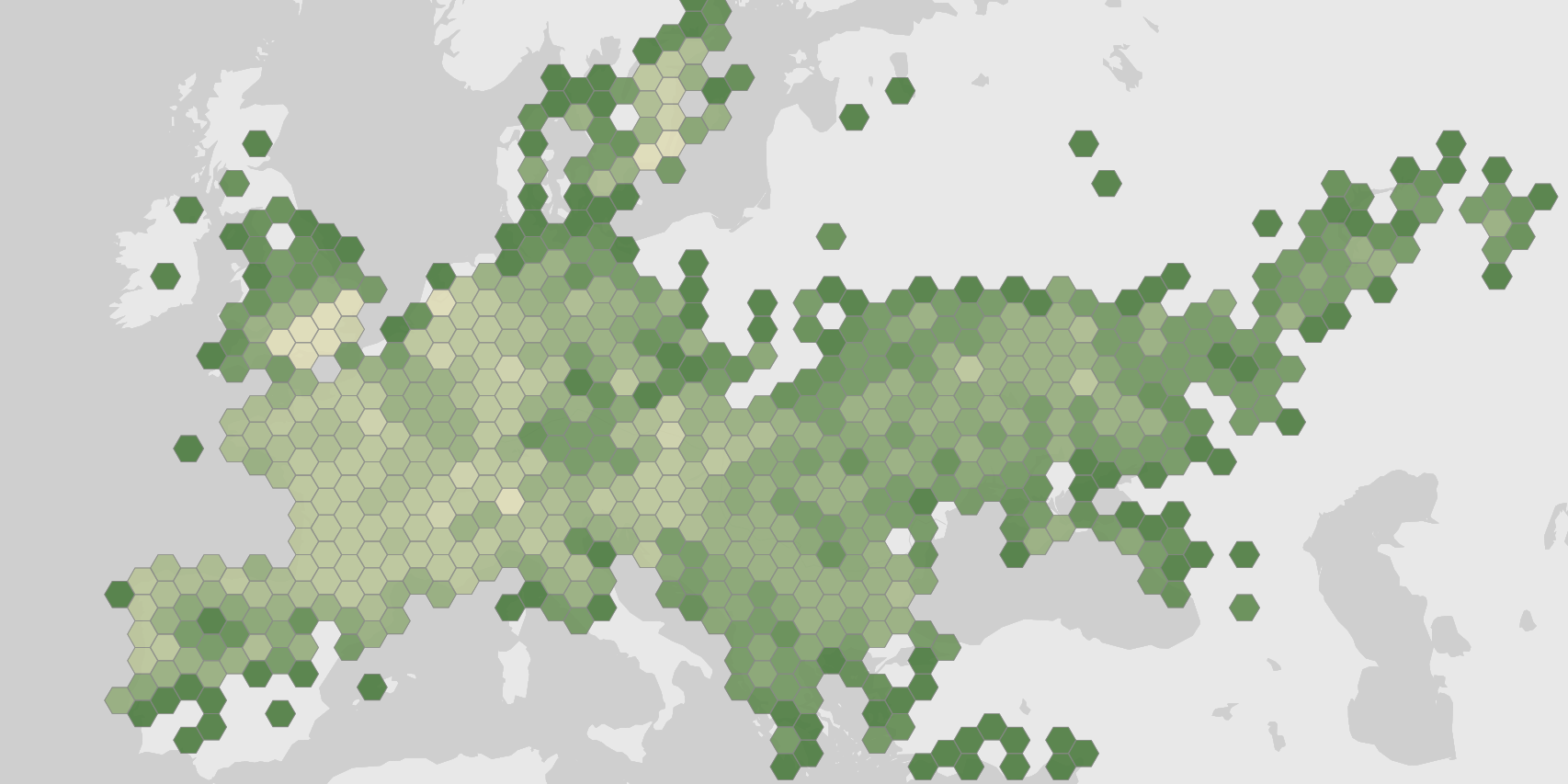
Lucanus cervus is widespread across Europe but notably absent from Ireland. It occurs across Germany, mainly in the south, and is common in the hilly and mountainous regions of Hungary and in the sun-exposed hillsides of Romania. The species also reaches the European part of Turkey, the Caucasus, Asia Minor, Syria, and western Kazakhstan. In Italy it concentrates in the north and center, while in Spain and Portugal it is confined to the northern halves of each country. In Britain it is largely restricted to southeastern England.
The species has vanished from Latvia and disappeared from Denmark around 1970, though it was reintroduced there in 2013. Its range is currently expanding only in Croatia and Slovakia, a rare bright spot against an otherwise contracting distribution in parts of its range.
Habitat depends entirely on the availability of dead wood: gardens, wooded parks, and pasture woodland all support the species as long as decaying timber is present. Larvae have been recorded developing near dead wood from oak, lime, beech, willow, black poplar, ash, horse chestnut, wild cherry, and common walnut, as well as near the non-native red oak.
Monthly observation counts peak sharply in June and July, consistent with the adult flight season, before dropping off through late summer. These figures reflect when adults are seen and reported, not the size of the population.
Behavior and Lifestyle
When approached, a stag beetle's first instinct is to freeze rather than flee, a trait that makes it an easy subject for observers and photographers alike. Beyond that stillness, the sexes behave quite differently: in a primary ancient forest in northern Italy, males proved far less elusive than females, tracked repeatedly in flight, while females stayed mostly underground near decaying wood.
Males typically take to the air at sunset, spending daylight hours resting or walking on standing trees. Flight is not constant but weather-dependent, triggered by a specific combination of air temperature and humidity, and it is this sunset flying that makes males far easier to detect than the more secretive females.
Activity is concentrated early in adult life. Beetles are most active during the first and second halves of June, tapering off as the short flight season progresses. Males also disperse farther than females on average, though the two sexes maintain similarly sized home ranges.
Population and Ecological Role
A range of predators target Lucanus cervus at its most vulnerable moment, when adults emerge to mate and lay eggs. In Britain these include cats, foxes, badgers, carrion crows, magpies, woodpeckers, kestrels, and false widow spiders; magpies have been observed waiting at emergence sites and consuming the beetle's abdomen once it appears. In Italy, the hooded crow fills a similar predatory role.
The beetle also carries passengers: mites in the suborder Uropodina attach as deutonymphs to the membrane between the head and pronotum, using the beetle purely for transport between habitats rather than as a food source.
As a saproxylic species, whose larvae spend years breaking down dead wood underground, Lucanus cervus contributes to forest decomposition while also serving as a food source for the birds and mammals that hunt it during its brief adult life.
Conservation and Threats
Lucanus cervus is currently assessed as Near Threatened, a status driven by significant declines across the northern and central parts of its European range. Ongoing changes to European forests threaten to push the species closer to qualifying as Vulnerable in the future, despite its wide overall distribution.
Habitat fragmentation and shifting land use are cited as major pressures, compounded by a general lack of public knowledge about the species and its needs, even though it remains one of the more recognizable insects in Europe. The beetle depends entirely on standing and fallen dead wood, a resource that is often removed from managed landscapes.
Legal protections are already in place: the species is listed in Appendix II of the EU Habitats Directive, requiring member states to designate special conservation areas, and in Appendix III of the Bern Convention. In the United Kingdom it is protected under Schedule 5 of the Wildlife and Countryside Act 1981.
Conservation status
- LC
- NT
- VU
- EN
- CR
Least Concern
Cultural Significance
Its conspicuous size and shape have made Lucanus cervus one of the most represented beetles in European iconography, with a presence in art stretching across the continent's history. One striking example comes from Cologne, where researchers have suggested that an altarpiece may honor a sponsor named Hirtz, an old synonym for stag beetle, hinting at a personal connection between patron and creature.
Human engagement with the species today leans toward conservation rather than collection: log pyramids, or stumperies, are built specifically to give stag beetle larvae the underground rotten wood they need, compensating for the decline of natural deadwood sources in modern landscapes.
Fun Facts
- The scientific name cervus, Latin for deer, refers directly to the male's oversized mandibles, which resemble a stag's antlers and serve the same purpose: settling contests between rival males.
- A male's fearsome-looking jaws are too weak to break human skin, yet females, which have no enlarged mandibles at all, can deliver a genuinely painful bite.
- The species may appear in a Cologne altarpiece honoring a sponsor named Hirtz, an old synonym for stag beetle, suggesting the insect once carried personal and even spiritual significance.
- Photographers have an easy time with this beetle because its main defense against an approaching large object is to freeze in place rather than run or fly.
- Tiny mites in the suborder Uropodina hitch rides on the beetle by clinging to the joint between its head and pronotum, using it purely as transport rather than as a host to feed on.
Ecology
Habitat
- Forest
- Woodland
- Grassland
- Urban
Behavior
- Solitary
- Crepuscular
- Arboreal
- Docile