Lumbricus terrestris is so widespread and so often carried around the world by human activity that in many regions it now out-competes the native earthworms it was never meant to meet, turning a familiar garden animal into a genuine ecological concern.
The species belongs to the class Clitellata, order Crassiclitellata, and family Lumbricidae within the phylum Annelida. Large, reddish-brown, and originally native to Western Europe, it has since spread to soils on nearly every inhabited continent.
Few animals live such a double life: prized by gardeners and composters for its soil-building work, yet capable of quietly reshaping ecosystems wherever it settles in as a newcomer.
Identification and Appearance
The clearest field mark is the combination of size and segmentation: adults typically measure 110 to 200 millimeters long and 7 to 10 millimeters in diameter, with 120 to 170 body segments, most often 135 to 150.
The body is cylindrical in cross-section except for a broad, flattened posterior section near the tail. The head end is dark brown to reddish brown, and this pigmentation fades gradually toward the rear of the body, giving the worm a two-toned look from front to back.
Movement relies on a hydrostatic skeleton driven by alternating longitudinal and circular muscle contractions. Tiny hair-like setae grip the surrounding soil with the help of slime, and on moist, flat ground the worm has been recorded moving across the surface at about 20 meters per hour, with nocturnal surface excursions away from the burrow estimated at up to 19 meters in a single night.
Mass surface appearances after heavy rain are often assumed to be a flood escape, but this cannot be the full explanation: Lumbricus terrestris can survive in oxygenated water for weeks at a time. The behavior is more likely linked to resource availability or to avoiding mating with close relatives when conditions allow easy surface travel.
Distribution and Habitat
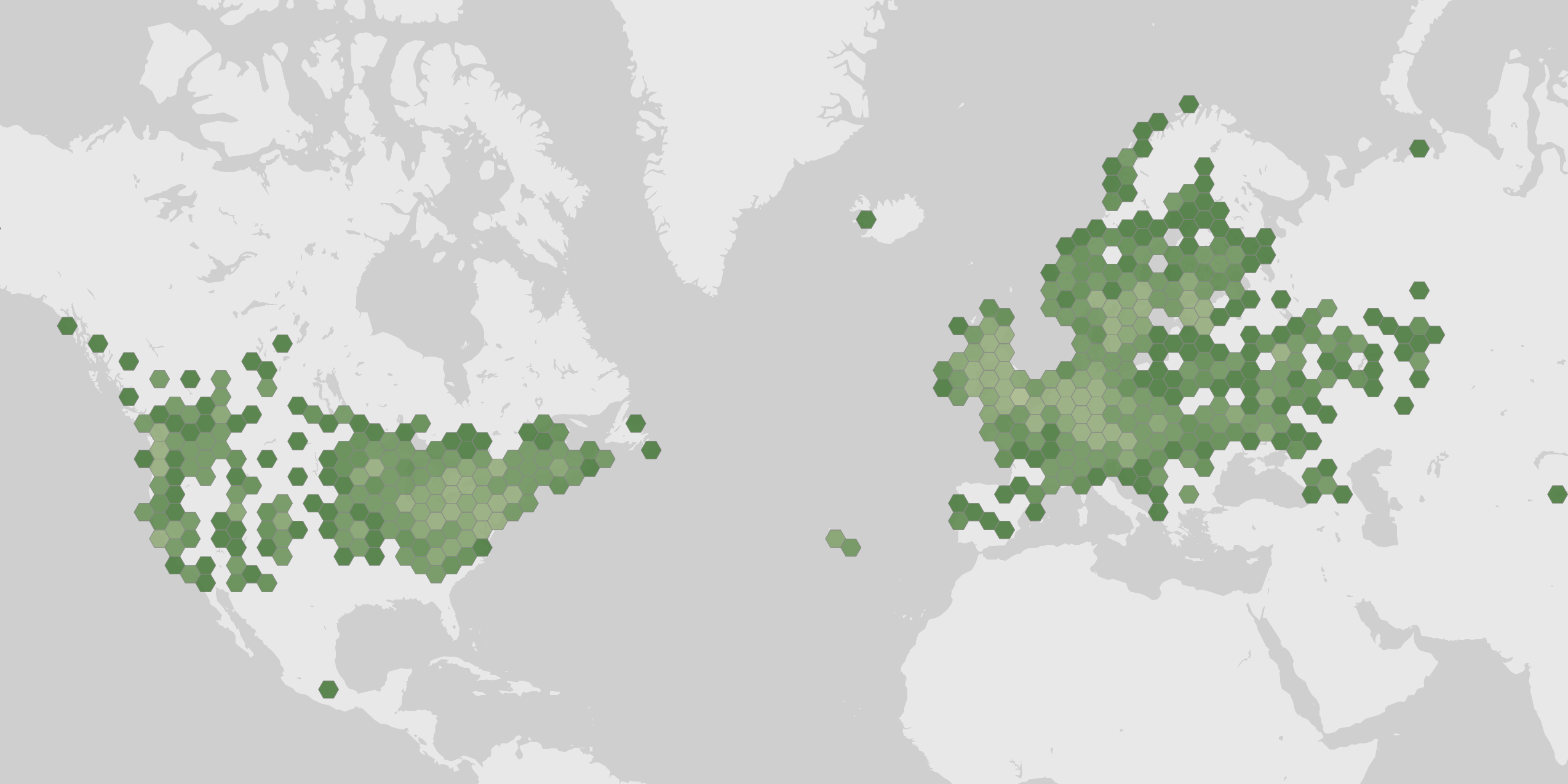
Monthly observation counts for Lumbricus terrestris rise sharply in spring, climbing from 440 records in February to a peak of 2,214 in April and 1,996 in May, before easing through the summer months. A smaller secondary rise appears in autumn, with 1,432 records in October, ahead of a clear winter low of around 395 to 440 records from December through February.
This pattern most likely reflects seasonal surface activity and observer effort rather than the size of the population itself. As presence records rather than abundance or range data, the counts show when and where people have logged the species, not how many worms actually live in a given area or the full extent of its distribution.
Diet and Nutrition
Lumbricus terrestris feeds mainly as a detritivore, pulling dead leaves from the soil surface down into the leaf litter and A-horizon mineral soil below. Its feeding preferences track the calcium, and likely nitrogen, content of the leaves on offer rather than the plant species itself.
Basswood, ash, and aspen leaves rank as the most favored food, followed by sugar maple and other maple varieties. Oak leaves are eaten far less readily because of their low calcium concentration, though the worm will still consume them when nothing richer is available.
Beyond leaf litter, the diet is not strictly vegetarian. Dead insects, soil micro-organisms, and feces have all been recorded as food sources, showing a degree of opportunism within an otherwise plant-based diet.
Reproduction and Life Cycle
Lumbricus terrestris is an obligatorily biparental simultaneous hermaphrodite: every mating exchanges sperm mutually between two individuals rather than relying on separate sexes. Copulation happens on the soil surface, but both partners stay anchored in their own burrows, and pairs typically visit each other's burrows repeatedly before mating. Mating is frequent, occurring roughly every 7 to 11 days, and factors such as a partner's relative size, its distance away, the risk of being dragged out of one's burrow during mating, and size-related fecundity all shape mate choice.
Sperm can be stored for as long as eight months after mating, and a mated worm may go on producing cocoons for up to a year afterward. Fertilization occurs inside the cocoon, which is deposited in a small chamber in the soil next to the parent's burrow.
Young worms emerge from the cocoon after a few weeks and begin feeding in the soil right away. Unlike adults, these early juveniles do not yet dig the vertical burrows characteristic of the species.
Worms are believed to need at least a year of development before reaching adulthood, with full reproductive maturity following in the second year. The natural lifespan in the wild is unknown, but individuals kept in captivity have lived as long as six years.
Population and Ecological Role
As a deep-burrowing anecic earthworm, Lumbricus terrestris builds semi-permanent vertical burrows and surfaces to feed rather than tunneling through the soil for food the way endogeic species do. It drags surface litter down into the mineral soil and deposits casts of mixed organic and mineral material back on top, a cycle that steadily reworks the soil around it.
Where it has invaded areas with podzol soil profiles, it can erase their distinctive layered structure, replacing the thick dark litter over a pale E horizon and reddish B horizon with a simpler sequence of thin litter and a dark, worm-mixed Ap horizon over the B. Its middens create micro-habitats that strongly influence soil fungi and shape where plant litter and litter-dwelling animals settle on the surface, while its casts have been shown to boost root development and root biomass in nearby plants.
Activity is closely tied to temperature and moisture: hot, dry nights and dry soil push the worm deep into its burrow, especially in summer, and cold winters reduce activity except in milder maritime climates where it can keep moving year-round.
Along the Atlantic fringe of northwestern Europe, Lumbricus terrestris has become locally endangered through predation by two introduced flatworms, the New Zealand flatworm (Arthurdendyus triangulatus) and the Australian flatworm (Australoplana sanguinea). Both predators can survive long periods without food, allowing them to persist even after driving earthworm numbers down to unsustainable levels, with knock-on damage to soil aeration and structure in affected areas.
Fun Facts
- Beyond its reputation as a pest in some regions, Lumbricus terrestris actively improves soil health by boosting aeration, nutrient cycling, and the return of nitrogen to the ecosystem.
- The species has crossed into art as well as ecology, lending its scientific name to the poem "Lumbricus Terrestris" by Rosemerry Wahtola Trommer.
- Its everyday name, the common earthworm, undersells a life built almost entirely underground in a semi-permanent burrow it rarely leaves for long.
Photos
Photographs from via iNaturalist, licensed under CC0 1.0., by Maxton Strait via iNaturalist, licensed under CC BY 4.0., by Nicole Kearney via iNaturalist, licensed under CC BY 4.0., by Katie Ling via iNaturalist, licensed under CC BY 4.0., by Zakqary Roy via iNaturalist, licensed under CC BY 4.0., by Ken Lange via iNaturalist, licensed under CC BY 4.0., by Полина Полежанкина via iNaturalist, licensed under CC BY 4.0., and by Ciprian Samoilă via iNaturalist, licensed under CC BY 4.0., credited on each photo.
Ecology and classification
Behavior
- Nocturnal
- Burrowing
Classification
- Phylum
- Annelida
- Class
- Clitellata
- Order
- Crassiclitellata
- Family
- Lumbricidae
- Genus
- Lumbricus
- Species
- Lumbricus terrestris
Sources
- GBIF Species names and classification
- iNaturalist Photos
- Wikidata Common names and conservation status
- Wikipedia Summary extract