A moth that hovers at flowers and hums like a tiny bird is not a bird at all — it's Macroglossum stellatarum, the hummingbird hawk-moth, whose resemblance to hummingbirds is one of the clearest examples of convergent evolution in the insect world.
Classified in the family Sphingidae within the order Lepidoptera, the species is found across temperate regions of Eurasia, part of the wider group known as hawk moths.
What makes it worth watching is its daytime habit: unlike most moths, it feeds openly in gardens and meadows under full sunlight, making it one of the few moths regularly mistaken for a bird.
Identification and Appearance
The clearest field mark is behavioral rather than purely visual: the moth hovers almost motionless in front of a flower while unrolling its long proboscis to drink nectar, exactly as a hummingbird does, and it produces an audible hum while doing so.
Its scientific name, Macroglossum stellatarum, points to this trait directly — 'macroglossum' refers to its unusually long, tongue-like proboscis, the feature that lets it feed while hovering instead of landing on the flower.
Distribution and Habitat
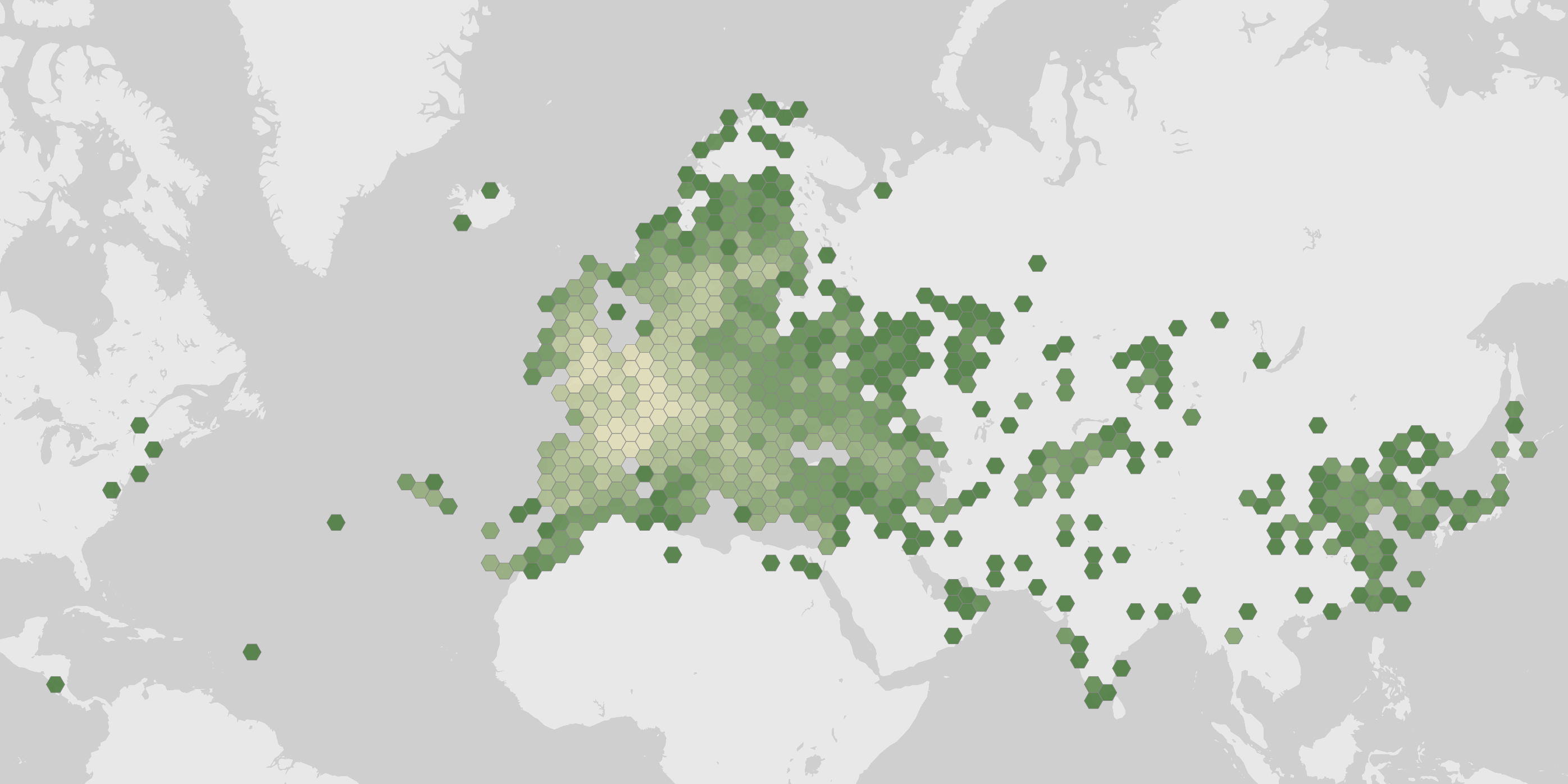
Macroglossum stellatarum ranges across the northern Old World from Portugal to Japan, though it breeds mainly in warmer climates such as southern Europe, North Africa, and points east; in Spain it can produce three generations in a single year.
The population in Britain and Ireland appears to be expanding, with numbers consistently increasing and the moth possibly shifting from a migratory visitor to a resident, as warmer winters linked to climate change let more individuals survive year-round. Elsewhere it remains a strong flier that disperses widely each summer but rarely survives winter north of the Alps or the Caucasus.
It turns up in gardens, parks, meadows, bushes, and woodland edges wherever its preferred nectar plants grow, including honeysuckle, red valerian, and other long-tubed flowers such as Centranthus, Jasminum, Buddleia, Nicotiana, Primula, Viola, Syringa, Verbena, Echium, Phlox, and Stachys. Its larvae feed mainly on bedstraws and madders (Rubia), and have also been recorded on Centranthus, Stellaria, and Epilobium.
Monthly presence records show a sharp seasonal pattern, with counts rising from under a thousand in winter to tens of thousands in June through August before falling away again by autumn — a pattern consistent with strong summer dispersal rather than year-round abundance, since these are presence observations, not population counts.
Behavior and Lifestyle
Its most distinctive behavior is free hovering flight: it holds itself steady in front of a flower's tube-shaped corolla while feeding, a technique that gives it far more maneuverability than fixed-wing flight but at a high energetic cost, accompanied by an audible humming sound from its wingbeats.
Unusually for a hawkmoth, it is active mainly in bright daytime sunshine but also flies at dusk, dawn, and even in rain, extending its feeding opportunities well beyond what most related species attempt.
Like many large insects, it relies on Johnston's organs, sensory structures at the base of the antennae, to judge its body position in the air — a mechanism that likely underlies its precise control while hovering just centimeters from a flower.
Cultural Significance
The hummingbird hawk-moth has long been regarded as a lucky omen in parts of Europe, most famously when a swarm of the moths was reported flying across the English Channel on D-Day, the day of the Normandy landings in the Second World War.
The family name Sphingidae, shared by this species, comes from the belief that the larvae of these moths resemble the Egyptian Sphinx, linking the group's scientific identity to ancient iconography.
The moth has also crossed into popular culture, inspiring the They Might Be Giants song "Bee of the Bird of the Moth," which takes its name from the confusion the species causes between bees, birds, and moths.
Fun Facts
- European garden-watchers once mistook it for a genuine miniature hummingbird, a mix-up that is preserved in its common name to this day.
- In 1994, researchers Farina, Varjú, and Zhou studied how the moth regulates its hovering distance from flowers by presenting it with dummy flowers in the lab.
- It was formally named by Carl Linnaeus in 1758, making it one of the earliest hawk moths given a scientific description.
- Though it looks and behaves like a hummingbird, it shares no evolutionary lineage with birds at all — the similarity evolved completely independently.
Ecology
Habitat
- Woodland
- Shrubland
- Grassland
- Urban
Diet
- Nectarivore
Behavior
- Diurnal
- Migratory
- Crepuscular