A single act of domestication in southern Mexico, roughly 9,000 years ago, turned a wild grass called teosinte into one of the most important food crops on Earth.
Zea mays, commonly called maize or corn, is a tall, stout member of the grass family Poaceae. It produces separate male and female flowers on the same plant: a pollen-bearing tassel at the top and grain-bearing ears lower on the stalk. Once found only in the Americas, it now grows on every populated continent and carries an IUCN status of Least Concern, reflecting its status as a widely cultivated crop rather than a wild population under threat.
Few plants have shaped human history as thoroughly as this one. Native American farmers grew it alongside beans and squash in the Three Sisters system, and it went on to become a global staple, a biofuel source, and a subject of intense agricultural science.
Identification and Appearance
The clearest way to recognize maize is by its single, unbranched stalk topped with a feathery tassel and set with one or more husk-wrapped ears lower down. Plants grow 1.2 to 4 meters (4 to 13 feet) tall on a single stem, with long, narrow leaves arising alternately from nodes along its length.
Maize is monoecious, carrying male and female flowers separately on the same plant. The tassel at the stem's top holds the male flowers, whose anthers release pollen to the wind. Farther down, each female inflorescence first appears as silk, a bundle of soft tubular hairs, one strand for each carpel; once pollinated, each strand's carpel develops into a single kernel.
A mature ear carries 8 to 32 rows of kernels, with as many as 1,200 kernels on a large cob. Modern commercial kernels are usually yellow or white, but other varieties range through orange, red, brown, blue, purple, and black. Yellow color comes from carotenoids, red from anthocyanins and phlobaphenes, and orange or green kernels from combinations of these pigments.
Flowering depends on day length: maize is a short-day plant that needs nights of a certain minimum length plus warm days above 10°C (50°F) to begin flowering, a mechanism controlled through its phytochrome system. Tropical varieties can grow unusually tall instead of setting seed when planted at higher latitudes, since the longer summer days there delay flowering.
Distribution and Habitat
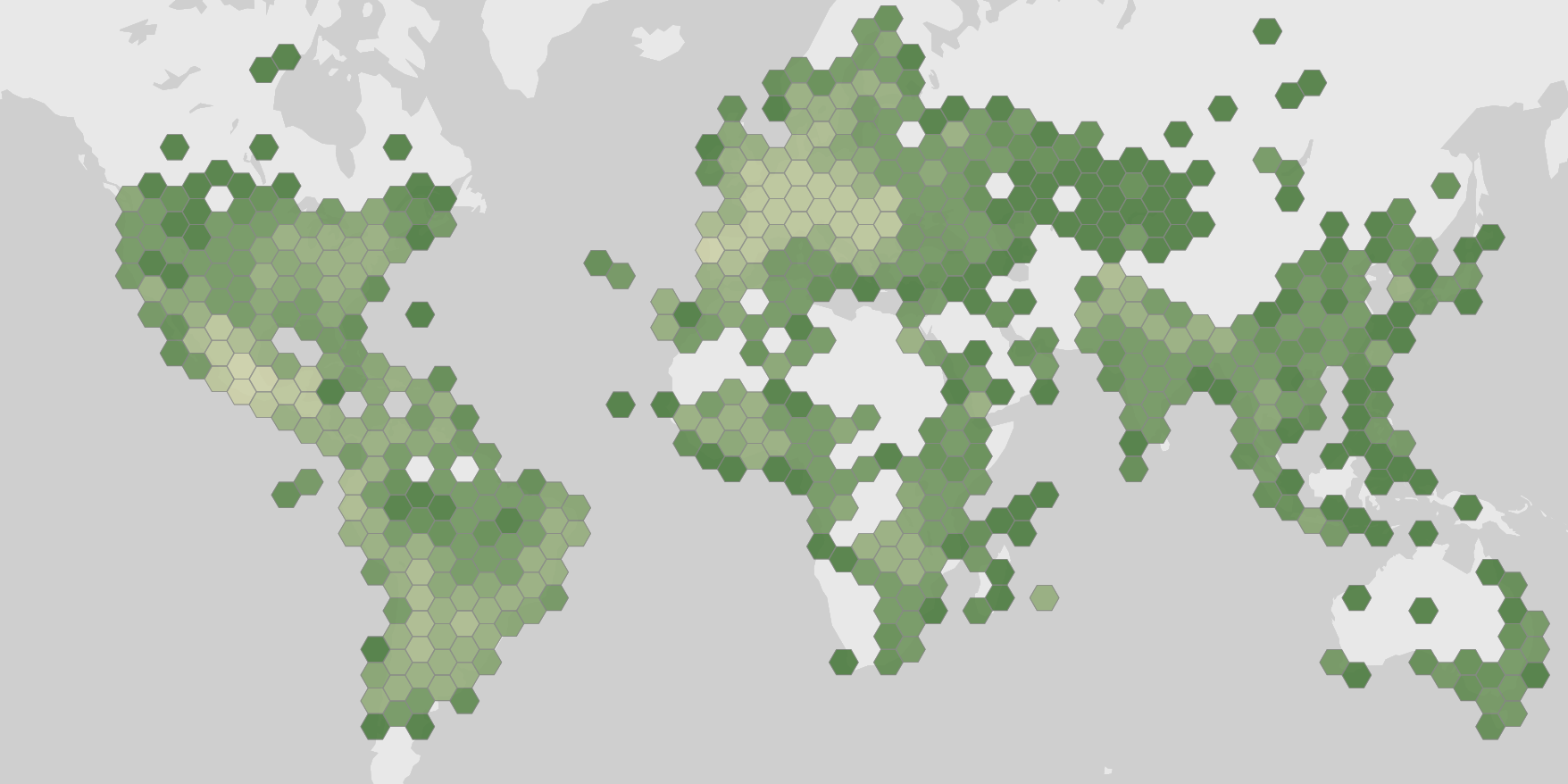
Maize is grown almost everywhere people farm, having spread from its native Americas to become a cultivated cereal across the globe, including large-scale production in China. Wherever it grows, it exists as a managed field crop rather than as a self-sustaining wild population.
Global presence records compiled by GBIF, which reflect where the plant has been observed rather than its abundance or full range, show reports peaking in January, with counts around 16,400 that month before easing through February and March. A secondary rise appears in June, with roughly 11,600 observations, likely tracking planting or field survey activity in different growing regions rather than any single growing season.
Growth and Form
Maize traces to a single domestication event in the Balsas River valley of south-central Mexico, most likely around 9,000 years ago, when farmers began selecting a wild grass called teosinte for kernels that stayed attached to the cob instead of scattering to reseed themselves. The oldest surviving maize types come from the Mexican highlands.
From that center, maize moved outward along two major routes across the Americas. It reached highland Ecuador at least 8,000 years ago, lower Central America by roughly 7,600 years ago, and the valleys of the Colombian Andes between 7,000 and 6,000 years ago.
The earliest plants bore a single small ear each. The Olmec and Maya later cultivated numerous varieties across Mesoamerica, processing the grain through nixtamalization and placing it at the center of Olmec calendar systems, language, and myth. Farther south, the Mapuche people of south-central Chile grew maize alongside quinoa and potatoes, and traders carried it as far as 40°S in what is now Argentina before the rise of the Inca Empire.
Reproduction and Life Cycle
Modern maize breeding began with farmers who selected their most productive plants and sold the seed to neighbors; James L. Reid's Reid's Yellow Dent, developed in the 1860s, was among the earliest successes. Techniques grew more systematic over time: ear-to-row selection from C. G. Hopkins around 1896, hybrids from selected inbred lines from G. H. Shull in 1909, and highly productive double-cross hybrids from four inbred lines, developed by D. F. Jones around 1918-1922.
Since the 1940s, the leading commercial strains have been first-generation hybrids built from inbred lines optimized for yield, nutrition, drought tolerance, and pest or disease resistance, using both conventional cross-breeding and genetic engineering. Evidence on whether the yield potential of individual plants has actually risen is mixed; much of the gain instead traces to traits like leaf angle, lodging resistance, and tolerance of dense planting.
Breeders have also produced specialized types: multi-eared varieties supply the baby corn used in Asian cuisine, and a fast-flowering 'mini-maize' allows researchers to run several generations in a single year. One landrace, olotón, has evolved a partnership with nitrogen-fixing microbes that can supply 29% to 82% of its nitrogen needs. Organizations such as CIMMYT maintain breeding programs, including a Drought Tolerant Maize for Africa project, and continue to draw on tropical landraces as sources of disease- and pest-resistance genes.
Uses and Human Relationships
Maize holds deep spiritual meaning in Mesoamerican cultures, where Maya belief held that humans themselves were created from corn. Maize deities held a central place in ritual and mythology, and the crop was woven into calendars, creation stories, and social organization as a symbol of life and sustenance.
After 1492, Spanish settlers carried maize to Europe, where it reached Spain within decades and spread on to Italy, West Africa, and the Philippines. By the 17th century it was common peasant food in southern Europe, and by the 18th century it was a staple for southern French and Italian farmers, notably as polenta in Italy. Despite this, Spanish colonists themselves generally preferred wheat bread, and Christian doctrine at the time held that only wheat could serve as communion bread.
Adoption in new regions brought a hidden cost: widespread pellagra wherever maize became a staple without the preparation Indigenous Americans had used since at least 1200-1500 BC, soaking kernels in alkaline water in a process called nixtamalization that releases niacin. Understanding this, along with dietary variety and high-lysine maize, largely ended pellagra in wealthier countries, though it persists where people depend heavily on donated maize. Modern maize farming has also become dominated by genetically modified varieties, mostly Bt maize; by 2016, 92% of the US crop was genetically modified. A 2000 recall involving up to $50 million in food products followed the discovery of Starlink corn, approved only for animal feed, in human food. Long before any of this, Native American farmers grew maize with beans and squash in the Three Sisters system, in which maize supported climbing beans, the beans fixed nitrogen for the soil, and squash leaves shaded out weeds.
Fun Facts
- The old farming saying 'knee-high by the Fourth of July' once marked healthy growth in the US Midwest, though modern hybrids grow far faster.
- Young maize shoots manufacture DIMBOA, a natural antibiotic compound that helps defend the plant against a wide range of insect pests.
- Maize pollen can trigger allergies, but because most of it settles within a few meters of the tassel, the risk falls mainly on farmworkers.
- A cob can carry up to 1,200 kernels arranged in 8 to 32 rows, colored by pigments ranging from carotenoids to anthocyanins.
- Unlike its wild ancestor teosinte, whose kernels drop naturally to reseed themselves, domesticated maize kernels stay fixed to the cob and cannot spread without human planting.
- A specialized 'mini-maize' variety was bred to flower quickly, letting researchers complete multiple generations of study in a single year.
- The landrace olotón hosts nitrogen-fixing microbes that can supply as much as 82% of the plant's nitrogen requirement.
Photos
Photographs from via iNaturalist, licensed under CC0 1.0., by Ole N. via iNaturalist, licensed under CC BY 4.0., by Andrew Sebastian via iNaturalist, licensed under CC BY 4.0., by Bobo-X via iNaturalist, licensed under CC BY 4.0., by Наталья Пикалова via iNaturalist, licensed under CC BY 4.0., by Ben Redding via iNaturalist, licensed under CC BY 4.0., by giantcicada via iNaturalist, licensed under CC BY 4.0., by Viktor Strenada via iNaturalist, licensed under CC BY 4.0., by Nick Butcher via iNaturalist, licensed under CC BY 4.0., and by Tom Norton via iNaturalist, licensed under CC BY 4.0., credited on each photo.
Ecology and classification
Habitat
Growth habit
- Graminoid
Classification
- Phylum
- Tracheophyta
- Class
- Liliopsida
- Order
- Poales
- Family
- Poaceae
- Genus
- Zea
- Species
- Zea mays
Sources
- GBIF Species names and classification
- iNaturalist Photos
- Wikidata Common names and conservation status
- Wikipedia Summary extract
- Encyclopedia of Life Habitat, diet and behavior traits