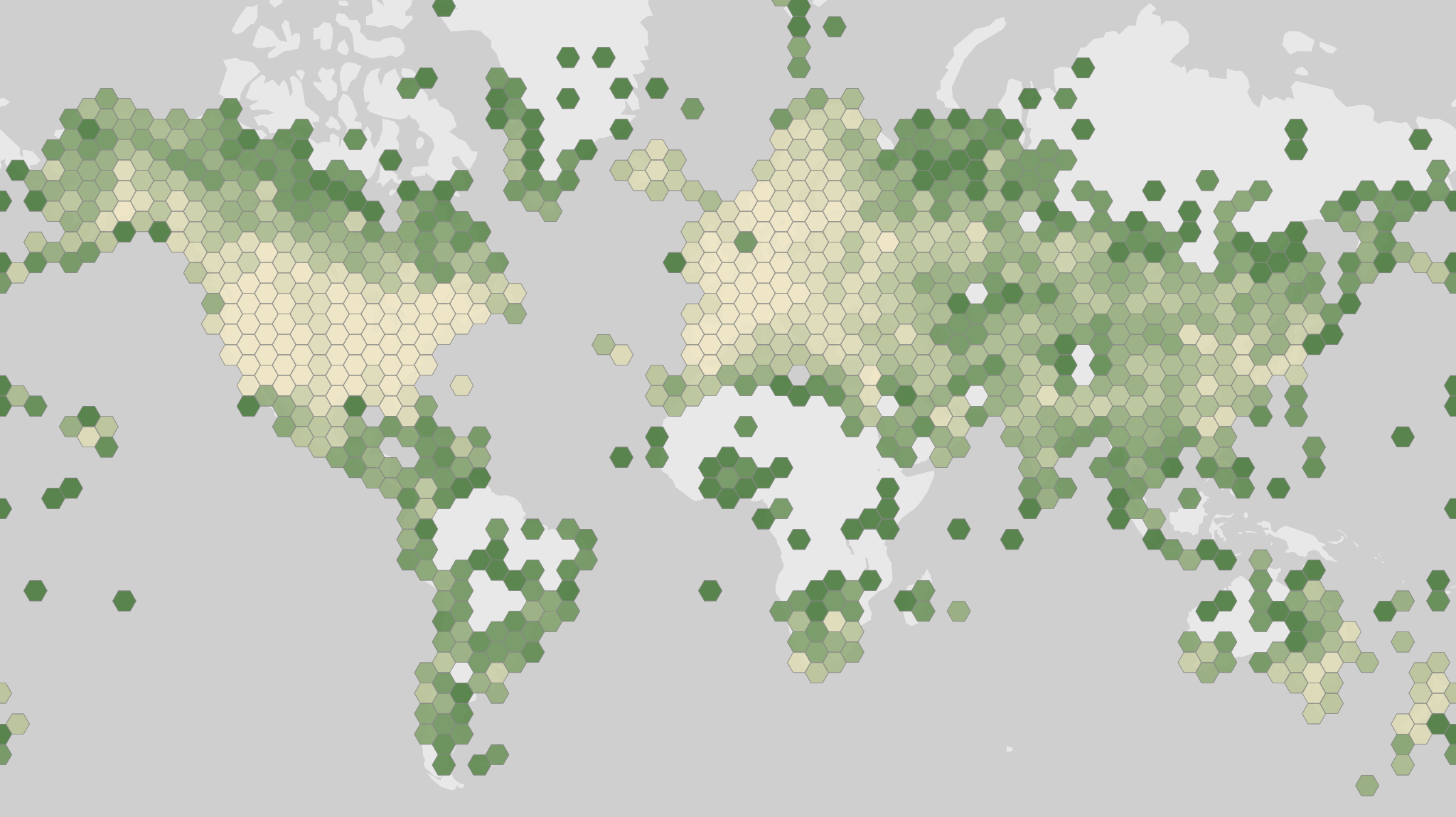
Few ducks have spread as far as the mallard, which breeds across temperate and subtropical North America, Eurasia and North Africa. It has also been introduced to New Zealand, Australia, South Africa and several countries in South America.
The mallard is a dabbling duck in the subfamily Anatinae of the waterfowl family Anatidae. It lives in wetlands, where it eats water plants and small animals, and it usually gathers in groups or flocks of varying sizes.
The IUCN lists the mallard as Least Concern. Its range covers about , and its population is very large, although it is decreasing. Its ability to live alongside people makes it one of the best-known wild birds in the world.
Identification and Appearance
The breeding male is the easiest mallard to recognize, with a glossy bottle-green head, a white collar and a purple-tinged brown breast. Its back is black at the rear, with white-bordered dark tail feathers, and its belly is pale grey.
The mallard is a medium-large duck, heavier than most other dabbling ducks. Adults are 50 to 65 cm long, have a wingspan of 81 to 98 cm and weigh about on average. The male's bill is yellowish-orange with a black tip, while the female's bill is darker, ranging from black to mottled orange and brown.
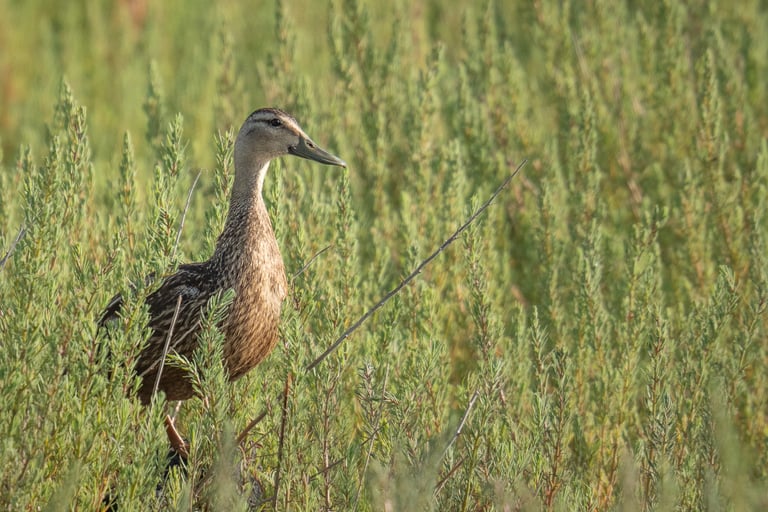
The female is mottled brown, with each feather showing sharp contrast from buff to very dark brown. Her cheeks, eyebrow, throat and neck are buff, and her crown and eye-stripe are darker. Both sexes have iridescent purple-blue speculum feathers edged with white, which show in flight or at rest and are briefly lost during the summer moult.
Several brown-plumaged ducks can be confused with the female mallard. The female gadwall is smaller and has an orange-lined bill and a white belly. In North America, the American black duck is darker in both sexes, and the mottled duck is somewhat darker than the female mallard, with a different bill colour and no white edge on the speculum.
Distribution and Habitat
The mallard breeds in a wide range of habitats and climates, from Arctic tundra to subtropical regions. It uses both fresh and salt water, including parks, small ponds, rivers, lakes, estuaries, shallow inlets and open sea within sight of the coast.
It prefers lowland wetlands such as marshes, ponds, shallow pools, tidal flats and protected coves. Water less than 0.9 metres (3.0 ft) deep is preferred, and birds avoid areas more than a few metres deep. Highly productive waters with floating, emergent and submerged vegetation attract them, as do the aquatic invertebrates these waters support.
Mallards need dry ground away from the water's edge for nesting, along with plenty of open pond area for feeding. They nest mainly in grasslands away from the water, but they also use old bird nests, tree cavities, rights-of-way and meadows with woody vegetation.
In the north, the mallard is strongly migratory and winters farther south. In North America it winters south to the southern United States and northern Mexico, and it regularly strays into Central America and the Caribbean between September and May. Some birds stay through winter where food and shelter are plentiful.
Behavior and Lifestyle
Outside the breeding season, mallards form flocks. Birds from the northern parts of the range move south to warmer areas, where they wait and feed until the next breeding season begins. Some individuals remain in the north all year, forming resident populations.
Mallards are social animals that prefer to congregate in groups. They often feed and rest together on open water, and they are comfortable around people, so they are common in urban parks, lakes and ponds.
Adult mallards also show a strong tendency to defend their space during the breeding season. Males and females both charge at rivals to drive them off, and males often attack each other by pecking at a rival's chest.
Communication
The mallard is a noisy duck. The female gives the familiar deep quack, usually as a sequence of 2 to 10 quacks that start loud and fade in volume. The male makes a similar sound that is deeper and quieter.
A female with a nest or young uses a shorter, truncated version of the quack. The young respond strongly to it, and the repetition and frequency changes of these calls help ducklings learn to recognize their own species. If a nest or brood is threatened, the female hisses.
Mallards also signal visually with their iridescent speculum and the bright plumage of males. Wing take-off produces a faint whistling sound that can be heard as the birds leave the water.
Recordings
flight call · France · Sonothèque ADVL · Public domain
Diet and Nutrition
Mallards eat both plants and animals. Their plant foods include duckweeds, smartweeds, pondweeds, grasses, sedges, arrowhead and wild millet, and in farmland they also take corn and soybeans. In bottomland hardwood forests, acorns are an important food.
Animal prey is mostly aquatic. Frogs and newts are the main groups taken, and the mallard also eats aquatic insect larvae such as stoneflies and caddisflies. Crustaceans, worms, snails and spiders are also eaten.
The mix of foods changes with the season and the habitat, with plants and seeds making up more of the diet where crops and shallow wetlands are common.
Nesting and Breeding
Mallards usually form pairs in October and November in the Northern Hemisphere, and pair bonds last until March. Most females breed for the first time as yearlings, although older hens have much lower duckling mortality. Males leave the female soon after mating and join other males until they moult, which begins in June.
Nests are usually on the ground, hidden in vegetation, where the female's speckled plumage camouflages her. Females also nest in tree hollows, boathouses, roof gardens and balconies, though young that hatch high above the ground can have difficulty reaching the water.
A clutch contains 8 to 13 creamy white to greenish-buff eggs, each about 58 mm long and 32 mm wide. The eggs are laid on alternate days, and incubation begins when the clutch is almost complete. Incubation takes 27 to 28 days, and the young fledge at 50 to 60 days.
The ducklings are precocial and can swim as soon as they hatch. They stay close to their mother for warmth, protection and to learn where to find food. Females usually drive away unfamiliar ducklings, and in New Zealand, where mallards are naturalized, nest survival is generally higher than in their native range.
If a nest fails, some females lay a second clutch around early to mid-summer. Late clutches also occur in unusually warm autumns, and in November 2011 a female hatched and raised eleven ducklings at the London Wetland Centre.
Population and Ecological Role
The mallard is the most abundant and widespread waterfowl. Its population is estimated at more than 17 million mature individuals as of 2025, although that number is decreasing.
Mallards are an important food for many predators. Foxes take brooding females, and large birds of prey such as eagles and harriers take adults. Herons, gulls, pike and catfish prey on ducklings and adults, and crows sometimes kill young birds.
By feeding on seeds, plants and invertebrates in shallow wetlands, mallards help move nutrients and link water and land habitats.
Domestication and Human History
People have long shared wetlands with mallards. The domestic duck was first domesticated in Southeast Asia at least 4,000 years ago during the Neolithic Age, and the Romans in Europe and the Malays in Asia also kept ducks.
Almost all domestic duck breeds derive from the mallard, except for some Muscovy breeds. Domestic ducks are mostly kept for meat and eggs, and they tend to be less aggressive than mallards and have no territorial behaviour. Because the domestic duck and the mallard are the same species, the two interbreed and produce fertile hybrids, so mallards carry genes from domestic ducks.
The mallard is also an important game species. Hunters take large numbers each year, and licence fees support the management of populations and the protection of important habitats. Hunting can reduce numbers in some places and at some times.
Mallards also come into contact with aviation. The US Federal Aviation Administration has counted 1,320 mallard collisions with aircraft since standardized data collection began in 1990, and 261 of these caused damage. The mallard ranks as the seventh most hazardous bird to both military and commercial aircraft in the United States.
Conservation and Threats
The IUCN has rated the mallard as Least Concern since 1998. Its range is larger than 65,000,000 km², and its population, estimated at more than 17 million mature individuals as of 2025, is decreasing.
The greatest threat to mallards is the loss of habitat, although they adapt readily to human disturbance. Botulism is a further danger in summer, when hot temperatures and low water levels allow the bacterium Clostridium botulinum to multiply, and outbreaks can cause mass die-offs.
The release of feral mallards into areas where they are not native can cause problems by interbreeding with local waterfowl. In some regions, the main risk comes from the loss of genetic diversity among a region's traditional ducks once mallards colonize an area.
In the United States, the mallard is protected under the Migratory Bird Act, and in the United Kingdom it is protected under the Wildlife and Countryside Act 1981, which restricts certain hunting methods and the taking or killing of mallards.
Photos
Photographs from via iNaturalist, licensed under CC0 1.0., by Liem Malarney via iNaturalist, licensed under CC BY 4.0., by Ross McCallum via iNaturalist, licensed under CC BY 4.0., by Tatiana Strus via iNaturalist, licensed under CC BY 4.0., by Анна Васильченко via iNaturalist, licensed under CC BY 4.0., by Carmen via iNaturalist, licensed under CC BY 4.0., and by Liam Steele via iNaturalist, licensed under CC BY 4.0., credited on each photo.
Ecology and classification
Classification
- Phylum
- Chordata
- Class
- Aves
- Order
- Anseriformes
- Family
- Anatidae
- Genus
- Anas
- Species
- Anas platyrhynchos
Sources
- GBIF Species names and classification
- iNaturalist Photos
- Wikidata Common names and conservation status
- Wikipedia Summary extract
- Encyclopedia of Life Habitat, diet and behavior traits
- Xeno-canto Audio recordings
- Animal Diversity Web Animal habitat, behavior and diet
- AnAge Longevity
- AVONET Bird mass, habitat, migration, diet and range size
- GloBI What it eats, what eats it, parasites and pollinators
- trophiCH
- Wardeh et al. 2015 (EID2)
- HWML Parasite Collection
- TETRA-EU