The wild ancestor of every cultivated apple still grows in the mountains of Central Asia, where Malus sieversii clings to forested slopes much as it did before humans ever tasted its fruit. From that origin, Malus domestica has become the most widely grown tree in its genus, cultivated across temperate regions worldwide for its round, edible pome.
As a deciduous member of the rose family, Rosaceae, the apple tree has traveled from the forested flanks of the Tian Shan mountains across Eurasia and, eventually, to the Americas with European colonists. Its long partnership with people, its genetic complexity, and its deep place in mythology and religion make it one of the most culturally significant plants ever domesticated.
Identification and Appearance
The single best way to recognize an apple tree is its blossom: rose-pink buds that open to five-petaled flowers 3 to 4 centimeters across, fading to white or light pink, clustered in groups of three to seven with a central "king bloom" that opens first and often develops the largest fruit.
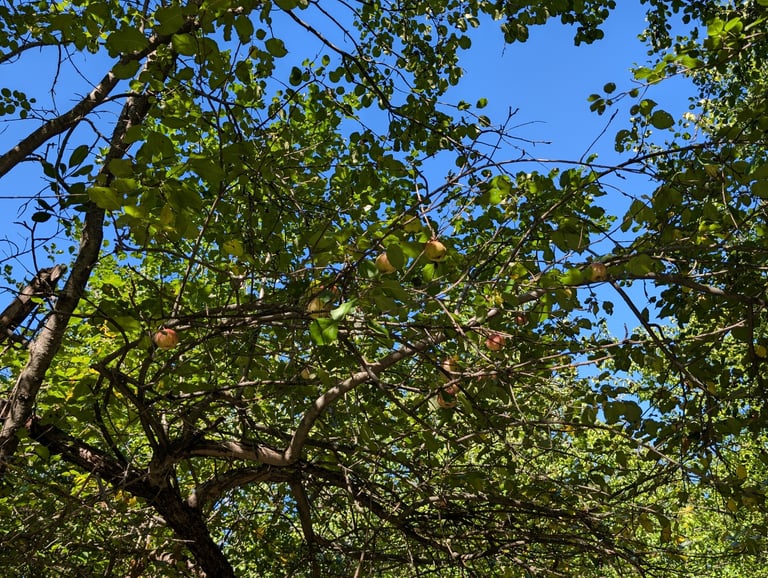
Cultivated trees typically stand 2 to 4.5 meters tall, though wild forms can reach 15 meters, with most growing between 2 and 10 meters. The crown is rounded to erect with a dense canopy. Bark on the trunk is dark gray or gray-brown, while young branches are reddish or dark brown and covered in fine downy hairs that disappear with age. Buds are egg-shaped, dark red or purple, and usually less than 4 millimeters long, with hairy-edged scales.
Leaves are simple, ranging from elliptic to ovate to oblong, with broadly angled teeth but no lobes. Their upper surface is nearly hairless while the underside stays densely hairy. The fruit itself, a pome maturing in late summer or autumn, varies enormously between cultivars: it can measure anywhere from 2.5 to 12 centimeters across and range from nearly round to conical or elongated. Skin color runs from yellow, green, or whitish-yellow at the base to overlays of orange-red, pink-red, purple-red, or brown-red covering anywhere from none to all of the surface, sometimes roughened by russeting and always coated in a protective wax layer.
Inside, the flesh is usually pale yellowish-white but can be pink, yellow, or green, and in rare cultivars even black or purple. Five sepals persist and stand out from the fruit's surface, while the core holds three to five carpels, each containing one or two seeds that range from light tan to dark, often reddish or purplish-black, brown.
Distribution and Habitat
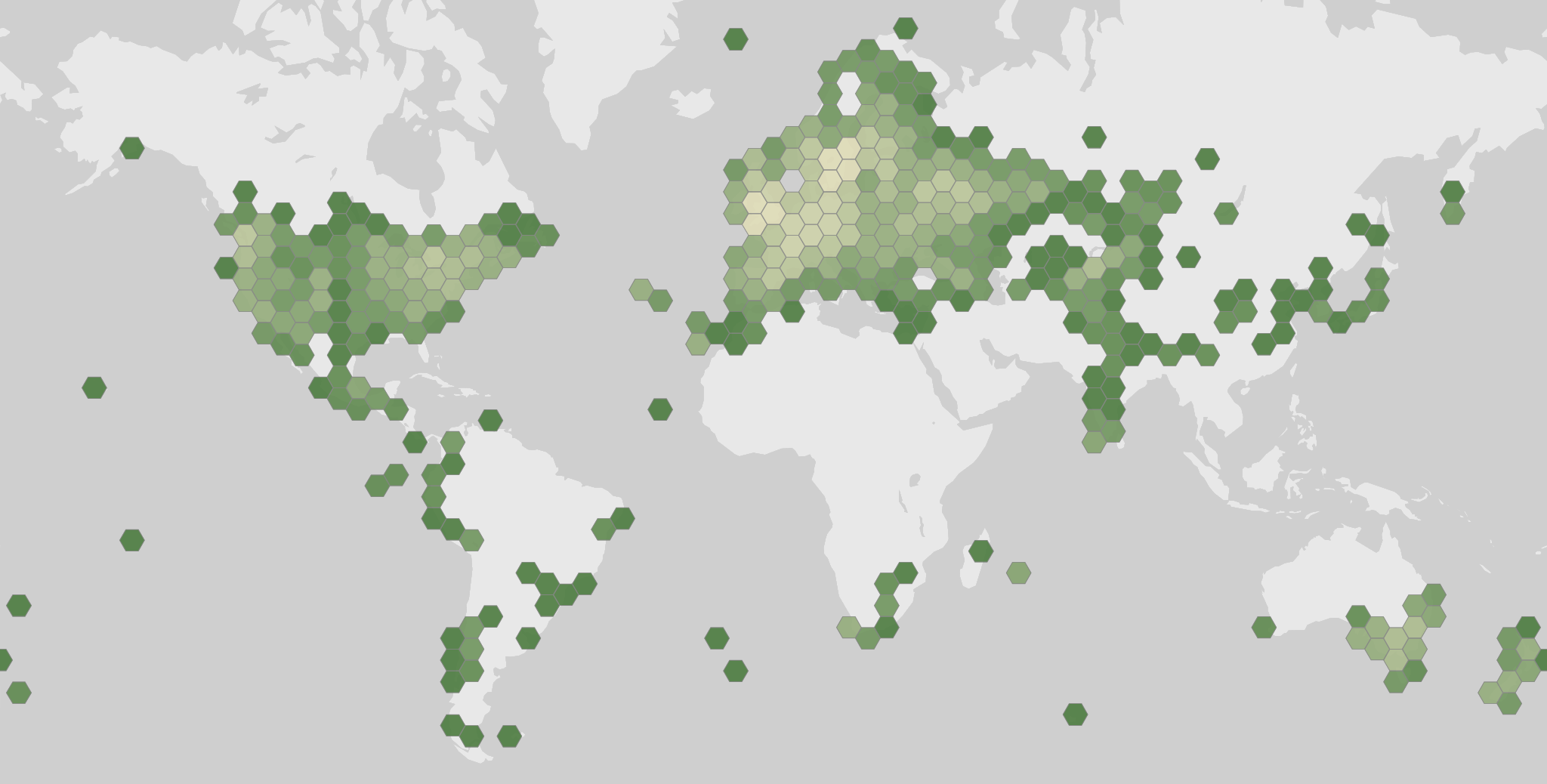
Observation records for Malus domestica show a pronounced seasonal pattern, with counts climbing sharply from around 2,100 in March to over 19,500 in May and staying high through June, July, and August before dropping off by October. This pattern most likely reflects the tree's spring flowering and summer fruiting periods, when the tree is most visible and identifiable to observers, rather than any change in how many trees exist.
Because these figures are presence observations rather than counts of abundance, they cannot be read as a population estimate or a complete picture of where the species grows. What they do suggest, cautiously, is a strong seasonal peak in recorded sightings during late spring and summer, consistent with the tree's blossoming and fruiting cycle described elsewhere in its biology.
Reproduction and Life Cycle
Apple trees cannot reliably reproduce themselves through seed: because each seedling is an "extreme heterozygote," it differs from both parents and from its siblings, making seed-grown apples unpredictable in flavor and form. This is compounded in triploid cultivars, where three sets of chromosomes divide unevenly during meiosis, so that even when seeds do form, seedlings rarely survive.
Because of this genetic instability, growers propagate desired cultivars asexually by grafting cuttings onto rootstocks, a practice that also controls the ultimate size, hardiness, and disease resistance of the tree. Dwarf rootstocks, which produce trees under 3 meters tall that fruit earlier and are easier to harvest, date back to around 300 BCE in Persia and Asia Minor; Alexander the Great reportedly sent dwarf apple samples to Aristotle's Lyceum, and dwarfing rootstocks became common again by the 15th century. Much of the modern rootstock system was developed in early 1900s England at the East Malling Research Station, whose "M"-prefixed rootstocks, and their later "MM" crosses with the cultivar 'Northern Spy', are still used today.
Flowering occurs in spring alongside leaf budding, but apple trees are self-incompatible and must cross-pollinate with a different, compatible cultivar to set fruit. Honey bees are the primary pollinators, supplemented in some orchards by orchard mason bees. Cultivars are grouped by bloom timing, from Group A varieties like 'Gravenstein' flowering in early May in England, to Group H varieties like 'Court-Pendu Gris' blooming in late May, and successful pollination requires overlap between compatible groups within roughly a six-day window.
Uses and Human Relationships
Apple cultivation traces back 4,000 to 10,000 years to the Tian Shan mountains, from where the fruit traveled the Silk Road into Europe, picking up genetic influence from wild crabapples in Siberia, the Caucasus, and Europe along the way. Chinese growers cultivated related soft apple species as dessert fruit for more than 2,000 years, while seeds resembling apples found near Udine in northeastern Italy date to between 6570 and 5684 BCE, though it remains unclear whether these were wild or early domesticated forms.
Grafting, essential to preserving desirable cultivars, was already practiced in Roman times, and the Roman writer Pliny the Elder described storing apples in well-ventilated, north-facing rooms on beds of straw or chaff to extend their shelf life beyond the natural limit of a few months. Medieval Europeans dried cored and sliced apples to preserve them even longer. Spanish colonists introduced the tree to the Chiloé Archipelago in the 16th century, where it adapted particularly well, and English colonists brought it to North America in the 17th century, with the first named cultivar introduced in Boston in 1640 by Reverend William Blaxton. Since only crab apples are native to North America, every other apple cultivar there descends from these introduced trees.
Human selection over millennia has focused on fruit size, acidity, color, firmness, and sugar content, yet the wild ancestor Malus sieversii is only slightly smaller than modern domesticated apples, an unusual trait among domesticated fruits. Cultivar diversity exploded quickly once grafting spread: an 1845 American nursery catalogue already listed 350 of the "best" cultivars. Beyond agriculture, apples carry deep cultural weight, appearing as symbols of temptation, health, and diversity across human history and holding significance in mythologies including Norse and Greek traditions as well as in religions such as Christianity.
Fun Facts
- Apples hold cultural significance across many mythologies, including Norse and Greek traditions, and in religions such as Christianity.
- Dwarf apple rootstocks were known as early as 300 BCE, and Alexander the Great is said to have sent samples of dwarf apple trees to Aristotle's Lyceum.
- Seeds resembling apples found near Udine in northeastern Italy have been carbon dated to between 6570 and 5684 BCE, though whether they came from wild or domesticated trees remains uncertain.
- The only apples native to North America are crab apples; every other cultivar grown there descends from trees introduced by European colonists in the 17th century.
- By 1845, an American nursery catalogue already offered 350 of the "best" apple cultivars, showing how fast new varieties proliferated once grafting techniques spread.
- In parts of Ecuador, apple trees have been acclimatized at very high altitudes where constant temperate conditions allow some trees to produce two crops per year.
Photos
Photographs from via iNaturalist, licensed under CC0 1.0., by Sandy Wolkenberg via iNaturalist, licensed under CC BY 4.0., by Мирослав Соболев via iNaturalist, licensed under CC BY 4.0., by Fives via iNaturalist, licensed under CC BY 4.0., by martinarcand1 via iNaturalist, licensed under CC BY 4.0., and by The Wrong Industry via iNaturalist, licensed under CC BY 4.0., credited on each photo.
Ecology and classification
Growth habit
- Tree
Classification
- Phylum
- Tracheophyta
- Class
- Magnoliopsida
- Order
- Rosales
- Family
- Rosaceae
- Genus
- Malus
- Species
- Malus domestica
Sources
- GBIF Species names and classification
- iNaturalist Photos
- Wikidata Common names and conservation status
- Wikipedia Summary extract