The scientific name Malus sylvestris translates to "forest apple," a fitting label for a tree that has quietly shaped both the woodlands and the orchards of Europe. It is the wild ancestor lurking behind countless hedgerow apples, yet it survives today mostly as scattered individuals rather than in the thick stands its name suggests.
Native to western Eurasia, from the British Isles across the European mainland into Anatolia and the south Caucasus, the European crab apple is currently classified as Data Deficient by the IUCN. That status reflects how little is systematically known about its numbers, even though botanists agree it is rare and declining across much of its range. What makes the species worth a closer look is less its rarity than its dependence on a vanished world of grazing megafauna, a relationship still written into its thorny branches and its fruit.
Identification and Appearance
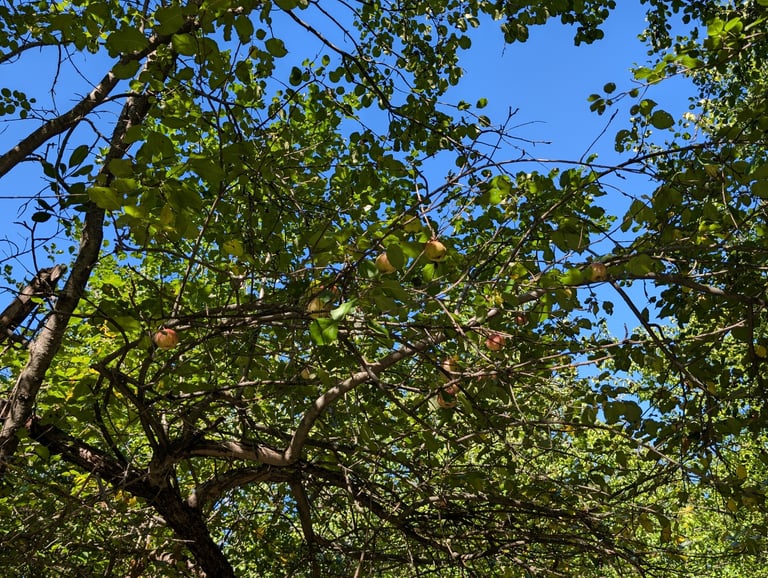
The clearest field mark is the crown itself: densely, almost tangled branching, unlike the looser, straighter-branched crown of a domesticated apple tree. This wild growth habit, combined with pronounced thorniness that intensifies after pruning or browsing, sets it apart at a glance.
A mature Malus sylvestris is a small to medium tree, occasionally growing as a multi-stemmed bush, reaching up to 14 meters in height with trunk diameters usually between 23 and 45 centimeters, though some individuals exceed 90 centimeters. The bark is light brown and flakes with age. Leaves are roundish-oval, sometimes hairy beneath, and tend to be smaller, stiffer, and shinier than those of domesticated apples.
Hermaphrodite flowers open from May into June, just ahead of hawthorn, with white or pinkish petals pollinated by insects. The pome fruits that follow ripen in autumn, fall to the ground, and typically measure around 3 centimeters across, usually smaller than domesticated or hybrid fruit.
Because wild and domesticated apples hybridize readily, pure identification can be difficult without flowers. According to a 2022 study by Feulner et al., the most reliable field distinction combines a hairless calyx, hairless leaf midrib, hairless veins on the leaf underside, and a leaf surface that is at most sparsely hairy. Of these traits, a hairless calyx is the single most decisive feature, since hybrids consistently retain hairy calyces even when their leaves appear smooth.
Distribution and Habitat
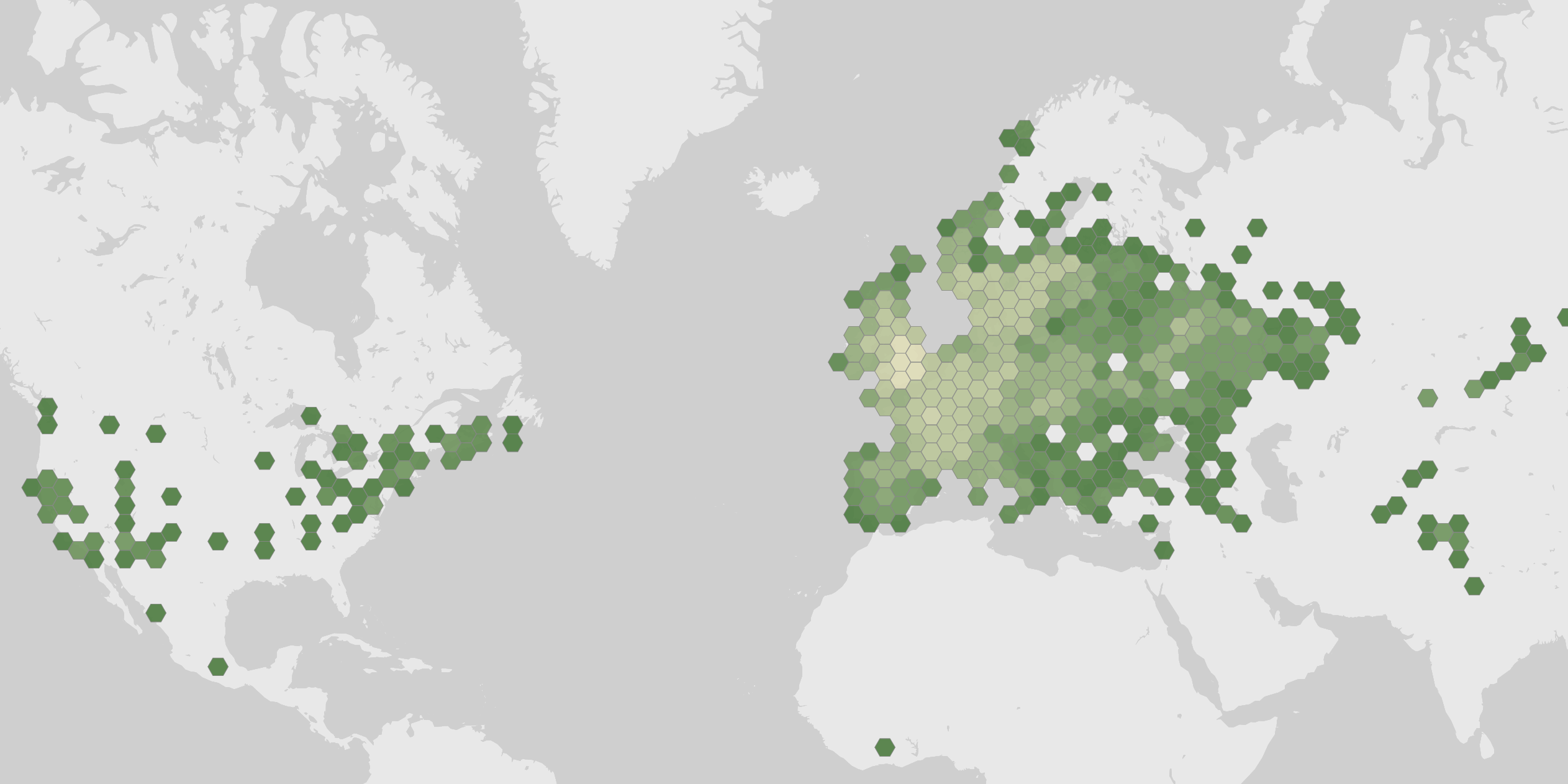
Malus sylvestris ranges across nearly all of Europe except the far north and south, extending into Anatolia and the south Caucasus. It never forms dense stands; instead it occurs as single trees or small groups scattered through the landscape.
Its weak competitiveness and high demand for light confine it largely to places where competing vegetation is thin: the wet margins of forests, wood pasture, farmland hedgerows, and other marginal or disturbed sites. In the British Isles it is found throughout Ireland, England, and Wales, becoming less frequent in Scotland, where it favors woodlands and wood pastures specifically.
Monthly observation counts show a strong rise from April through August, peaking near May and June, coinciding with the flowering period described for the species. This pattern likely reflects when the tree is most conspicuous and most often recorded rather than a true seasonal shift in its presence, since these figures are presence observations, not measures of population size or range completeness.
Uses and Human Relationships
Across several mythological traditions, the apple carried symbolic weight closely tied to the crab apple's presence in the landscape. In Irish mythology, the apple represents healing, replenishment, and fertility, and holds a particular association with the otherworld. Greek myth places an apple in the hands of Gaia, the Earth goddess, given as a gift to Hera, Queen of Heaven.
The Anglo-Saxon Nine Herbs Charm, a 10th-century healing incantation recorded in the Lacnunga manuscript, invokes the crabapple among nine sacred plants said to counteract poisons and ailments, weaving herbal knowledge into poetic ritual. In classical Roman literature and mythology, the apple, denoted by the Latin term malus, frequently symbolized love, beauty, fertility, and at times discord, as in the story of the golden apple that triggered the Judgment of Paris.
These recurring associations across Irish, Greek, Anglo-Saxon, and Roman traditions point to a long-standing cultural relationship between people and the wild apple, well before the fruit was ever formally cultivated.
Conservation and Threats
The IUCN lists Malus sylvestris as Data Deficient, meaning there is not enough systematic information to assign it a firmer status, even though it is widely reported as threatened and rare across its range. The most pressing threat is introgression from domesticated apples, whose pollen and genes increasingly blend into wild populations through hybridization, blurring the line between pure wild trees and their cultivated relatives.
A second major threat is the collapse of natural regeneration. Modern forestry practice favors closed forest canopies over the coppicing and open pasture systems the species evolved alongside, leaving little of the light-rich, competition-free ground it needs to establish new trees. The species is heavily adapted to grazing and large herbivores: it resprouts vigorously, tolerates crown collapse and major branch loss, and relies on animals such as cattle and horses for seed dispersal, a role documented in a study from Mols, Denmark, where cattle accounted for most dispersal, followed by horses, even with wild animals present.
This dependence has become a liability. Since the extinction of wild horses and aurochs, and the near-extinction of the European bison, domesticated livestock has only partially filled the ecological gap left behind. The decline of traditional common pasturing since the 16th century, combined with the shift to factory farming, has removed large herbivores from much of the landscape, replacing the once-widespread half-open savanna ecosystems with closed-canopy forest and intensive agriculture, leaving little transitional habitat and few opportunities for successful regeneration.
Fun Facts
- The scientific name Malus sylvestris literally means "forest apple," describing the wet forest edges and wood pastures where it grows best.
- Wild crab apple genes are folded into the domesticated apple's genome, picked up as cultivated apples spread through Europe from their Central Asian ancestor, Malus sieversii.
- In Britain, the crab apple supports around 93 insect species, including the hawthorn moth (Scythropia crataegella), which feeds on its leaves.
- A Danish study at Mols found that cattle, followed by horses, carried out most seed dispersal for the species, standing in for extinct wild herbivores like aurochs and wild horses.
- The tree appears in the Anglo-Saxon Nine Herbs Charm, a 10th-century incantation said to counteract poisons and ailments using nine sacred plants.
Photos
Photographs from via iNaturalist, licensed under CC0 1.0., by Sandy Wolkenberg via iNaturalist, licensed under CC BY 4.0., by Мирослав Соболев via iNaturalist, licensed under CC BY 4.0., by Fives via iNaturalist, licensed under CC BY 4.0., by martinarcand1 via iNaturalist, licensed under CC BY 4.0., and by The Wrong Industry via iNaturalist, licensed under CC BY 4.0., credited on each photo.
Ecology and classification
Growth habit
- Tree
Classification
- Phylum
- Tracheophyta
- Class
- Magnoliopsida
- Order
- Rosales
- Family
- Rosaceae
- Genus
- Malus
- Species
- Malus sylvestris
Sources
- GBIF Species names and classification
- iNaturalist Photos
- Wikidata Common names and conservation status
- Wikipedia Summary extract