Despite looking capable of a dangerous bite, the grass snake has no venom at all and feeds almost exclusively on amphibians, making it one of Europe's most harmless large reptiles.
This semi-aquatic colubrid belongs to the family Colubridae and ranges across much of Eurasia, always staying close to water. The IUCN lists it as Least Concern, reflecting its wide distribution rather than any guarantee of safety in every part of its range.
What makes the grass snake worth a closer look is not danger but disguise: a snake that mimics cobras, plays dead, and turns up in garden ponds as readily as in marshes and lakeshores across the continent.
Identification and Appearance
The clearest field mark is the pale yellow or white collar circling the neck just behind the head, the feature that gives the species its alternative name, the ringed snake. Body color ranges from dark green or brown to grey and even black, with darker individuals more common in colder regions, likely because dark pigment absorbs heat more efficiently for thermoregulation.
Adults reach 1 meter or more in length, with females of the species typically outweighing males at maturity; a mature individual can weigh in the range of 94 grams. The body is slender and cylindrical, built for both swimming and moving through dense vegetation.
The underside offers a second reliable identification feature: a whitish belly marked with irregular black blotches, arranged in no consistent pattern from one snake to the next. This patchwork belly, combined with the neck collar, distinguishes the Natrix natrix from most other European snakes at a glance.
Color variation across the geographic range means that no single description fits every population, but the collar and blotched underside remain constant markers regardless of overall body tone.
Distribution and Habitat
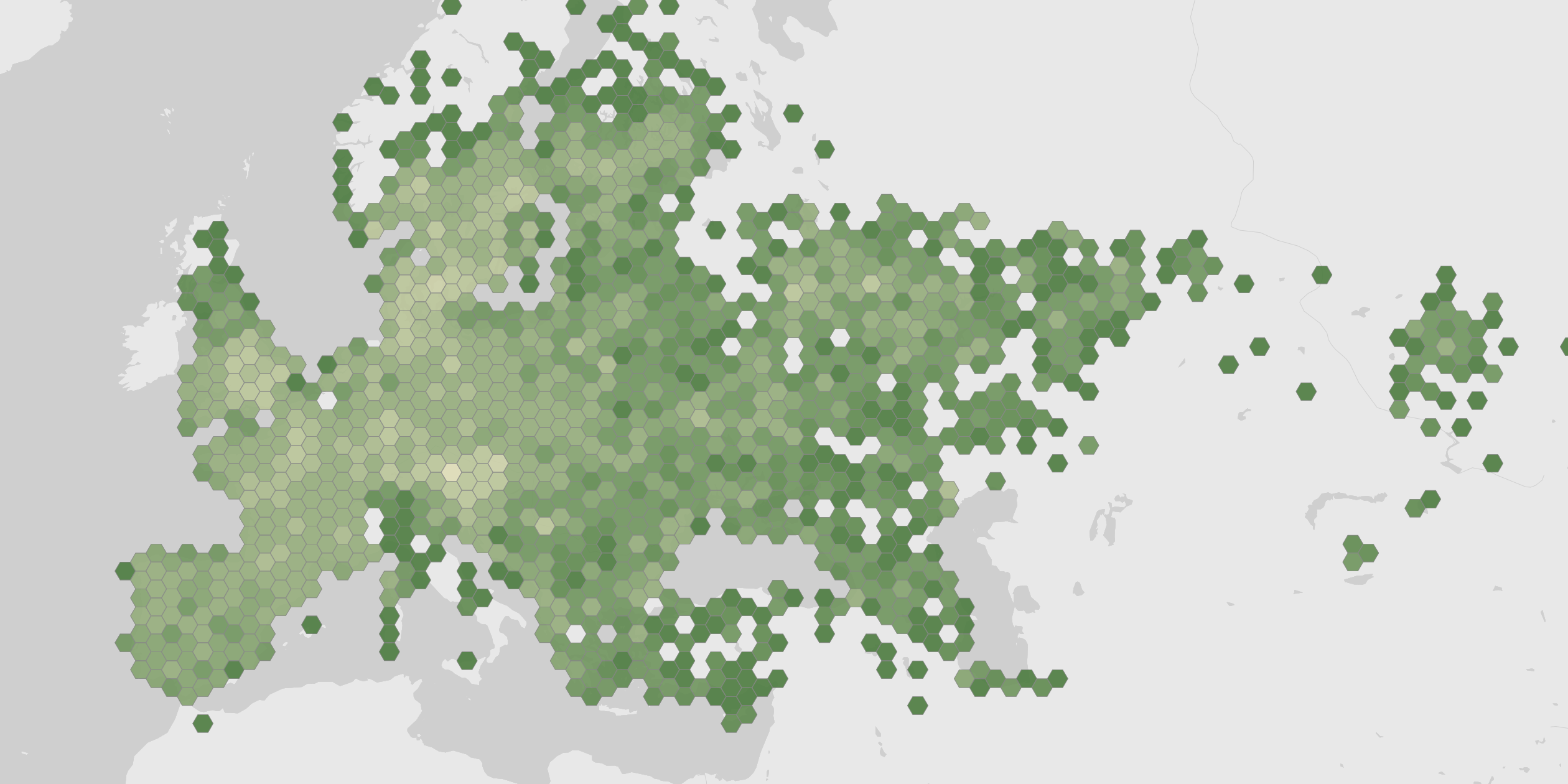
The grass snake ranges across mainland Europe from mid-Scandinavia south to southern Italy, extending into the Middle East and northwestern Africa. Populations once classified as the subspecies N. n. helvetica in Britain have since been reclassified as a separate species, the barred grass snake Natrix helvetica, meaning any N. natrix now recorded in Britain likely comes from imported animals rather than a native population.
Water access shapes much of its habitat choice: ponds, lakes, streams, marshes, and ditches offer both basking sites and abundant amphibian prey. Yet despite being a capable swimmer, the species does not always need water throughout an entire season, and its preferred habitat appears to be open woodland and edge habitats such as field margins and woodland borders, which combine shelter with good basking opportunities. Gardens, parks, hedgerows, and wet heathland round out the range of environments it will use.
Monthly observation data show a sharp seasonal pattern, climbing from just a few hundred sightings in January and February to a peak of nearly 28,000 in May, staying high through June and July, then falling steeply by October and dropping to near-winter lows by December. This pattern likely reflects seasonal activity and basking behavior rather than actual population size, since these are presence records only. It fits with the species' habit of overwintering underground in stable, frost-free conditions once temperatures drop.
The near-absence of records in deep winter is consistent with this underground dormancy, while the spring and early-summer surge lines up with the period when snakes are most active, basking, and visible near water's edge.
Hunting and Diet
The grass snake hunts by actively searching pond edges, streambanks, and other damp margins, relying on both sight and its Jacobson's organ to detect prey by scent. This active-search strategy, rather than ambush, drives it toward the amphibian-rich fringes of ponds, lakes, and marshes where its main prey concentrates.
Common toads and common frogs make up the bulk of its diet, though it will occasionally take ants and their larvae. Prey is always swallowed alive, since the species is not known to accept carrion; even in captivity, individuals have taken earthworms offered by hand but consistently refuse dead food.
Unlike many colubrids, the grass snake does not constrict its prey. It simply seizes and swallows amphibians whole while they are still living, a method suited to prey that is rarely large or dangerous enough to require subduing first.
Because amphibians are seasonal themselves, becoming scarce or dormant in colder months, the snake's foraging activity tracks the availability of frogs and toads near water, concentrating hunting effort during the warmer, wetter parts of the year when amphibians are most abundant.
Reproduction and Life Cycle
Breeding begins with a temperature-driven courtship ritual: males emerge from winter dormancy first each spring and spend much of the day basking to raise their body temperature and metabolism, a behavior thought to maximize sperm production ahead of mating. Females follow up to two weeks later, and mating typically occurs in April, though it can begin earlier if conditions are warm enough.
Females lay leathery eggs in batches of 8 to 40 between June and July, choosing sites with warmth and moisture, such as compost heaps and other areas of rotting vegetation. Successful incubation requires a minimum temperature around 21°C, though development proceeds best near 28°C with high humidity.
Eggs hatch after roughly 10 weeks. Hatchlings emerge at about 18 centimeters in length and are fully independent from the moment they leave the egg, receiving no parental care.
Adults that survive to maturity can live as long as 20 years, giving individuals many breeding seasons over a lifetime once they reach reproductive age.
Population and Ecological Role
Rather than reporting a population count, the available evidence highlights the grass snake's role as an active, wide-ranging predator within its wetland and woodland-edge habitats. After breeding in summer, snakes hunt intensively and may travel several hundred meters in a single day, though a large recent meal slows them down considerably; a snake that has just eaten tends to stay put and bask rather than move, digesting before hunting again. Individual snakes may need only two or three substantial prey items across an entire season, a low feeding frequency that reflects the energy density of amphibian prey.
Like other snakes, grass snakes molt at least once during their active season, a process locals call being "in blue" because the eyes turn a milky blue-white as new skin forms beneath the old. During this period their eyesight is impaired, they avoid hunting and moving, and they become notably more aggressive than usual until the old skin sloughs off in one piece.
Defense strategies shape its interactions with predators, which include corvids, storks, owls, foxes, and domestic cats. When threatened, the grass snake can release a garlic-smelling fluid from its anal glands, feign death through complete limpness while secreting blood from the mouth and nose, or rear up and flatten its head and neck to resemble a cobra. This cobra-mimicking display is puzzling given how little the two groups' modern ranges overlap, but fossil evidence of an extinct European cobra species overlapping with ancient Natrix relatives suggests the behavior may be a holdover from a time when true cobras shared its range, or possibly a defense against birds that encounter cobras during migration to Africa.
Conservation and Threats
The grass snake carries an IUCN status of Least Concern, reflecting its broad distribution across Europe, the Middle East, and northwestern Africa rather than freedom from all local pressures. Predation pressure comes from a wide range of species, including corvids, storks, owls, foxes, and domestic cats, which is a natural part of its ecology rather than a conservation threat in itself.
Protection varies by country: in Denmark, the grass snake has been protected since 1981, when all five native reptile species received legal protection. This contrasts with the situation for two recognized subspecies, the Sardinian grass snake (N. n. cetti) and N. n. schweizeri, both of which are considered critically endangered, showing that the species' overall Least Concern status masks serious localized risk.
Cultural Significance
In Baltic mythology, the grass snake, known as žaltys in Lithuanian and zalktis in Latvian, held sacred status. Families reportedly kept live grass snakes as household guardians, letting them live under the marital bed or near the hearth and believing they accepted food offered by hand. Folk belief held that killing one brought grave misfortune, captured in the Latvian saying "who kills a grass snake, kills his happiness," and that an injured snake might take revenge on whoever harmed it.
This reverence persisted even after Christianization introduced the serpent as a symbol of evil, surviving into the late 19th century as belief in household snake-spirits: a snake living unseen beneath every home, whose departure supposedly foretold the house burning down. These traditions produced enduring literary works, including the Lithuanian folk tale Eglė the Queen of Serpents and the Latvian fairy tale The Grass Snake's Bride, both built around the recurring image of a snake king wearing a golden crown, likely inspired by the species' yellow neck markings.
The grass snake's cultural reach extended beyond folklore into classical literature and modern symbolism. The Roman poet Virgil described it in his Georgics around 29 BC as a large, feared snake of the Calabrian marshes that ate frogs and fish. In more recent times, Romantic nationalism in 19th and 20th century Latvia turned the grass snake into a symbol of education and wisdom, embedding its motif in military insignia, folk dance groups, educational logos, and the traditional Lielvārde Belt.
Fun Facts
- The genus name Natrix is thought to be based on Medusa, the serpent-haired figure of ancient Greek mythology.
- Latvian folklore holds that killing a grass snake brings such bad luck that even the sun goddess Saulė is said to cry for nine days upon seeing one dead.
- Baltic households reportedly kept grass snakes as pets, letting them live under the marital bed or near the hearth and offering them food by hand.
- The Roman poet Virgil wrote about the species nearly 2,000 years ago, describing a large, feared marsh snake in Calabria that fed on frogs and fish.
- In Latvia, the grass snake's yellow collar markings inspired the folk image of a golden-crowned snake king, a motif still used today in military and educational insignia.
Photos
Photographs from via iNaturalist, licensed under CC0 1.0., by adam1420 via iNaturalist, licensed under CC BY 4.0., by Dominic via iNaturalist, licensed under CC BY 4.0., by Steven Lamonde via iNaturalist, licensed under CC BY 4.0., by geosesarma via iNaturalist, licensed under CC BY 4.0., by Josiah Londerée via iNaturalist, licensed under CC BY 4.0., by Daniel J. Layton via iNaturalist, licensed under CC BY 4.0., by Hannah Jones via iNaturalist, licensed under CC BY 4.0., by Chris Stahl via iNaturalist, licensed under CC BY 4.0., by Eric Koglin via iNaturalist, licensed under CC BY 4.0., by avalontile via iNaturalist, licensed under CC BY 4.0., and by northerly via iNaturalist, licensed under CC BY 4.0., credited on each photo.
Ecology and classification
Classification
- Phylum
- Chordata
- Class
- Squamata
- Family
- Colubridae
- Genus
- Natrix
- Species
- Natrix natrix
Sources
- GBIF Species names and classification
- iNaturalist Photos
- Wikidata Common names and conservation status
- Wikipedia Summary extract
- Encyclopedia of Life Habitat, diet and behavior traits
- AnAge Longevity