The Northern Cardinal (Cardinalis cardinalis) is the only songbird claimed as the official state bird of seven U.S. states—Illinois, Indiana, Kentucky, North Carolina, Ohio, Virginia, and West Virginia—more than any other species in the country.
This mid-sized songbird belongs to the family Cardinalidae within the order Passeriformes. It ranges across southeastern Canada, the eastern and southwestern United States, and south through Mexico into Belize and Guatemala, favoring woodlands, gardens, shrublands, and wetlands. The IUCN lists it as Least Concern, reflecting a population that has expanded rather than contracted over the past two centuries.
Its bold color, clear whistled songs, and comfort around backyard feeders have made it one of North America's most familiar birds, easily recognized even by people who know little else about wildlife.
Identification and Appearance
A raised, pointed crest and a thick, cone-shaped coral-red beak mark a Northern Cardinal instantly, regardless of sex. No other common backyard bird in its range combines that crest with such a strongly hooked, seed-cracking bill.
The species is mid-sized for a songbird, measuring 21–23.5 cm (8.3–9.3 in) in body length with a wingspan of 25–31 cm (9.8–12.2 in). Adults weigh 33.6–65 g (1.19–2.29 oz), averaging 44.8 g (1.58 oz), and males run slightly larger than females on average.
The adult male is brilliant crimson red with a black mask covering the face and extending onto the upper chest; the color turns duller and darker across the back and wings. The adult female is fawn-colored with grayish-brown tones overall and only a slight reddish tint on wings, crest, and tail; her face mask is gray to black but far less defined than the male's. Both sexes share the prominent crest and coral beak. Juveniles of both sexes resemble the adult female—brown above, red-brown below, with a brick-colored crest, forehead, wings, and tail—until they molt into adult plumage in fall.
A rare "yellow morph" occurs when a male lacks the enzyme needed to convert carotenoids into red pigment; these birds show yellow feathers and a yellow beak but keep the standard black face mask, making them a striking exception to the species' usual red-and-coral look.
Distribution and Habitat
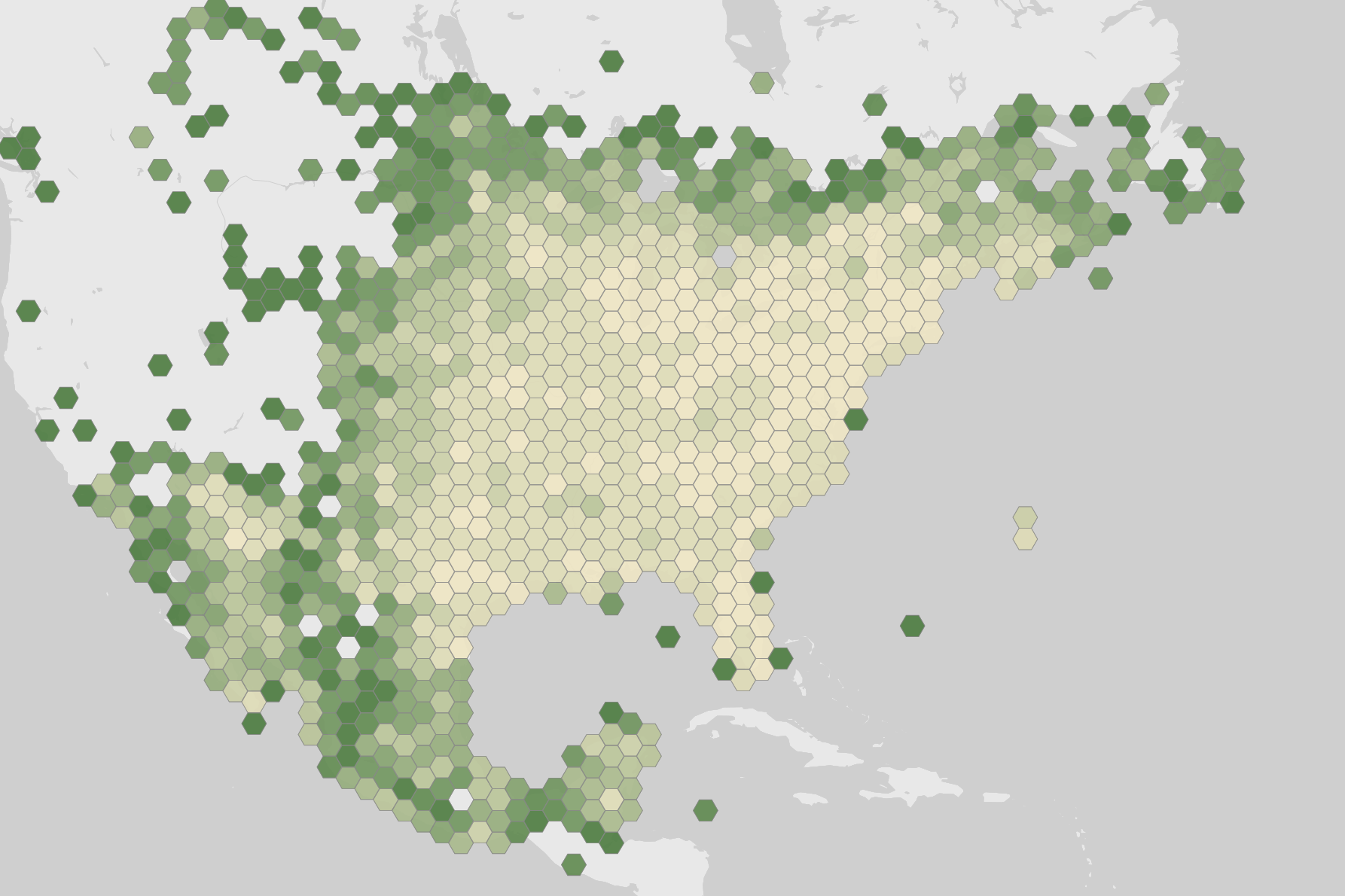
The Northern Cardinal occupies a broad range stretching from southeastern Canada—southern Ontario, Quebec, New Brunswick, and Nova Scotia east to Cape Breton Island—through the eastern United States from Maine to Minnesota and south to the Texas–Mexico border, with additional populations in New Mexico, southern Arizona, and southern California. The range continues south through Mexico to the Isthmus of Tehuantepec and into northern Guatemala and Belize, with a separate Pacific-slope population along Mexico's coast from Jalisco to Oaxaca. It was introduced to Bermuda in 1700 and to Hawaii in 1929.
The species favors the edges of woods, hedgerows, and vegetation around houses rather than unbroken forest interior, and it tends to avoid extensive continuous woodland. It uses savanna and grassland, forest, and mountain biomes, along with suburban, agricultural, and riparian settings, and it prefers dense thickets for nesting.
Range expansion has been well documented in New England: described as rare there in 1929, the cardinal was reported "pushing northward" by 1955, and Massachusetts data show rapid population growth since 1960. Within that state, it is now most abundant in the east, particularly where dense cover meets open ground—woodland edges, brushy fields, wooded wetlands, parks, and suburbs.
Monthly observation counts peak sharply in April and May (roughly 3.75 and 4.23 million records) before dropping to a steadier 1.5–2 million per month from June through December. Since the cardinal does not migrate and is present year-round, this spring peak most likely reflects greater observer activity and visibility during the breeding season rather than a true seasonal shift in where the birds live; these figures are presence records, not a measure of abundance or population size.
Behavior and Lifestyle
Northern Cardinals are non-migratory, year-round residents throughout their range, active mainly during the day and especially busy in the morning and evening hours. In winter, most individuals gather into flocks and roost together, a marked contrast to their behavior during the breeding season, when they become strongly territorial.
Winter home ranges have been measured at about 0.212 square kilometers in a northern Kentucky study. Males defend territory by singing loudly and clearly from treetops or other high perches, and they will chase off rival males that enter their space. This territorial drive is strong enough that a male may repeatedly attack his own reflection in a window or mirror, mistaking it for an intruder.
Cold weather brings specific survival behaviors: cardinals fluff their small, hairlike down feathers to trap warm air against the body, and they shiver and tense their muscles—especially in the breast—to generate heat. When needed, they can lower their body temperature by 1.7 to 3.3 °C (3 to 6 °F) to conserve energy through harsh cold.
Mated pairs often travel together outside the breeding season. Because cardinals learn their songs rather than inheriting them fixed, song syllables tend to overlap more between neighboring birds than between cardinals living farther apart, producing local dialects across the range.
Communication
Both sexes sing clear, whistled phrases that are repeated several times and then varied, with common patterns rendered as "cheeeer-a-dote, cheeer-a-dote-dote-dote," "purdy, purdy, purdy...whoit, whoit, whoit, whoit," "what-cheer, what-cheer...wheet, wheet, wheet, wheet," and "cheer, cheer, cheer, what, what, what, what." These songs defend territory and help attract and hold a mate.
A short, metallic "chip" call serves as a contact and alarm signal; it is given especially when a predator approaches the nest, warning the female and nestlings of danger. Visual signals reinforce these calls, including tail-flicks and the raising or lowering of the crest to indicate alarm.
Although the human ear cannot tell them apart, the songs of males and females are sexually dimorphic, likely due to differences in hormone levels between the sexes. Nestlings add their own vocal channel, begging loudly to draw parents in for feeding; very young chicks will beg even if the nest is disturbed, while older nestlings learn to respond only to the specific presence or songs of their own parents.
Diet and Nutrition
About 90 percent of the Northern Cardinal's diet consists of weed seeds, grains, fruits, and sunflower seeds, with a strong preference for seeds that are easy to husk. That selectivity relaxes in winter, when food grows scarce and the birds take whatever is available.
Insects make up the rest of the adult diet, and the species will occasionally scavenge unusual food when conditions are harsh—one observer recorded a cardinal feeding on a dead black-capped chickadee during a cold, snowy day. At backyard feeders, sunflower and safflower seeds are particular favorites.
Diet shifts dramatically for the youngest birds: parents feed nestlings almost exclusively insects, a protein-rich menu that supports rapid early growth before the birds transition toward the largely seed-and-grain diet of adulthood.
Nesting and Breeding
Northern Cardinals are serially monogamous, though polygyny occurs occasionally and extra-pair copulations are common; DNA studies found that 9 to 35 percent of nestlings were not fathered by the female's social mate. Pair formation begins in early spring with physical displays, including courtship feeding in which the male brings food and feeds the female beak-to-beak; pairs sometimes sing together before nesting and may stay together across several breeding seasons, though some pairs "divorce" between seasons or find new mates if one dies.
The female alone builds the nest, typically in a well-concealed spot in dense shrub, vine tangle, or small tree 1–3 m (3.3–9.8 ft) off the ground, a process that takes three to nine days. She crushes twigs until pliable and shapes a four-layered cup: coarse twigs at the base, a leafy mat, a lining of grapevine bark where available, and a final layer of fine grasses, stems, rootlets, and pine needles. The finished nest stands 5.1–7.6 cm (2.0–3.0 in) tall and about 10.1 cm (4.0 in) across, and is rarely reused.
Clutches usually hold three to four eggs, though anywhere from one to five is possible. The eggs are white with a green, blue, or brown tint and lavender-to-brown blotches concentrated toward the larger end, measuring about 26 x 19 mm (1.02 x 0.75 in). The female incubates alone for 11 to 13 days while the male delivers food to her; two broods are typical per year across a March-to-September breeding season, and the second nest is often parasitized by brown-headed cowbirds.
Chicks hatch blind, naked, and weighing just 3–3.5 grams, growing feathers only at 4 to 5 days old and gaining roughly 2–3 grams per day. Both parents feed them insects and remove fecal sacs from the nest, eating the earliest sacs and later carrying them away. Young fledge at 7 to 13 days (usually 9 to 10) and continue receiving food from their parents for another 25 to 56 days before becoming fully independent, often joining flocks of other juveniles and potentially breeding the following spring.
Population and Ecological Role
The global population is estimated at around 100 million individuals spread across roughly 5,800,000 km2 (2,200,000 sq mi), and the trend appears stable or increasing, a pattern tied to expanding edge habitat and widespread backyard bird feeding over the past two centuries.
Ecologically, the species disperses seeds of the fruits and plants it eats, giving it some influence over local plant community composition, and it helps control insect pests such as boll weevils, cutworms, and caterpillars. It also functions as prey, supporting falcons, Accipiter hawks, shrikes, bald and golden eagles, and owls including long-eared and eastern screech owls, while eggs and chicks fall to milk snakes, black racers, blue jays, crows, squirrels, chipmunks, and domestic cats.
When brown-headed cowbirds parasitize cardinal nests, the cardinals often end up raising cowbird chicks alongside or instead of their own, inadvertently supporting local cowbird numbers. The species also hosts a range of internal and external parasites.
Conservation and Threats
The IUCN rates the Northern Cardinal as Least Concern, a status matching a population that has grown in both number and geographic range over the last 200 years, largely because human activity has expanded the edge and suburban habitat the species favors.
Legal protections back up this trend: in the United States, the cardinal is covered by the Migratory Bird Treaty Act of 1918, making it illegal to take, kill, or possess the bird, with violations punishable by fines up to $15,000 and up to six months in prison; a similar Convention for the Protection of Migratory Birds applies in Canada. It holds no special status under CITES or the U.S. Federal List.
No major range-wide threats are documented; the species has, if anything, benefited from human-altered landscapes rather than suffered from them, though individual nests remain vulnerable to predators and cowbird brood parasitism.
Conservation status
- LC
- NT
- VU
- EN
- CR
Least Concern
Cultural Significance
In Cherokee mythology, a Northern Cardinal singing near a home signals that visitors will soon arrive, while one that enters the home itself can be taken as an omen of death, since the bird is said to carry the souls of the dead. Other Cherokee legends describe the cardinal as the daughter of the sun and credit it with the ability to predict the weather; more broadly it is associated with the sun and treated as a symbol of good luck.
The English word "cardinal" traces to the Latin cardinalis, originally used to address the red-robed heads of the Roman Catholic Church, a link reflected in the bird's fiery color. In Hindu tradition, the cardinal is connected to the root chakra associated with yoga practice.
The bird's visibility extends into modern American culture: it is the mascot of Major League Baseball's St. Louis Cardinals and the NFL's Arizona Cardinals, along with numerous college athletic programs, and it is the state bird of seven states—Illinois, Indiana, Kentucky, North Carolina, Ohio, Virginia, and West Virginia. Amtrak named its Chicago-to-Washington, D.C. train "The Cardinal" because the bird is the state bird of several states along that route.
Fun Facts
- A rare "yellow morph" lacks the enzyme needed to convert yellow carotenoids into red pigment, producing a bird with yellow feathers and beak but the same black face mask as normal males.
- A wild banded cardinal is known to have lived at least 15 years and 9 months, and one captive bird reached 28.5 years.
- DNA studies found that 9 to 35 percent of nestlings were not fathered by the female's social mate, despite the species' reputation for monogamy.
- Territorial males sometimes attack their own reflection in a window or mirror, mistaking it for a rival male invading their space.
- A 2016 study in Atlanta, Georgia found that Northern Cardinals biologically suppress West Nile virus after infection, unlike many other bird species.
- Amtrak named its Chicago-to-Washington, D.C. train "The Cardinal," since the bird is the state bird of several states along the route.
- One observer recorded a cardinal feeding on a dead black-capped chickadee during a cold, snowy day, an unusual scavenging moment for a bird whose diet is mostly seeds and grain.
Ecology
Habitat
- Wetland
- Woodland
- Shrubland
- Grassland
Behavior
- Territorial
- Social
- Diurnal
- Arboreal
Diet
- Omnivore
Photos
SourcesGBIFiNaturalistWikidataWikipediaEncyclopedia of LifeAnimal Diversity WebAnAge