The summer tanager beats captured wasps against a tree branch until the stingers and inedible parts fall away, a behavior that lets this songbird safely raid the nests of bees and wasps for food.
A medium-sized member of the cardinal family (Cardinalidae), Piranga rubra breeds across the southern United States and northern Mexico and winters as far south as northern South America. It carries a Least Concern status from the IUCN, with its breeding population holding relatively steady across its range.
Few North American songbirds combine such vivid red plumage with such a specialized diet, making the summer tanager a rewarding find for anyone scanning the treetops of an oak woodland.
Identification and Appearance
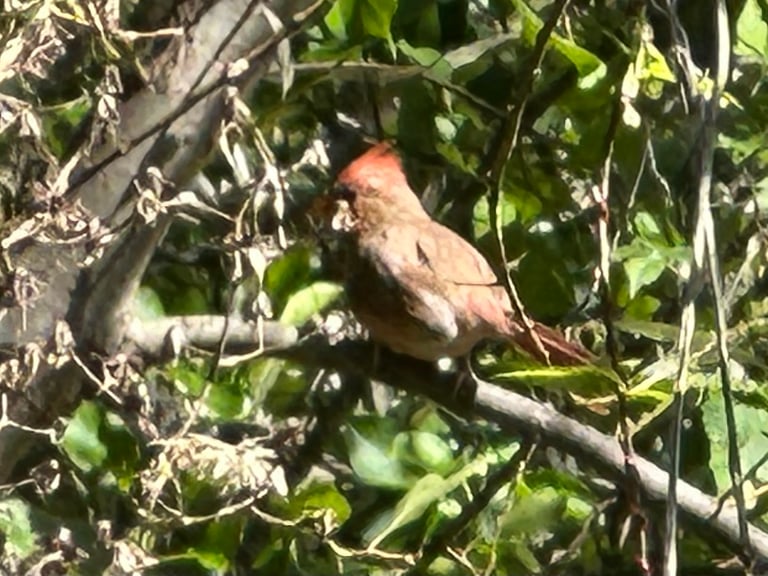
Adult males are unmistakable: an overall rose-red bird with a stout, pointed bill, the only entirely red songbird across much of its range aside from the similar hepatic tanager. The hepatic tanager, however, has a dark bill, while the summer tanager's bill is pale, a key distinguishing mark.
The species measures about 17 cm in length and weighs a mean of 30.1 g, ranging from 25.8 to 33.6 g, with a wingspan of 28 to 30 cm. Females look quite different from males, showing orangish underparts and olive upperparts with olive-brown wings and tail, a pattern that provides better camouflage while nesting.
As with all birds, the red and orange coloration comes from pigments obtained through diet rather than being produced internally. Vocally, the species can be confused with the American robin, since both sing in repeated melodic units, but the summer tanager's song is more monotonous, often built from just three or four distinct phrases, and it is clearer and less nasal than the buzzy song of the scarlet tanager.
Distribution and Habitat
The summer tanager breeds across the southern United States and northern Mexico, reaching as far north as Iowa and New Jersey in the east, and winters from Mexico and Central America into northern South America. Its overall range spans roughly 3,270,000 square kilometers, and the species is an extremely rare vagrant to western Europe.
Habitat use shifts regionally. In the eastern United States, breeding birds favor open woodlands of mixed oak and other hardwoods, while in the west they occupy riparian woodlands of cottonwoods and willows. The birds also turn up in orchards, parks, and roadside trees, showing tolerance for human-altered landscapes.
On the wintering grounds, summer tanagers continue to use open woodlands along with tall secondary growth, gallery forest, forest edges, shaded plantations, and trees in parks and gardens along city streets. In Mexico they occupy humid evergreen forest and tropical deciduous forest. The species is typically found at low elevations, though it has been recorded wintering as high as 1,800 m in Panama.
Monthly observation patterns show higher numbers in spring, consistent with migratory movement through parts of its range, though such counts reflect where the species has been observed rather than its overall abundance.

Behavior and Lifestyle
Summer tanagers are largely solitary outside the breeding and migratory seasons, though they sometimes join mixed-species flocks with other tanagers and warblers, especially at forest edges and fruiting trees. Pairs are rarely seen by people, as the birds tend to stay concealed in the tops of tall trees.
During the breeding season, males defend both a nest site and a feeding territory, chasing rival males in vigorous flights that sometimes involve physical contact. Territory sizes have been measured at 90,000 to 110,000 square meters in one study. Males also engage in counter-singing, responding to the songs of neighboring rivals, particularly early in the breeding season.
The species is migratory, traveling mainly at night; migratory flocks can number up to 30 individuals, though it is unclear whether these birds fly together deliberately or simply gather on the ground. Nocturnal migration carries real risk: collisions with television towers are a documented source of mortality, as shown by the number of tower casualties recorded.
Flight is swift and direct, and the birds often sit still on a perch before moving in sudden bursts. Breeding pairs preen frequently, and individuals occasionally sunbathe. In winter, the species becomes territorial again, defending space even while otherwise living a solitary existence.
Communication
Males rely heavily on song, using a rich, musical voice, distinct from the buzzy songs of other tanagers, to attract mates and establish territory. Singing intensifies through the breeding season, and some females produce a garbled version of the male's song.
Both sexes also give a loud, clicking call used across a range of situations, alongside the sharp pi-tuk or pik-i-tuk-i-tuk call note. Communication combines these acoustic signals with visual displays, such as the chases and confrontations between rival males, and tactile contact during territorial disputes.
Hunting and Diet
Summer tanagers hunt primarily in the treetops, catching bees and wasps in flight, which form the primary component of their diet. They frequently attack wasp nests repeatedly until the insects abandon them, then devour the exposed larvae. Once an insect is caught, the tanager carries it back to a perch and beats it against the branch until it dies, a technique that also strips away stingers and other inedible parts before eating.
Beyond bees and wasps, the species eats a wide variety of other insects, including beetles, dragonflies, grubs, cicadas, grasshoppers, ants, caterpillars, weevils, and spiders, along with occasional larger invertebrates such as snails and slugs. One record even describes an attempt to eat a green anole, a vertebrate, at a migratory stopover site in Mississippi.
Fruit supplements the diet, especially during the late breeding season, migration, and on the wintering range, with blackberries, whortleberries, mulberries, pokeweed, citrus, and bananas all recorded. In its winter range, fruit of Cymbopetalum mayanum is especially favored, drawing birds into human-altered habitats where such trees grow.
Nesting and Breeding
Courtship begins soon after males arrive on the breeding grounds in full song, usually a few days ahead of females. The male chases the female in sudden, energetic pursuits and may display by carrying food items and hopping nearby. Pairs are serially monogamous, staying together for one breeding season but not necessarily reuniting in later years.
Nest building starts two to four weeks after arrival on the breeding grounds. The female alone builds the nest, typically on a horizontal branch 2.5 to 10.5 meters above the ground, out of dried herbaceous vegetation lined with fine grasses; nests in the eastern range tend to be flimsy and ragged, while western nests are sturdier. She lays 3 to 4 pale blue or pale green eggs spotted with reddish brown, incubating them alone for 12 to 13 days while the male often rests and preens, sometimes feeding her on the nest.
After hatching, both parents feed the altricial chicks, with the male sometimes passing food to the female to deliver. The young leave the nest after 8 to 10 days and can make short, fluttery flights by day 10. Both parents continue attending the fledglings for 2 to 4 weeks after they leave the nest, and also remove fecal sacs from the nest to keep it sanitary during the nestling stage. The species breeds once annually between April and August, and individuals reach sexual maturity at one year of age.
Population and Ecological Role
The North American breeding population has remained relatively steady, without pressing conservation concerns tied to population size. As insect predators, summer tanagers help regulate populations of the bees, wasps, and other invertebrates they consume, and by eating fruit they also disperse seeds of the plants involved.
The species hosts external parasites, including a louse, Philopterus subflavescens, and two mites, Trombicula irritans and Sternostoma pirangae, along with recorded internal parasites such as a trematode in the genus Mesocoelium. It has also been recorded as prey of the gray ratsnake, Pantherophis spiloides.
Conservation and Threats
The summer tanager carries a Least Concern status from the IUCN, and it is not protected under the U.S. Endangered Species Act. It does receive protection under the U.S. Migratory Bird Act, though it holds no special status under CITES or at the state level in Michigan.
The most significant human impact on the species is likely destruction of breeding habitat. Collision with television towers during nocturnal migration is also a documented and significant source of mortality, a risk tied directly to the bird's habit of migrating at night.
Two subspecies are recognized: P. r. cooperi in the west and P. r. rubra in the east. The breeding population in North America has remained relatively steady, without the sharp declines that trigger elevated conservation concern.
Cultural Significance
Summer tanager feathers have been used in traditional headdresses and ceremonial attire, where they carry associations with status, power, and connection to the spirit world. The bird also carries a name in at least one indigenous language, Piranga Abejera, reflecting its strong association with bees.
Beyond symbolic use, the species has a practical reputation among people: because it eats large numbers of bees and wasps, insects some people regard as pests, it is valued for its role in controlling these populations around human settlements.
Fun Facts
- The genus Piranga was introduced by French ornithologist Louis Pierre Vieillot in 1808, with the summer tanager itself designated as the type species.
- The name Piranga Abejera, used in at least one indigenous language, translates to reference the bird's strong association with bees.
- Unlike most birds, the summer tanager's red plumage is entirely diet-derived, a trait shared by all birds that display red or orange coloration.
Photos
Photographs from via iNaturalist, licensed under CC0 1.0., by Melissa McMasters via iNaturalist, licensed under CC BY 4.0., by Dan Vickers via iNaturalist, licensed under CC BY 4.0., by northerly via iNaturalist, licensed under CC BY 4.0., by ian bullock via iNaturalist, licensed under CC BY 4.0., by Meghan Waldon via iNaturalist, licensed under CC BY 4.0., by Melissa Meadows via iNaturalist, licensed under CC BY 4.0., by jonathan hunsberger via iNaturalist, licensed under CC BY 4.0., by Rita Clare via iNaturalist, licensed under CC BY 4.0., and by yongestation via iNaturalist, licensed under CC BY 4.0., credited on each photo.
Ecology and classification
Classification
- Phylum
- Chordata
- Class
- Aves
- Order
- Passeriformes
- Family
- Cardinalidae
- Genus
- Piranga
- Species
- Piranga rubra
Sources
- GBIF Species names and classification
- iNaturalist Photos
- Wikidata Common names and conservation status
- Wikipedia Summary extract
- Encyclopedia of Life Habitat, diet and behavior traits
- Animal Diversity Web Animal habitat, behavior and diet
- AnAge Longevity
- AVONET Bird mass, habitat, migration, diet and range size
- GloBI What it eats, what eats it, parasites and pollinators
- SquamataBase
- HWML Parasite Collection