The white-tailed deer shares the title of most widely distributed terrestrial mammal in the Americas with its main predator, the mountain lion—together the two species span nearly the entire hemisphere, from the boreal edges of Canada to the high Andes of Peru.
This medium-sized deer belongs to the family Cervidae within the order Artiodactyla, and its many subspecies have adapted to arid grasslands, the Amazon and Orinoco basins, the Llanos, and Andean highlands alike. The IUCN lists it as Least Concern, reflecting its resilience and broad range across North and South America.
Few large mammals show this degree of ecological flexibility, and the whitetail's story includes near-extinction from overhunting, a dramatic recovery, and an ongoing, often contentious relationship with the humans who now share its range.
Identification and Appearance
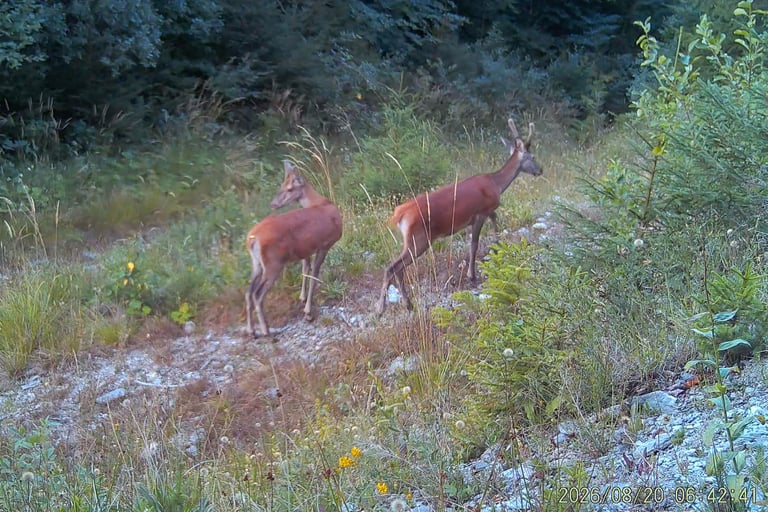
The clearest field mark is the tail: white on the underside, it is flared upward and side to side when the deer is alarmed, flashing a bright warning as the animal flees. This tail-flagging gives the species its common name and is visible even in dense cover.
Size varies enormously across the range, following Bergmann's and Allen's rules—deer grow larger farther from the equator. North American bucks typically weigh 68 to 136 kg, though bucks over 180 kg have been recorded in Minnesota, Ontario, and Manitoba; one Minnesota buck taken in 1926 was estimated at 232 kg live weight. Does usually weigh 40 to 90 kg in North America, while tropical and Florida Keys populations run much smaller, averaging 35 to 50 kg. Total length ranges from 95 to 220 cm, including a 10 to 37 cm tail, with shoulder height between 53 and 120 cm.
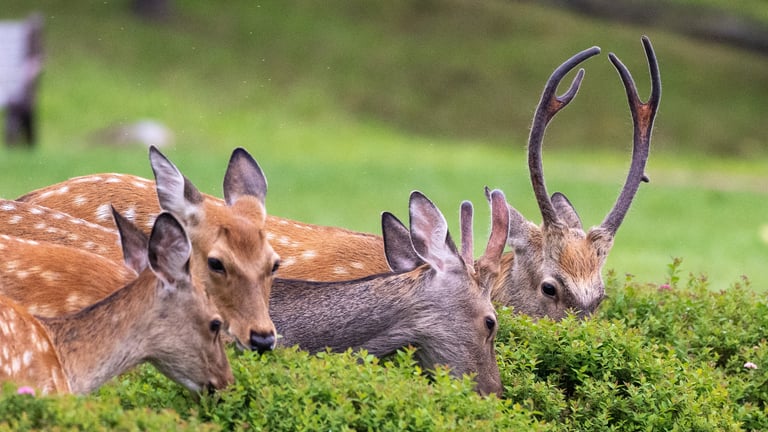
Coat color shifts seasonally: reddish-brown in spring and summer, turning grey-brown through fall and winter. Older deer tend to have longer snouts and grayer coats than younger animals. Males alone grow antlers, shed and regrown every year, with branching pattern shaped by nutrition, age, and genetics rather than age alone—healthy yearlings can already show eight points. Roughly one in 10,000 females also grows antlers, usually linked to a hormonal condition called freemartinism.
The species' horizontally slit pupils give strong night vision, and its dichromatic (blue-and-yellow) color vision means it poorly distinguishes reds and oranges—the reasoning behind blaze-orange hunting safety gear. A notable variant exists at the former Seneca Army Depot in New York, home to an all-white (non-albino) population that has thrived under dedicated conservation management.
Distribution and Habitat
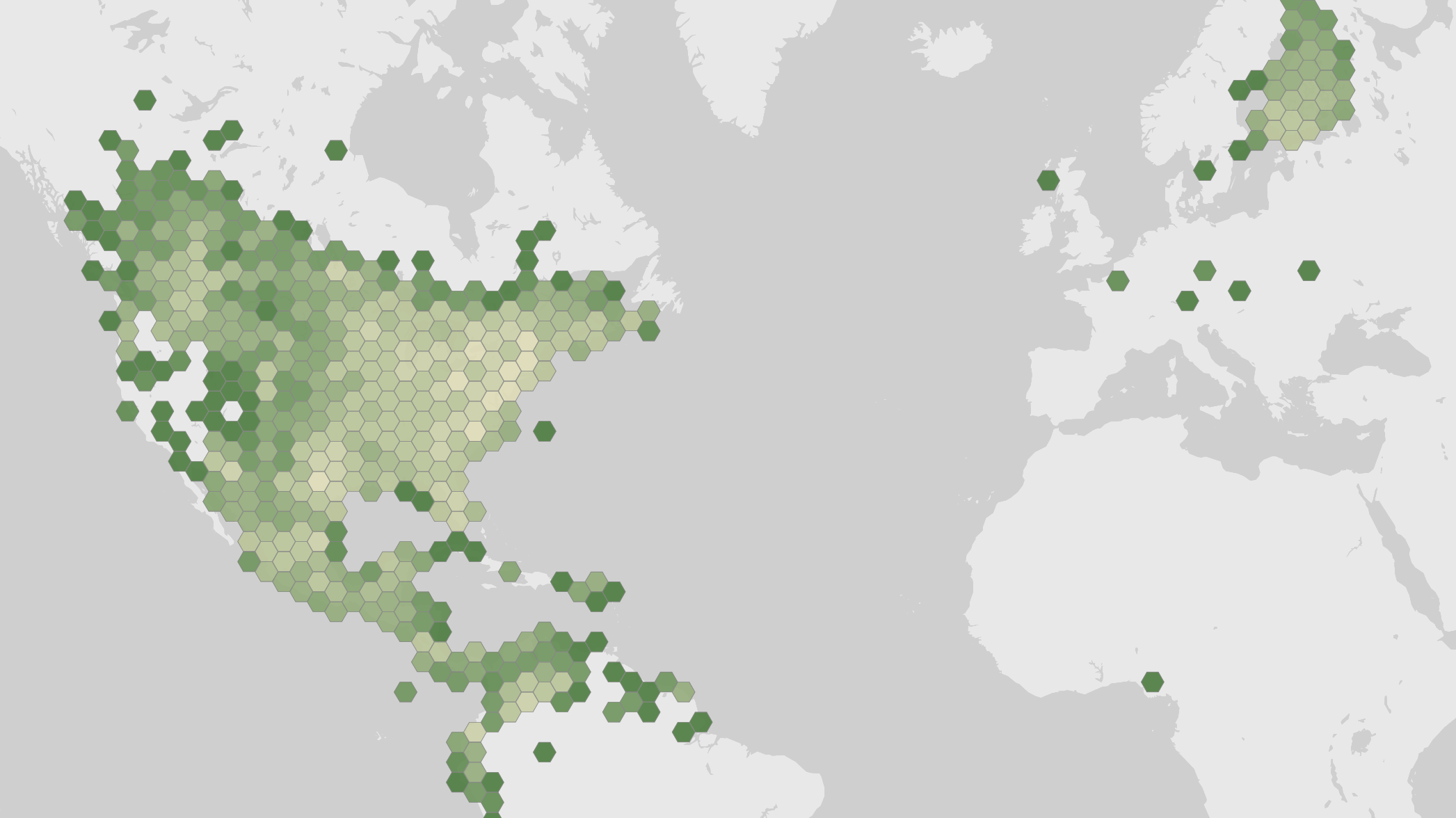
The white-tailed deer occupies the widest range of any deer in the Americas, found from southern Canada through the continental United States, Mexico, Central America, and South America as far as the Andes of Peru. In the United States it is abundant east of the Rocky Mountains, while west of that divide its niche is largely filled by the mule deer and black-tailed deer, except in select river valleys and foothills reaching into eastern Washington, Oregon, and southern Yukon.
Habitat use centers on edge environments where cover and forage sit close together—clearcut-forest margins, riparian corridors, and woodland-grassland transitions. Across its range it occupies hardwood and conifer forests, chaparral, oak savanna, desert grassland, tropical dry forest, coastal marsh, and high-elevation Andean grassland; Andean populations even carry thicker, wool-like coats suited to colder mountain air. In the arid Southwest, deer concentrate near the most mesic microclimates and reliable water sources, while in the Great Plains they depend on wooded draws and floodplains for cover.
Beyond its native range, the species has been introduced—mainly for sport hunting—to New Zealand, several Caribbean islands, and parts of Europe including Finland, the Czech Republic, France, and Germany, where it now persists as an established non-native population.
Monthly observation counts show detections rising through spring and peaking around June, with somewhat lower counts in the depths of winter. These figures reflect how often the species was recorded, not its true abundance, but the pattern hints at greater visibility or activity during the warmer months.
Behavior and Lifestyle
White-tailed deer are crepuscular, most active around dawn and dusk, and generally solitary outside of the breeding season—the core social unit is a doe with her fawns, though does can gather into herds of up to hundreds of individuals in open, low-predation settings. Young males disperse from their mother's group within the first year, while young females often stay for two years.
Home ranges are typically small, often a square kilometer or less; a study of reintroduced does in the Nicoya Peninsula recorded an average range of about 323 hectares. Rather than migrating to a separate winter range, whitetails "yard up" within their own territory during heavy snow, and they habitually reuse the same travel routes while foraging, though they avoid bedding down in a spot used the previous day.
The rut begins as early as September and dominates male behavior for weeks: bucks compete individually by clashing antlers rather than guarding harems, and intensity depends on temperature and the local ratio of males to females—warm weather above about 4 °C reduces how far bucks travel searching for mates. Rutting bucks eat and rest little, steadily losing physical condition as the season progresses.
Whitetails are also strong, capable animals: they can bound at speeds up to 30 mph through tangled forest terrain and are competent swimmers, entering lakes and large streams to escape predators or insects or to reach islands.
Communication
Vocal signals form one layer of communication: fawns give a high-pitched bleat that deepens into a guttural grunt as they mature, does use maternal grunts to locate bedded fawns, and both sexes snort to signal an approaching threat. Mature bucks combine these into a distinctive grunt-snort-wheeze pattern that advertises dominance and aggression, while an injured deer's loud "blatt" or bawl is one of the most startling sounds in the forest.
Visual signaling centers on the tail: raising and waving the white underside, known as tail-flagging, alerts other deer to danger, though researchers suspect its main function is warning off predators rather than communicating with other deer.
Chemical communication runs through a set of specialized glands—preorbital, forehead, tarsal, metatarsal, and interdigital—that produce scents used for marking and warning. Bucks make rubs by stripping bark with their antlers and scrapes by exposing bare earth with their hooves, then deposit forehead-gland scent and rub-urinate over these sites to signal their presence to other deer, especially during the breeding season when scent marking intensifies.
Diet and Nutrition
White-tailed deer are herbivores whose diet shifts with whatever vegetation their local habitat provides. In eastern forests they browse buds and twigs of maple, sassafras, poplar, aspen, and birch along with a range of shrubs, while desert populations rely on huajillo brush, yucca, prickly pear cactus, comal, and ratama and other tough, drought-adapted shrubs.
Conifers become an important fallback food in winter, when broadleaf browse is scarce. Feeding activity follows the species' crepuscular rhythm, concentrated in the hours before dawn and again from late afternoon into dusk, which limits exposure during the riskiest daylight hours.
Reproduction and Raising Young
Breeding is polygynous: bucks compete for mating access through individual sparring rather than defending harems, and does enter estrus—the rut—typically in late October or November, triggered by shortening daylight. A doe not bred in her first estrus cycles again roughly 28 days later. Mating occurs between October and December, and copulation itself is a brief copulatory jump.
Gestation lasts about 198 days, or roughly 6.5 months, and fawns are born the following spring, usually in May or June. A doe's first litter is typically a single fawn, but does produce 2 fawns on average in later years, occasionally 3. Newborn fawns are spotted, precocial enough to stand and nibble vegetation within days, and lose their spots by the first summer.
For about the first month, mothers hide fawns in dense vegetation and nurse them four to five times a day, a strategy that keeps scent levels low and reduces detection by predators. Fawns then begin following their mother on foraging trips, becoming fully ruminant by two months old, and are weaned after 8 to 10 weeks.
Males leave their mother's side after about a year, while females often stay for two years. Sexual maturity arrives around 1.5 to 2 years for bucks, and females can breed as early as six months old, though 18 months is more typical.
Population and Ecological Role
White-tailed deer act as both major herbivores and important prey animals within their ecosystems, and where they are abundant their grazing can reshape entire plant communities—severe winters have seen them girdle and kill large numbers of trees through concentrated browsing. This dual role as consumer and prey links them closely to populations of large predators across their range.
Body size and antler proportions vary strikingly by region: the largest, heaviest-antlered deer occur in temperate North America, such as the northern, Dakota, and northwest subspecies, while the smallest populations live in the Florida Keys and partially wooded Neotropical lowlands. Savanna-adapted forms in the Southwestern United States and northern Mexico, such as the Texas white-tailed deer, carry antlers large in proportion to their body size, rivaling those of much bigger northern deer.
Introduced populations illustrate how quickly the species can expand under favorable conditions: after four animals from Minnesota were released in Finland in 1935, the population grew to roughly 109,000 by 2020, spreading through northern Scandinavia and southern Karelia and sometimes displacing native species along the way.
Conservation and Threats
The white-tailed deer is classified as Least Concern by the IUCN, a status built on a remarkable recovery: after commercial exploitation and unregulated hunting reduced the U.S. population to roughly 300,000 animals by 1930, regulated hunting and habitat improvement helped it rebound to an estimated 30 million by 2005. Today the population is considered healthy and roughly comparable to pre-colonization numbers, even though it has declined by several million since 2000.
The main modern pressures are no longer overhunting but habitat loss to development, changes in logging practices, and, in many areas, the opposite problem—local overabundance. Reduced numbers of natural predators have allowed some populations to exceed the land's cultural carrying capacity, driving deer-vehicle collisions, crop damage, and pressure on native plant communities.
Management now relies heavily on regulated hunting, including antlerless-only seasons designed to cull does, alongside more targeted and costly methods such as professional sharpshooting in areas unsuitable for public hunting. Nonlethal options—contraceptive injections, sterilization, and translocation—are used more selectively, in part because translocation carries a real risk of spreading chronic wasting disease between herds.
Cultural Significance
White-tailed deer carry deep cultural weight for many Indigenous peoples of the Americas, appearing across myths, legends, and traditional artwork. In Mesoamerica, hunting the species dates back to very early times and was accompanied by dedicated rites and rituals, reflecting its long-standing importance beyond simple subsistence.
It remains probably the most hunted native big-game species in the Americas, valued both as sport and for its meat, hide, and antlers. Early settlers and Native American communities alike processed whitetail hides into buckskin leather, and mounted heads remain a common sight in lodges and hunting camps today, a continuation of the species' long role as a prized quarry.
Fun Facts
- A population at the former Seneca Army Depot in Romulus, New York, is entirely white except for the nose and hooves—not albino—and represents the largest known concentration of white deer, sustained by dedicated conservation management.
- About 1 in 10,000 females grows antlers, a trait usually linked to a hormonal condition called freemartinism rather than normal development.
- Whitetails process visual information much faster than humans, giving them a strong edge at detecting motion in low light.
- They can bound at up to 30 mph through tangled forest and swim across lakes to escape predators or reach islands.
- Fawns withhold urination and defecation while hidden, and the mother ingests the waste when she returns, removing any scent trail predators could follow.
- Four deer brought from Minnesota to Finland in 1935 grew into a population of about 109,000 animals by 2020.
- A Minnesota buck taken in 1926 weighed 403 lb field-dressed and was estimated at 511 lb alive, among the heaviest ever recorded.
Photos
Photographs from via iNaturalist, licensed under CC0 1.0., by Natasha Haggard via iNaturalist, licensed under CC BY 4.0., by Jason E. Farabaugh via iNaturalist, licensed under CC BY 4.0., by Lee Ann Ratledge via iNaturalist, licensed under CC BY 4.0., by Dan Vickers via iNaturalist, licensed under CC BY 4.0., by Whitney Mattila via iNaturalist, licensed under CC BY 4.0., by azurebeetle via iNaturalist, licensed under CC BY 4.0., by Aedan Rooney via iNaturalist, licensed under CC BY 4.0., and by fallriver22 via iNaturalist, licensed under CC BY 4.0., credited on each photo.
Ecology and classification
Classification
- Phylum
- Chordata
- Class
- Mammalia
- Order
- Artiodactyla
- Family
- Cervidae
- Genus
- Odocoileus
- Species
- Odocoileus virginianus
Sources
- GBIF Species names and classification
- iNaturalist Photos
- Wikidata Common names and conservation status
- Wikipedia Summary extract
- Encyclopedia of Life Habitat, diet and behavior traits
- Animal Diversity Web Animal habitat, behavior and diet
- AnAge Longevity