Overhunted to the brink of extinction across East Asia during the 19th century, the sika deer staged one of the fastest comebacks of any large mammal once protection laws took hold in the mid-20th century, with populations rebounding sharply between the 1950s and 1980s.
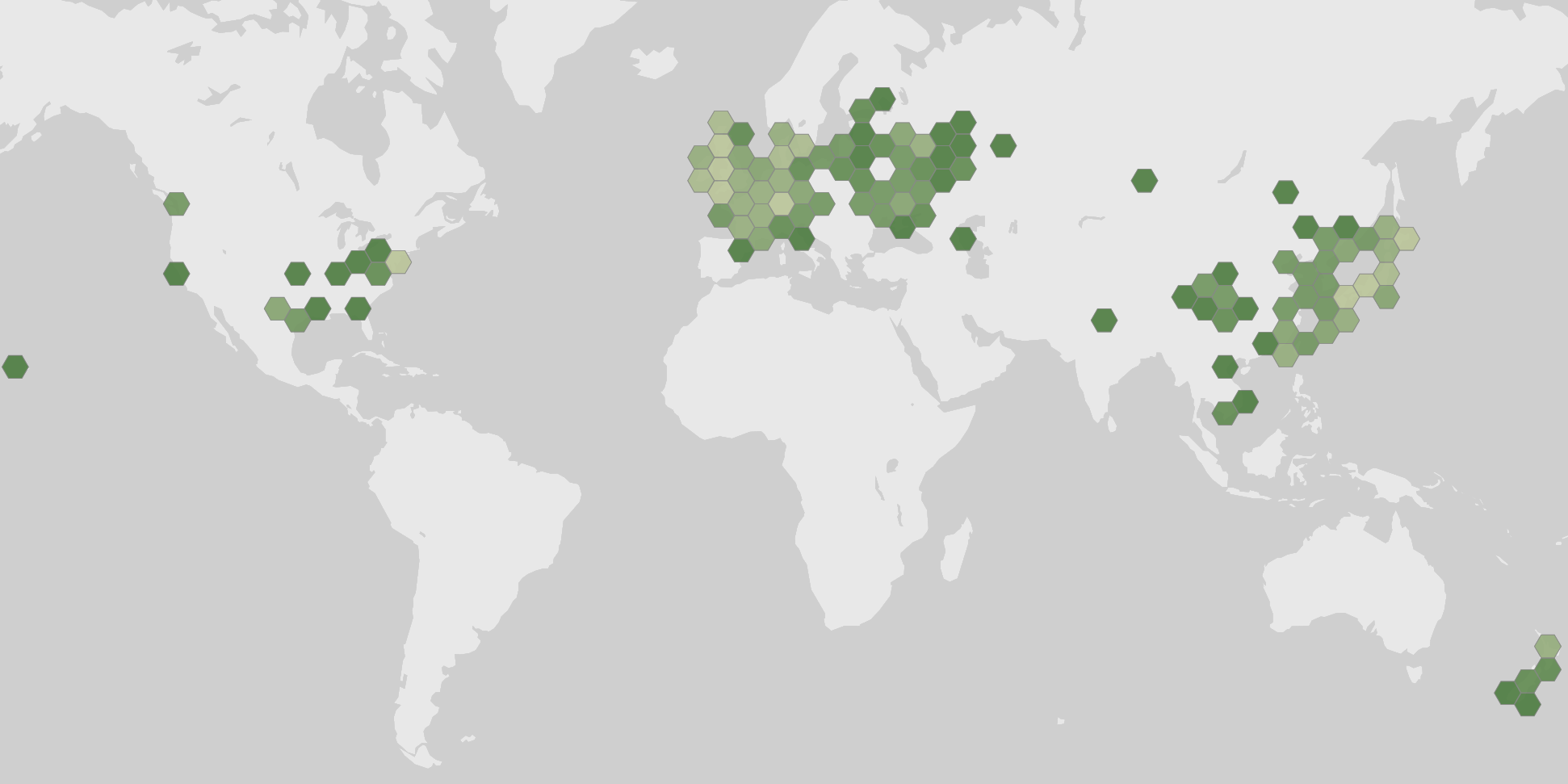
Cervus nippon is a mid-sized deer in the family Cervidae, native to forests stretching from northern Vietnam through China, Korea, and Japan to the Russian Far East. Introduced herds now also roam parts of Europe, the eastern United States, and New Zealand. The species as a whole is listed as Least Concern.
What makes the sika deer worth a closer look is its unusual persistence of juvenile spotting into adulthood, its striking regional variation in size and antler form, and its deep cultural roots in Japan, where it is regarded as a messenger of the Shinto gods.
Identification and Appearance
The single most useful field mark is the sika deer's retained spotting: unlike most deer, adults keep their white spots year-round, though how visible they are depends on the population. Mainland subspecies show larger, bolder spots, while Japanese and Taiwanese animals -- the ancestors of most introduced herds -- carry spots so faint they are barely noticeable.
Size varies enormously across the roughly dozen subspecies. Shoulder height ranges from 50 to 110 cm and head-and-body length from 95 to 180 cm, with a short tail of 7.5 to 13 cm. An average adult weighs around 42 kg, but this masks huge subspecies differences: the Manchurian sika deer is the largest, with stags reaching 68 to 109 kg and occasionally up to 160 kg, while Japanese sika deer stags weigh only 40 to 70 kg. Males are always noticeably larger than females.
Coat color ranges from mahogany to black, with white individuals occasionally recorded. In winter the coat darkens, thickens, and the spots fade, while stags grow a mane on the neck. Males carry stout, upright antlers with a distinctive forward-facing intermediate tine and a forked tip, occasionally showing flattened, palmate sections; antlers range from 28 cm in small subspecies to over 80 cm in the largest. Females lack antlers but have a pair of black bumps on the forehead. When startled, sika deer flare their rump hair in a display similar to that of American elk.
Distribution and Habitat
Sika deer are primarily forest dwellers, favoring temperate and subtropical woodland with a dense understory and patchy clearings for foraging. They also use deciduous and mixed woodland on damp, acidic soil, conifer plantations, farmland, freshwater marshes, and open grassland where introduced, such as in New Zealand.
Elevation range runs from sea level to 1,800 meters, and populations in mountainous country such as Japan make seasonal altitudinal migrations of up to 700 meters, moving to lower winter ranges as snow accumulates and back to larger, higher summer ranges as conditions allow. Native range historically stretched from northern Vietnam through China, Korea, and Japan to the Russian Far East, and the species tends to avoid areas where snow depth regularly exceeds 10 to 20 cm, though it can tolerate snow up to 50 cm in parts of its native range.
Introduced, free-living populations now persist in Western and Central Europe, the eastern United States, and New Zealand, generally in habitats resembling their native forest and woodland range. Monthly observation counts show a clear late-summer to early-autumn peak, with counts more than doubling from around 900 to 1,200 in the winter and spring months to over 2,100 in August and September before dropping off by December; this pattern reflects when the deer are most often recorded, not their true abundance.
Behavior and Lifestyle
Sika deer are mostly nocturnal, though in areas with less human disturbance they can be active throughout the day. Social organization is loose: males live alone for most of the year and only occasionally band together, while females and their fawns form small groups of two or three during the calving season. Larger, mixed herds gather in autumn and winter outside the breeding season.
During the rut, which peaks from early September through November, males become strongly territorial. They dig shallow scrapes up to 1.6 meters wide and 0.3 meters deep with their antlers and forefeet, urinating in them repeatedly to mark boundaries, and thrash vegetation to reinforce their claim. Territorial males average 4.76 hectares of ground, though the most dominant stags may hold up to 12 hectares, while the roughly four-fifths of males that remain nonterritorial range over an average of 11.74 hectares. Disputes between rival males, fought with antlers and hooves, can be fierce, prolonged, and occasionally fatal.
Locomotion is distinctive: at moderate speed sika deer use a stiff gallop with bounds up to 3 meters, and at higher speed shift to a stiff-legged, four-footed hopping gait covering up to 6 meters per bound and clearing obstacles as tall as 1.7 meters. They are also strong swimmers, capable of covering up to 12 km in open sea to escape predators.
Communication
Sika deer are unusually vocal, with at least ten distinct calls documented. Does use soft whistles to keep in contact with each other and goat-like bleats when calling to their fawns, while fawns answer with soft, horse-like neighs. Males produce loud, blood-curdling screams, particularly during the rut, and alarm calls take the form of a sharp scream, a high-pitched whistle followed by a guttural bark, or a short chirp.
Beyond sound, sika deer rely heavily on posture, touch, and scent. Well-developed metatarsal and preorbital glands release chemical signals -- the metatarsal gland alone carries 35 different compounds, including long-chain fatty acids, aldehydes, and alcohols -- that convey information about reproductive status, while urine-soaked scrapes mark territorial boundaries with a strong, musky odor.
Diet and Nutrition
Sika deer switch between grazing and browsing depending on what their habitat offers, making them highly adaptable feeders. Their diet includes marsh grasses, fallen leaves, bark and woody stems, herbs, ground ferns, bamboo, and fungi, alongside opportunistic foods such as poison ivy, soybeans, and corn where these are available near farmland.
This flexibility lets the same species thrive in freshwater marshes, open grassland, and dense forest understory alike, shifting its foraging strategy to match local vegetation rather than depending on a narrow set of plants.
Reproduction and Raising Young
Sika deer are polygynous: a successful stag gathers as many as 12 females into his territory during the six-week rutting season, which runs from September through October. Rutting takes a heavy physical toll on males, who burn through fat reserves and can lose 20 to 30 percent of their body weight, while females maintain their weight and may move between several bucks to access different feeding areas.
Mating in the fall leads to a gestation of roughly seven months, about 30 weeks, with a single fawn born the following May or June. Newborns weigh 4.5 to 7.0 kg and are hidden by the mother in thick undergrowth immediately after birth, staying still and silent until she returns to nurse.
Fawns nurse for up to 10 months on milk that grows progressively richer, rising from about 13 percent fat at the start of lactation to around 30 percent by its end. Independence comes at 10 to 12 months of age, and both sexes reach sexual maturity at 16 to 18 months.
Sika deer can also interbreed with the closely related red deer, and some researchers suggest the resulting hybrids may hold an adaptive edge over purebred sika.
Population and Ecological Role
Sika deer function as important prey for larger predators across their range, and their browsing habits actively reshape the vegetation of the forests, marshes, and grasslands they occupy by suppressing understory plant growth and shifting plant composition over time.
This dual role as both prey and habitat modifier means their presence or absence can ripple through an ecosystem well beyond their own numbers, influencing both predator populations and the structure of the plant communities they feed on.
Conservation and Threats
The sika deer as a whole is classified as Least Concern, but this masks sharply different fortunes among its many subspecies. Several -- including the Taiwanese, Ryukyu, and multiple mainland Chinese subspecies -- are classified as endangered, and some may already be extinct in the wild.
The main threats have been unregulated hunting for food and commerce, and the conversion of forest habitat to agriculture; predation by wolves, feral dogs, foxes, and lynx has added further pressure to some populations. In China, thousands of years of hunting and habitat loss have reduced the wild population to fewer than 1,000 animals, and the North China and Shanxi sika deer subspecies are both believed extinct in the wild. The Kerama deer subspecies survives only on three uninhabited islets in the Ryukyu Islands.
Japan presents the opposite problem: its native population, estimated at 170,000 to 330,000 in 1993 and reaching roughly 3,080,000 by 2015, has exploded following the extinction of its main predator, the Japanese wolf, over a century ago. Efforts there now focus on controlling numbers rather than conserving them, since overabundant deer threaten both forests and farmland.
Conservation status
- LC
- NT
- VU
- EN
- CR
Least Concern
Cultural Significance
In Shinto tradition, the sika deer is regarded as a messenger between mortals and the kami, a belief still visible today in Nara, Japan, where deer roam freely through Nara Park and temples such as Tōdai-ji. In East Asian art more broadly, spotted deer images have long appeared in stories and decoration as signs of good luck, high rank, and wealth.
Beyond symbolism, sika deer have practical value to people: they are an important food and game animal, and in China their antlers are used in traditional medicine, giving the species a place in both cultural imagery and everyday human use.
Fun Facts
- Sika deer are strong enough swimmers to cross up to 12 km of open sea, often using this ability to escape predators.
- In Nara, Japan, deer have learned to bow their heads for treats, but the same bowed posture is also a pre-charge stance, so a bowing human risks being headbutted.
- Sika deer can interbreed with red deer, and the resulting hybrids may have an adaptive advantage over purebred sika.
- At speed, sika deer can clear obstacles up to 1.7 meters high while bounding as far as 6 meters per stride.
- The Kerama deer subspecies survives only on three uninhabited islets in Japan's Ryukyu Islands.
- Sika deer use at least ten distinct vocal calls, from soft whistles between does to blood-curdling screams from rutting stags.
- Many introduced populations around the world descend from ornamental deer originally kept in parklands before escaping into the wild.
Ecology
Habitat
- Wetland
- Forest
- Woodland
- Grassland
Behavior
- Nocturnal
- Solitary
- Territorial
- Social
Diet
- Herbivore
Photos
SourcesGBIFiNaturalistWikidataWikipediaEncyclopedia of LifeAnimal Diversity WebAnAge