Reeves's muntjac, also known as the Chinese muntjac, is a small deer named after John Reeves, a naturalist employed by the British East India Company in the 19th century. It is native to south-eastern China and Taiwan, where it ranges from Gansu to Yunnan.
The species is rated Least Concern because it is common and widespread in its native range. Outside Asia, it has become established in the United Kingdom, Ireland, the Netherlands, Belgium, and Japan, where it causes concern as an invasive species.
Its adaptability explains much of its story. The same traits that let it thrive in forests and scrub have allowed it to colonize farmland, suburbs, and even urban areas far from home.
Identification and Appearance
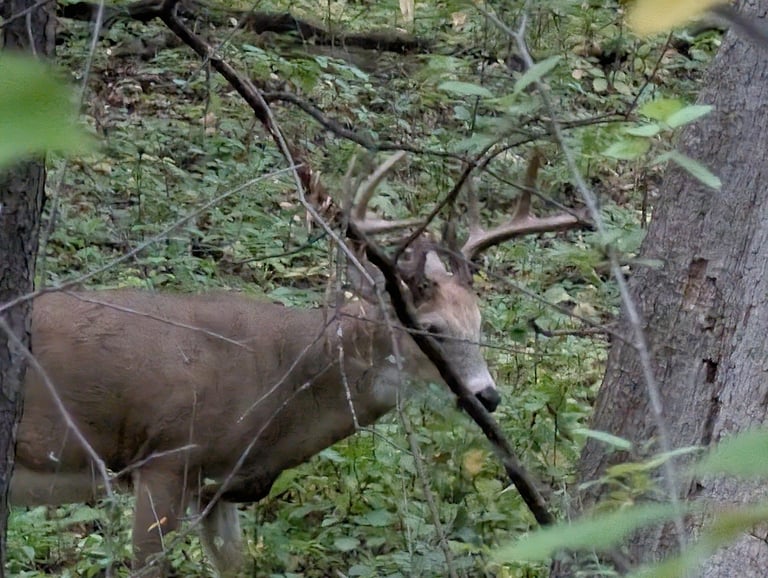
The most useful field marks are the reddish-brown coat and the striped markings on the face. The belly is creamy-white, and the lighter fur extends to the neck, chin, and underside of the tail.
Adults weigh between 10 and when fully grown. The species stands about 0.5 m high at the shoulder, and its short tail can reach 10 cm.
Males carry short antlers, usually 10 cm or less, along with long upper canines that often reach about 5.1 cm. Females lack these canines but have bony lumps on their foreheads and small black spots in places on the body.
The Taiwanese subspecies, Muntiacus reevesi micrurus, is known as the Formosan Reeves's muntjac and is darker than other subspecies.
Distribution and Habitat
In its native range, Reeves's muntjac lives in dense scrub, woodland, and subtropical forest at moderate elevations. It also uses quiet gardens and cuts paths through forest undergrowth.
In England, it has proven far more flexible. Feral animals occupy deciduous and coniferous forests, farmland, and suburban and urban areas, and they use both open and covered habitats. Salisbury Plain, which is mostly open grassland and scrub, has also been colonized.
The British population grew from a few escapes and releases beginning in 1901 near Woburn Abbey in Bedfordshire. Colonies now exist throughout England south of the Humber, and the population continues to grow.
Outside Britain, the deer has been introduced in Belgium, the Netherlands, and the Republic of Ireland, and it was once present in France, though it no longer is. In Japan, escapes from a zoo in Chiba Prefecture have grown to 71,500 individuals by 2023. Sightings peak in May and are lowest in November, a pattern that reflects when the deer are seen rather than how many there are.
Behavior and Lifestyle
Reeves's muntjac is a solitary, territorial deer. Its activity is cathemeral, but it is most active at dawn and dusk, and its feeding bouts typically last 30 to 40 minutes. Between bouts it browses briefly, then rests and chews its cud.
Each animal defends a small territory. Home ranges average about , and in Britain adult males range over about 20 to 28 hectares. Females' territories tend to overlap, while males' territories overlap only with those of females.
Males defend their ground with tusk-like canines and use their short antlers to push an opponent off balance. An adult male will sometimes tolerate a younger, antlerless male in his territory, which gives the subordinate practice sparring and gives the dominant male a co-defender.
The deer moves along trails through its territory, and the vegetation along them wears down with use. It also tramples clearings for bedding and urinating, and in Britain it walks up the stems of small saplings to reach foliage out of normal reach.
Communication
Reeves's muntjac is best known for its barks, which it gives mainly when a predator is suspected or when a dominant animal confronts a subordinate. The barks are most frequent at dawn and dusk and in dense cover, where visibility is poor. They are unlikely to carry far through vegetation, so they probably do not serve as long-distance warnings.
Its other vocalizations are linked to reproduction. A male makes a buzzing sound when he finds a doe in estrus, and a willing female answers with a cat-like whine. Foraging deer make soft growling noises as they move with their heads held low.
The main chemical channel comes from the preorbital gland. The deer places scent marks on vegetation to define its territory and advertise its presence. The chemistry of these secretions could in principle signal an animal's age, sex, and population of origin, though it is not established that muntjacs use it this way.
Diet and Nutrition
Reeves's muntjac is an omnivore that eats a wide variety of plants. Its diet includes bamboo, seeds, bark, fruit, foliage, herbs, blossoms, succulent shoots, fungi, berries, grasses, and nuts. Flowering plants form the main part of what it eats.
The deer also takes eggs and carrion when they are available, and it can take small mammals and ground-nesting birds. In China, it has been known to take pheasants from hunters' snares.
Food is available year-round in its native range, but it is not plentiful. In China, the deer defends its territory aggressively to protect access to food, and it browses low to the ground.
Reproduction and Raising Young
Reeves's muntjac is polygynous. Males hold territories that overlap those of females, and they fight with their canines for access to females in estrus.
In China, breeding occurs year-round. In England, it is more seasonal and generally falls between late October and early March. Does gestate for about , and the mean interval between births is about 233 days. Most litters contain a single young, and females produce about one and a half litters a year.
Both sexes grow quickly. Does become sexually mature in the first year, and the young are weaned at about two months. They are nearly independent by about six months, when they must leave the mother's territory. Lactation usually lasts only the first 17 weeks.
Males can grow new antlers in as little as 103 days, which helps a species that can breed throughout the year. The species can live up to , a figure that comes largely from captive animals.
Population and Ecological Role
Reeves's muntjac is common across south-eastern China, and its population in Britain has grown steadily since the mid-20th century. Estimates reached 52,000 in England in 1995 and 104,000 in 2008.
Its presence changes the animals around it. Its alarm barks warn other small mammals that predators such as tigers or leopards are nearby. At high densities, competition for food and the loss of ground cover can reduce populations of small mammals, which in turn affects their predators.
At moderate densities, browsing can create more habitat for invertebrates, and dung adds to their diversity. At high densities, overbrowsing reduces plant diversity and quality.
Conservation and Threats
Reeves's muntjac is rated Least Concern by the IUCN. It is common in south-eastern China and is not listed as threatened or endangered there.
Hong Kong protects the species under the Wild Animals Protection Ordinance (Cap 170). In the European Union, the species has been on the Union list of Invasive Alien Species since 2016, which forbids importing, breeding, transporting, selling, or intentionally releasing it.
In England, it was illegal to release the species except where it was already established. The Invasive Alien Species (Enforcement and Permitting) Order 2019 now prohibits capturing and re-releasing muntjacs in all cases.
In Japan, the species is considered a harmful invasive. An eradication effort on Izu Ōshima ran from 2007 to 2014 and failed, which has been blamed on inadequate survey methods. By 2014, at least 11,000 individuals lived on the island, and their population was growing by 15 percent a year.
Cultural Significance
In China and western Europe, Reeves's muntjac is hunted for meat, and in Britain it is also hunted for sport. Its meat is low in fat and valued for its culinary qualities.
In its native environments, the barks of the deer have served as warnings to people in the woods of nearby predators such as tigers or leopards.
The tanned skin is notable for its softness and has occasionally been used in beauty-care products, musical instruments, lenses, and packaging for antique items.
Photos
Photographs from via iNaturalist, licensed under CC0 1.0., by Marcin Zuwała via iNaturalist, licensed under CC BY 4.0., by James Heal via iNaturalist, licensed under CC BY 4.0., by Josh Hedley via iNaturalist, licensed under CC BY 4.0., by Donald Hobern via iNaturalist, licensed under CC BY 4.0., by 祐 via iNaturalist, licensed under CC BY 4.0., by Heather Alice-Grace Orchard via iNaturalist, licensed under CC BY 4.0., by Vladislav Isaev via iNaturalist, licensed under CC BY 4.0., by elliejll via iNaturalist, licensed under CC BY 4.0., by Yung-Lun Lin via iNaturalist, licensed under CC BY 4.0., by Clare Edwards via iNaturalist, licensed under CC BY 4.0., and by Cheng-Te Hsu via iNaturalist, licensed under CC BY 4.0., credited on each photo.
Ecology and classification
Classification
- Phylum
- Chordata
- Class
- Mammalia
- Order
- Artiodactyla
- Family
- Cervidae
- Genus
- Muntiacus
- Species
- Muntiacus reevesi
Sources
- GBIF Species names and classification
- iNaturalist Photos
- Wikidata Common names and conservation status
- Wikipedia Summary extract
- Encyclopedia of Life Habitat, diet and behavior traits
- Animal Diversity Web Animal habitat, behavior and diet
- AnAge Longevity
- COMBINE Mammal size, lifespan, breeding, diet and activity
- GloBI What it eats, what eats it, parasites and pollinators
- Wardeh et al. 2015 (EID2)
- MammalBase