The olive-throated parakeet has two populations separated by hundreds of kilometers of sea, one native to Jamaica and another spanning Mexico to Costa Rica, a split wide enough that some authorities assess them as separate conservation units.
This small parrot, Aratinga nana, belongs to the family Psittacidae and lives in forests, woodlands, and cultivated land from Mexico through Central America and on Jamaica, with an introduced population in the Dominican Republic. Its dual status, thriving in parts of its range while declining in others, makes it a useful case study in how habitat pressure affects related populations differently.
Identification and Appearance
The bare white skin surrounding the eye is the most useful field mark, standing out against the bird's otherwise dark green head. Body length runs from about 21.5 to 26 cm and weight is roughly 72 to 85 g depending on subspecies, with the Jamaican nominate form slightly larger than the mainland "Aztec" birds.
Adults show a mainly dark green head and upperparts with yellowish ear coverts and rump. The throat and breast are olive-brown, fading to olive on the belly and vent. The wings are mostly green with dull blue on the upper flight feathers and gray underneath, while the tail is green above and yellowish below. The bill is brownish horn-colored with a paler tip, the iris yellow to orange, and the legs blackish gray.
The sexes look alike, and immature birds closely resemble adults. Among subspecies, E. n. astec has paler olive-brown underparts, especially on the belly and vent, while E. n. vicinalis is slightly larger than astec and brighter green above and below.
Distribution and Habitat
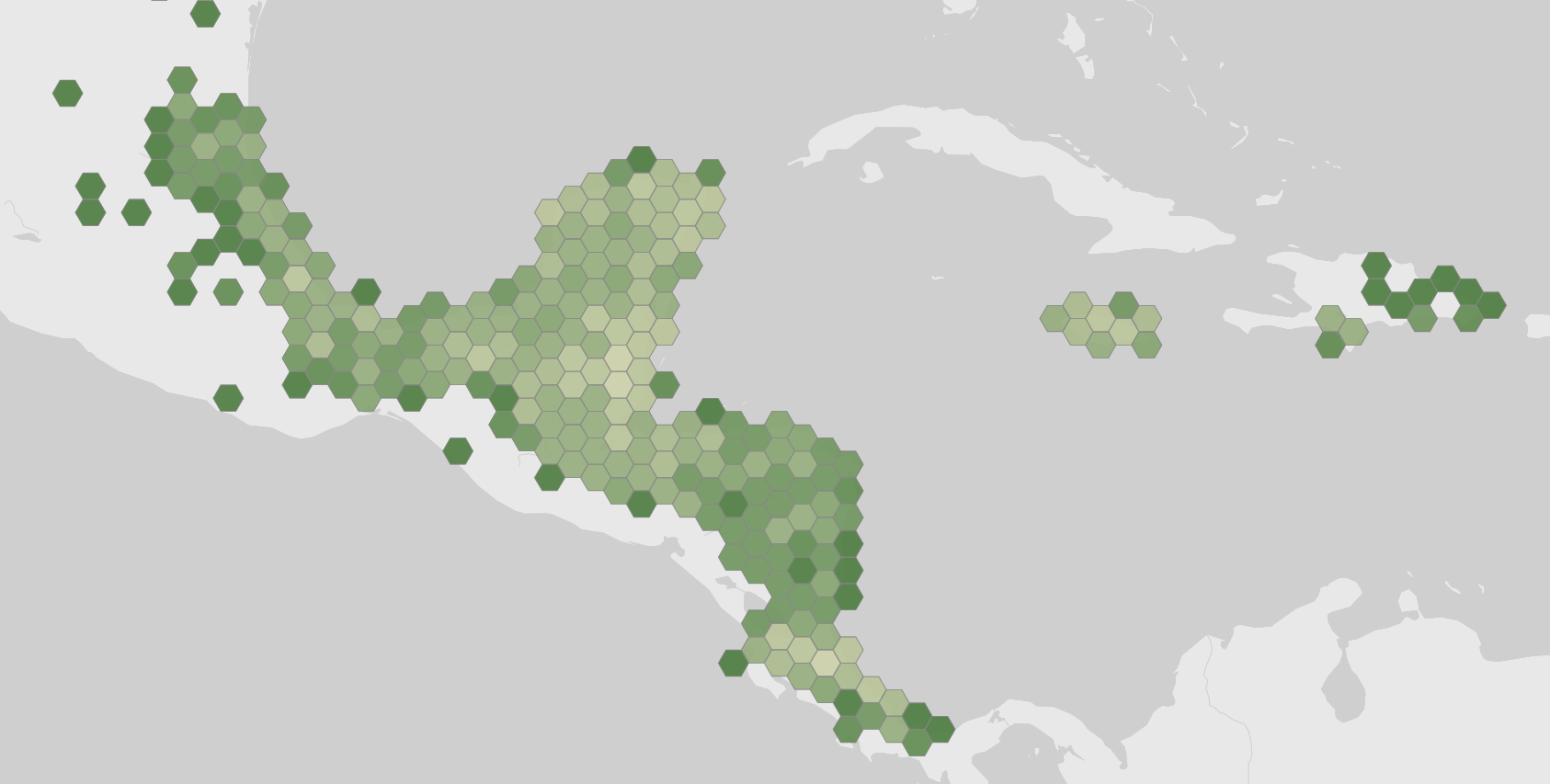
The species occurs in two widely separated regions: Jamaica (with an introduced population in the Dominican Republic) and a mainland range stretching from northeastern Mexico through Belize, Guatemala, Honduras, Nicaragua, and Costa Rica into western Panama's Bocas del Toro Province. Its overall range covers roughly 11,000 km².
Its principal habitat is deciduous woodland, but it also uses the interior and edges of humid forest, riparian corridors, scrublands, pine stands, plantations, clearings with scattered trees, and gardens. Pine stands are especially heavily used in the Dominican Republic.
Elevational limits vary by region: the species reaches 1,000 m in Mexico, 1,100 m in Honduras, 700 m in Costa Rica, and up to 1,500 m in Jamaica. Monthly observation counts show higher numbers from January through March and a drop around mid-year, which may reflect seasonal presence rather than true abundance changes.
Behavior and Lifestyle
Flocks of medium size move together through the home range, with arboreal, crepuscular activity typical of the species. Outside of breeding, interactions are mostly social within these flocks; during breeding, birds focus their interactions on their mate.
The nominate Jamaican subspecies shifts between moister and drier habitats in response to food availability, showing a degree of nomadism. The mainland subspecies are generally year-round residents, though E. n. astec visits Caye Caulker off Belize in winter, suggesting some local movement tied to resources.
Communication
Sound is the primary channel of communication, with a distinctive contact call likely unique to each individual bird, as documented in a related Aratinga species. Flight calls let birds exchange information about the location of food and shelter while on the wing.
The species' vocalizations are described as a sharp, grating "krik-krik-krik-krik" or a more raucous "krrieh krrie krreah," with little variation among the subspecies.
Diet and Feeding Habits
Flowers and fruits, particularly the buds and fruit of trees such as Ficus species, red birch, Erythrina, and Spathodea, along with cultivated crops, make up the bulk of the diet, placing this parakeet firmly among the frugivores and granivores of its forests. Its strong bill and muscular tongue let it seek out fruit and crack seeds that other animals cannot manage.
Flocks feed methodically and slowly, using their bills almost like extra hands while searching for ripe fruit, and members share information about food sources through flight calls and frequent chatter between birds in flight and those already in fruiting trees.
To cope with the chemical and mechanical defenses that many plants have evolved against seed predators, the birds ingest clay from riverbanks to help detoxify harmful compounds in seeds and fruit. They also spread risk by eating small amounts of toxic seeds mixed with much larger amounts of harmless ones, reducing any single dose of toxin.
Nesting and Breeding
Breeding is seasonal and monogamous, concentrated between April and May across most of the range, though timing shifts regionally: nesting runs from March to June in Jamaica, slightly earlier in the Dominican Republic, January to April in Costa Rica, and April to May in Belize and Guatemala.
Pairs nest in cavities excavated in termite mounds, or occasionally in tree holes as recorded in Jamaica. Clutches contain three to five eggs, which hatch after about 26 to 27 days of incubation.
After hatching, fledglings need roughly 50 days before reaching independence. Detailed information on parental care during this period is not well documented, though the species is known to care for and protect the young until fledging.
Population and Ecological Role
The Jamaican population is estimated at 10,000 to 20,000 mature individuals and is believed to be decreasing, while the population size of the mainland "Aztec" form is not precisely known but is also thought to be declining overall, with deforestation cited as a factor in the downward trend since 1997.
Ecologically, the species plays a dual role as both seed predator and seed disperser. As one of the most persistent predators of immature seeds in its forests, it can interfere with a tree's dispersal strategy and hinder germination, and it is often regarded as a crop pest by farmers. At the same time, by dropping fruit and seeds while foraging in the canopy, it provides food for other organisms, including ground-dwelling species like termites, and disperses seeds of many plants across the landscape.
Conservation and Threats
The species as a whole carries no special status under the US Migratory Bird Act, but it is listed in CITES Appendix II, and the IUCN assesses its two main populations separately. The Jamaican population is Near Threatened, with its confined range and population of 10,000 to 20,000 mature individuals believed to be decreasing; habitat loss and fragmentation, especially coastal development for residences, tourism, and industry, are described as the greatest ongoing threats, alongside some small-scale poaching for food and the pet trade. Despite this, it remains common and widespread in Jamaica, though persecuted there as a crop pest.
The mainland "Aztec" population is assessed as Least Concern. It holds a large range with an unknown but likely declining population, no immediate major threats identified, and occurs locally common to abundant within several protected areas, even as some sub-populations decline from habitat loss. The Dominican Republic population, introduced from Jamaican stock, appears to be increasing.
Cultural Significance
The olive-throated parakeet has significant economic importance in the wildlife trade: exports were valued at about $827,757 in 1997, a figure that fell to roughly $450,004 by 2000 as fewer birds were exported, reflecting the species' popularity as a pet.
Beyond the pet trade, the species contributes to ecotourism in the Caribbean and tropical regions, where hotels have offered free bird-watching tours as a perk for guests, drawing visitors interested in seeing the parakeet in its natural habitat.
Fun Facts
- The species has two widely separated populations, one on Jamaica and one spanning Mexico to Panama, that are assessed separately by the IUCN, with different conservation outcomes.
- Export values for the pet trade nearly halved between 1997 and 2000, falling from about $827,757 to roughly $450,004.
- Hotels in some Caribbean destinations have offered free bird tours featuring this species as a guest perk, linking it directly to local tourism.
Photos
Photographs from via iNaturalist, licensed under CC0 1.0., by Abby Hyde via iNaturalist, licensed under CC BY 4.0., by Sebastián de Jesús Herrera Buenfil via iNaturalist, licensed under CC BY 4.0., by Isis I. Castro Alberto via iNaturalist, licensed under CC BY 4.0., by Miguel A. Paixão via iNaturalist, licensed under CC BY 4.0., by Douglas Caro Lopez via iNaturalist, licensed under CC BY 4.0., by Jeff Bartlett via iNaturalist, licensed under CC BY 4.0., by Thomas Ebner via iNaturalist, licensed under CC BY 4.0., by josebarrientos via iNaturalist, licensed under CC BY 4.0., by Juan Cruzado Cortés via iNaturalist, licensed under CC BY 4.0., by Daniel Ghyselinck via iNaturalist, licensed under CC BY 4.0., and by Andre Knocklein via iNaturalist, licensed under CC BY 4.0., credited on each photo.
Ecology and classification
Classification
- Phylum
- Chordata
- Class
- Aves
- Order
- Psittaciformes
- Family
- Psittacidae
- Genus
- Aratinga
- Species
- Aratinga nana
Sources
- GBIF Species names and classification
- iNaturalist Photos
- Wikidata Common names and conservation status
- Wikipedia Summary extract
- Animal Diversity Web Animal habitat, behavior and diet
- AVONET Bird mass, habitat, migration, diet and range size