At night, in the right conditions, the mycelium of Panellus stipticus glows with a faint, eerie green light — a phenomenon that earned it the name "luminescent panellus" and links it to the small group of fungi known for producing foxfire.
Beyond the glow, this is a small, tough, wood-rotting mushroom in the family Mycenaceae, and the type species of its genus. It grows across northern temperate regions of Europe, North America, Asia, and the southern hemisphere, decomposing hardwood logs and stumps. No conservation status has been assigned to it, likely because it is common and widespread.
What makes Panellus stipticus worth a closer look is its tangled history: first described in 1783 as Agaricus stypticus by the French mycologist Jean Bulliard, it has carried many names since, only settling into its current one in 1879. Combined with its bitter taste, reputed medicinal past, and modern interest as a pollutant-degrading organism, it is a mushroom with far more going on than its modest size suggests.
Fruiting Body and Identification
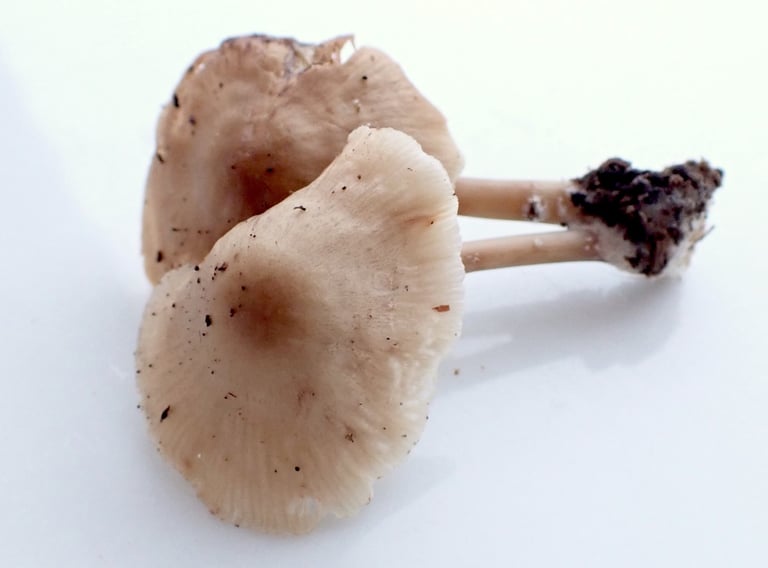
The most reliable identifying features of Panellus stipticus are its small, kidney- or clamshell-shaped cap and its off-center, laterally attached stem. The cap measures only 1.2 to 3.2 cm across by 1.2 to 2.5 cm deep, ranging from convex to nearly flat, with a scalloped edge lined by small rounded teeth that curve slightly inward. Its dry surface is patterned like cracked, dried mud and covered in fine hairs that give it a faintly woolly texture, sometimes marked with concentric zones.
Fresh caps range from yellowish-orange to buff or cinnamon, fading to tan, brown, or clay tones when dried — though moistening a dried specimen revives its original color. On the underside, narrow, closely spaced gills run brownish to buff, often forked and crossed by fine interconnecting veins. The stem, only 0.5 to 2 cm long and 0.3 to 0.8 cm thick, is dull white, covered in silky fibers, and narrows toward its point of attachment to the wood. The flesh is thin and tough, dark yellow-brown to cream-colored, and the fruit body has no distinctive odor.
Microscopic features help confirm identification. The spore print is white, and the smooth, elliptical to sausage-shaped spores measure 3–6 by 2–3 μm; they react weakly amyloid with Melzer's reagent, turning bluish-black. Club-shaped basidia measure 15–20 by 2.5–3.5 μm, and the cap's cuticle is built from loosely interwoven hyphae about 8–10 μm thick, dotted with scattered cystidia. These layered details, while unlikely to matter to a casual observer, distinguish Panellus stipticus from other small, wood-inhabiting fungi.
Distribution and Habitat
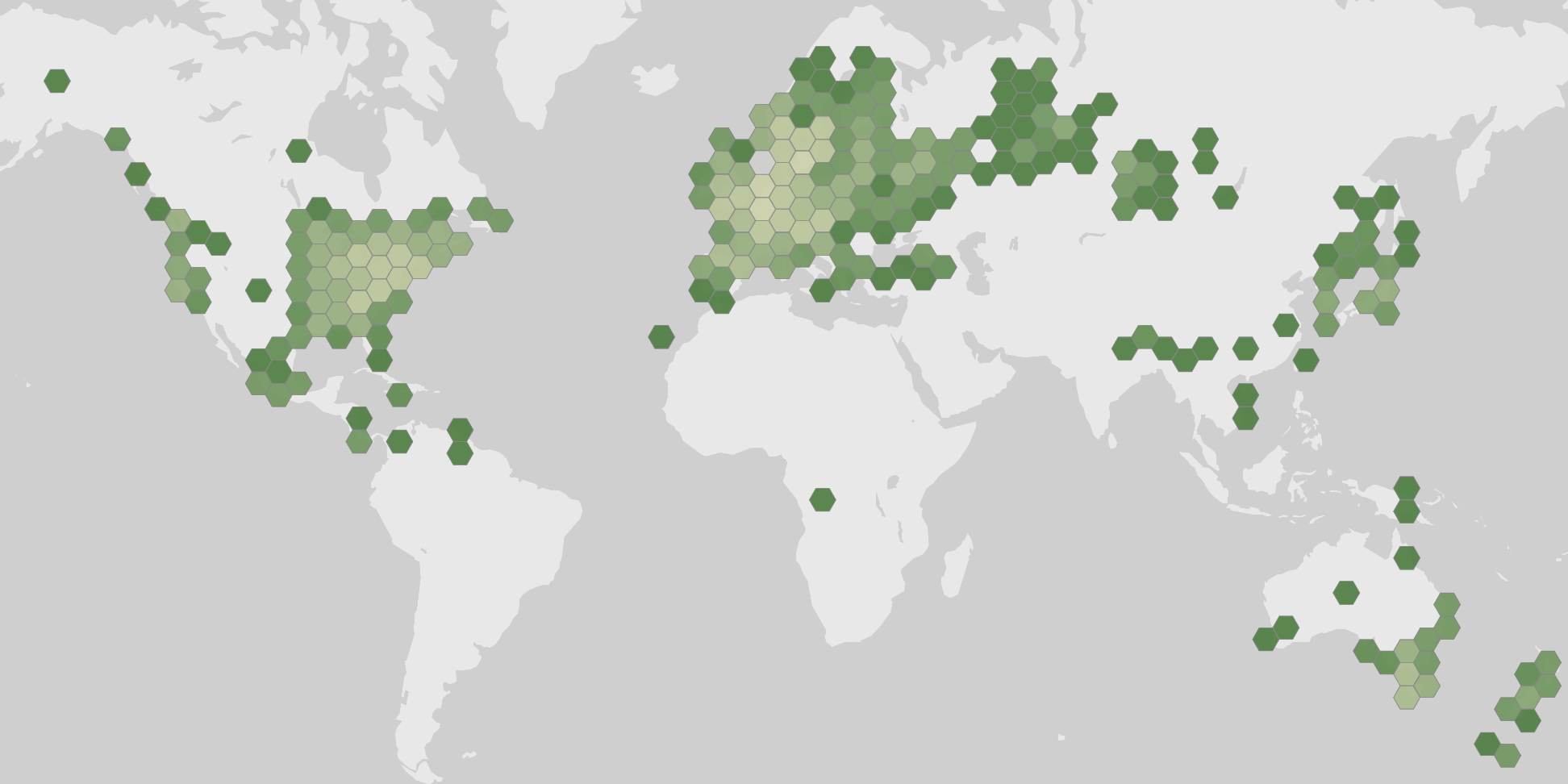
Panellus stipticus is common across northern temperate Europe and has also been recorded in Australia, New Zealand, Anatolia, Japan, and China. In North America it appears more frequently in the east than the west, with a range stretching from Alaska south to Costa Rica.
As a saprobic fungus, it causes a white rot in the hardwood it colonizes, bleaching the wood as its enzymes break down lignin, cellulose, and hemicellulose. Fruit bodies typically grow in tightly overlapping clusters on the sides of dead hardwood trees, logs, stumps, and fallen branches, occasionally colonizing wounds on living trees. Preferred hosts differ by continent: oak, birch, maple, hickory, pecan, and American hornbeam in North America, versus oak, birch, alder, beech, hazel, chestnut, and ash in Europe. It has also been found on loblolly pine, eastern white pine, and even Ericia shrubs in North Africa.
Monthly observation counts show a clear seasonal pattern, with numbers climbing sharply from a low around June (912 observations) to a peak in October (9,583), staying high through September, November, and December. This lines up with the fungus's known fruiting period of September through November in Europe, the Canary Islands, and North America, though fruit bodies are long-lasting and can be found year-round. These figures reflect presence observations rather than true abundance, but the pattern is consistent with a fungus that favors cooler, moister fall conditions. Notably, it behaves as an early-stage succession species, rarely appearing in wood plantations over 20 years old.
Life Cycle
A fruit body begins as a tiny white knob smaller than a cubic millimeter, growing within a day or two into a small pyramidal mass as its hyphae lengthen. A minute cap soon forms atop a stem that starts at just 1 mm, with the stem's hyphae eventually stopping their lengthwise growth and branching outward to form the flattening cap tissue. The young cap starts spherical, its margin curled inward against the stem, sheltering the developing hymenium — the spore-producing surface — until the cap expands enough to expose the gills.
Spores can be released from fruit bodies as small as 1.3 cm across, and spore liberation continues throughout the one to three months it takes a fruit body to reach full size, depending on temperature and moisture. Mature spores are dispersed by wind. As the fruit body approaches maturity, the upper cap surface takes on a granular texture as terminal hyphae separate.
Color develops through a yellowish-brown pigment concentrated just beneath the cap's cuticle, with very young fruit bodies pale buff before deepening to cinnamon. Light exposure controls the intensity: fruit bodies grown in diffuse light stay a uniform pale buff, while those in bright light turn cinnamon or tan. Zonate patterns on the cap can also appear, driven by fluctuating humidity that alternately speeds and slows growth.
Uses and Cultural History
Panellus stipticus is considered too small and bitter to eat, though it is not poisonous. Its taste is described as acidic, acrid, or astringent, and interestingly, this taste varies by region: specimens from eastern North America develop a mildly acrid flavor that dries out the mouth uncomfortably, while those from Japan, New Zealand, and Russia produce no sensation in the mouth but cause throat constriction and a nauseating taste instead. Fruit bodies are reputed to have been used in traditional Chinese medicine as a styptic to stop bleeding and, separately, as a strong purgative, though the species has not been scientifically validated for any significant medicinal properties.
Of more modern interest is its role as a white-rot fungus. It produces laccase, an enzyme that breaks down lignin by adding hydroxyl groups to phenolic compounds, allowing the aromatic rings to be cleaved open. This capacity has drawn scientific attention for bioremediation: a liquid culture of Panellus stipticus mycelium reduced the phenolic concentration of olive-processing wastewater — a notable environmental problem in Mediterranean countries — by 42% after a 31-day incubation. In a separate study, a culture of the fungus was shown to degrade 2,7-dichlorodibenzo-p-dioxin, a polychlorinated dioxin pollutant.
Fun Facts
- The mycelium of Panellus stipticus, grown in laboratory culture, glows with bioluminescence — a trait shared with only a small group of fungi known as the mycenoid lineage, which includes several Mycena species.
- It is the type species of the genus Panellus, meaning it serves as the reference point that defines the genus's characteristics.
- The taste of this mushroom differs by region: eastern North American specimens cause a slow-developing acrid, drying sensation in the mouth, while those from Japan, New Zealand, and Russia instead cause throat constriction and a nauseating taste with no mouth sensation at all.
- Slugs frequently feed on the fruit bodies and may be important agents in dispersing the fungus's spores.
- White-tailed deer are also known to eat this fungus.
- First described in 1783 by French mycologist Jean Bulliard as Agaricus stypticus, the species did not receive its current name, Panellus stipticus, until 1879.
Ecology
Habitat
- Forest
- Woodland