The male common scorpionfly carries a pair of curved claspers at the tip of its abdomen that give it an unmistakable scorpion-like silhouette, yet it has no sting and poses no threat to people.
This insect belongs to the order Mecoptera and the family Panorpidae, a small group known collectively as scorpionflies. It is native to Europe and Northern Asia, where it turns up in hedgerows and patches of nettle. Beyond its odd appearance, what makes the species worth a closer look is its courtship: males win mates not through combat but through gift-giving, offering nuptial prey and saliva secretions in a ritual that determines their reproductive success.
Identification and Appearance
The single most useful field mark is the male's pair of tail claspers, a scorpion-like feature found on no other common insect in its range. These claspers are used only to grip the female during mating and are not a stinger.
Adults reach a body length of about 30 millimeters (1.2 inches) and have a wingspan around 35 millimeters (1.4 inches). The body is black and yellow, with a reddish head and tail, and the head is drawn into a prominent, downward-pointing beak that opens at its tip. The wings are mostly clear but carry many dark spots and patches, giving them a mottled look in flight or at rest.
Females differ from males in being longer, heavier, and longer-legged, and they lack the clasper structure. In females, the eighth abdominal segment is distinctly shorter than the seventh, almost by half, while the sixth segment narrows toward the rear, a detail useful for close examination.
The larva looks nothing like the adult: it resembles a caterpillar, growing up to 20 millimeters (0.79 inches) long, and moves on three pairs of thoracic legs plus eight pairs of prolegs.
Distribution and Habitat
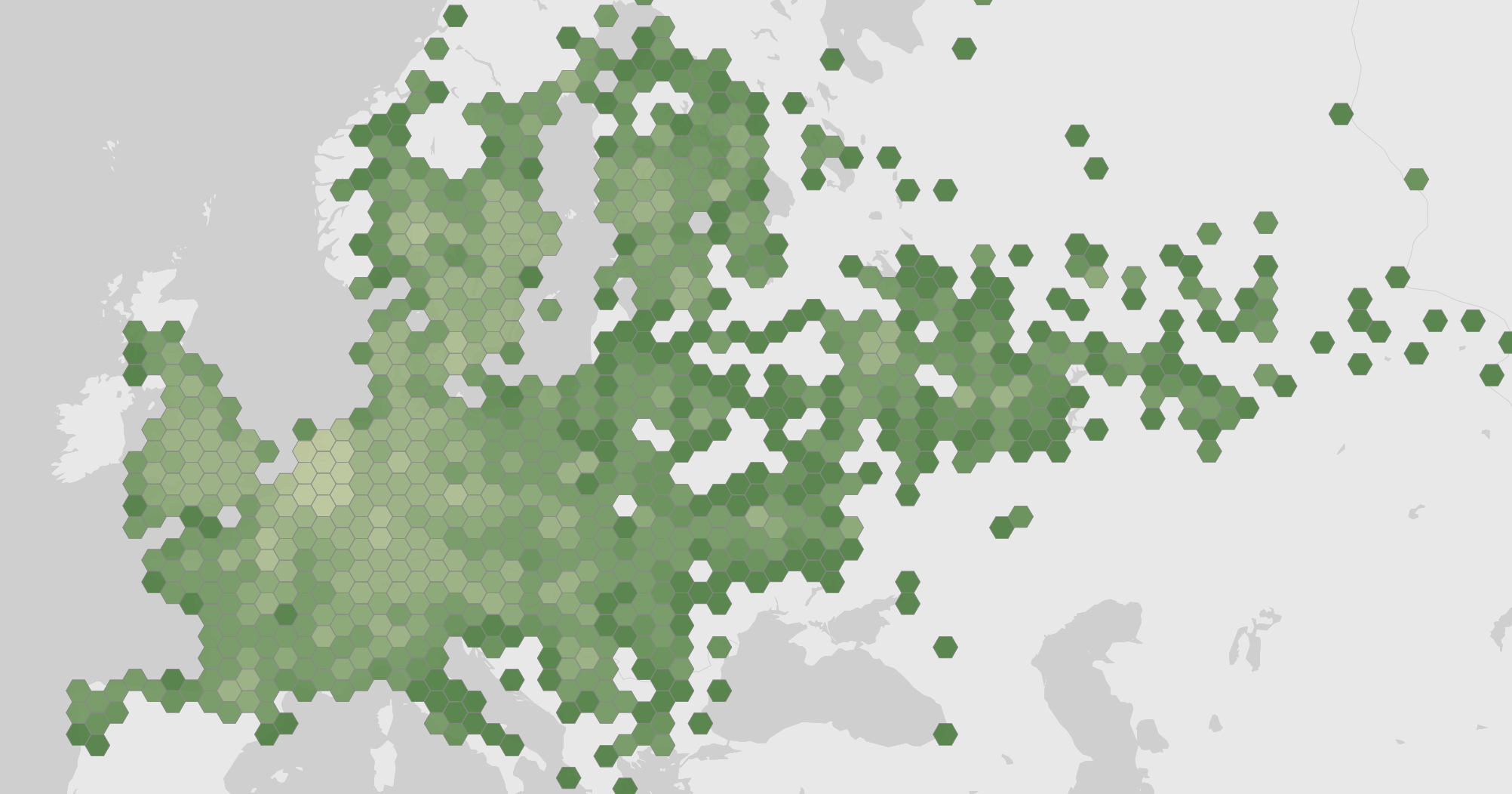
Panorpa communis is native across Europe, absent only from Iceland and Ireland, and extends into Northern Asia, though it does not occur in China. Within this range it favors hedgerows and patches of nettle, structured edge habitats that offer shelter and food.
Monthly observation counts show a sharp seasonal pattern, rising from near zero in winter to a peak of 22,348 records in June, with high numbers also in May (16,712) and July (14,733) before falling off through August and September. These figures come from presence observations rather than measures of abundance or a complete range map, but the pattern points cautiously to a late spring and early summer period when adults are most active and most often seen.
Reproduction and Life Cycle
Courtship begins with the male releasing pheromones to attract a female, followed by a ritualized premating display: both sexes perform slow wing movements interspersed with brief bursts of rapid abdominal vibration. Only after this exchange does the male offer his nuptial gift, either a saliva secretion or a piece of prey, typically a dead arthropod, for the female to feed on during mating.
The size of the gift matters directly to reproductive outcome: females that receive larger nuptial gifts from a male are more likely to mate successfully with him. This makes gift quality a central factor in male mating success within the species.
Fun Facts
- The male's clasper-tipped tail looks like a scorpion's sting, which is exactly where the common name 'scorpionfly' comes from, but the structure is used only for holding a mate and cannot sting.
- Its larva looks like a small caterpillar, complete with eight pairs of prolegs, a body plan quite different from the adult's slender, winged form.
- Adults have a distinctive beak-like head, with the mouth positioned at the tip of a long, downward-pointing snout rather than at the front of the face.
- The species has been documented across a wide native range, with recorded sightings as far apart as France, reflecting its broad distribution through Europe and Northern Asia.
Ecology
Habitat
- Shrubland
- Disturbed Ground